Trigger Finger: Symptoms, Causes, and Treatment Options
Trigger finger, also called stenosing tenosynovitis, happens when a finger or thumb catches, clicks, or locks as you try to bend or straighten it. We explain why it occurs, the most common symptoms, how doctors diagnose it, and the treatment options that help you get back to comfortable hand use.
If you feel a pop in your palm or need to use your other hand to straighten a finger, you are not alone. This condition is common, often treatable without surgery, and very responsive to early care.
What Is Trigger Finger?
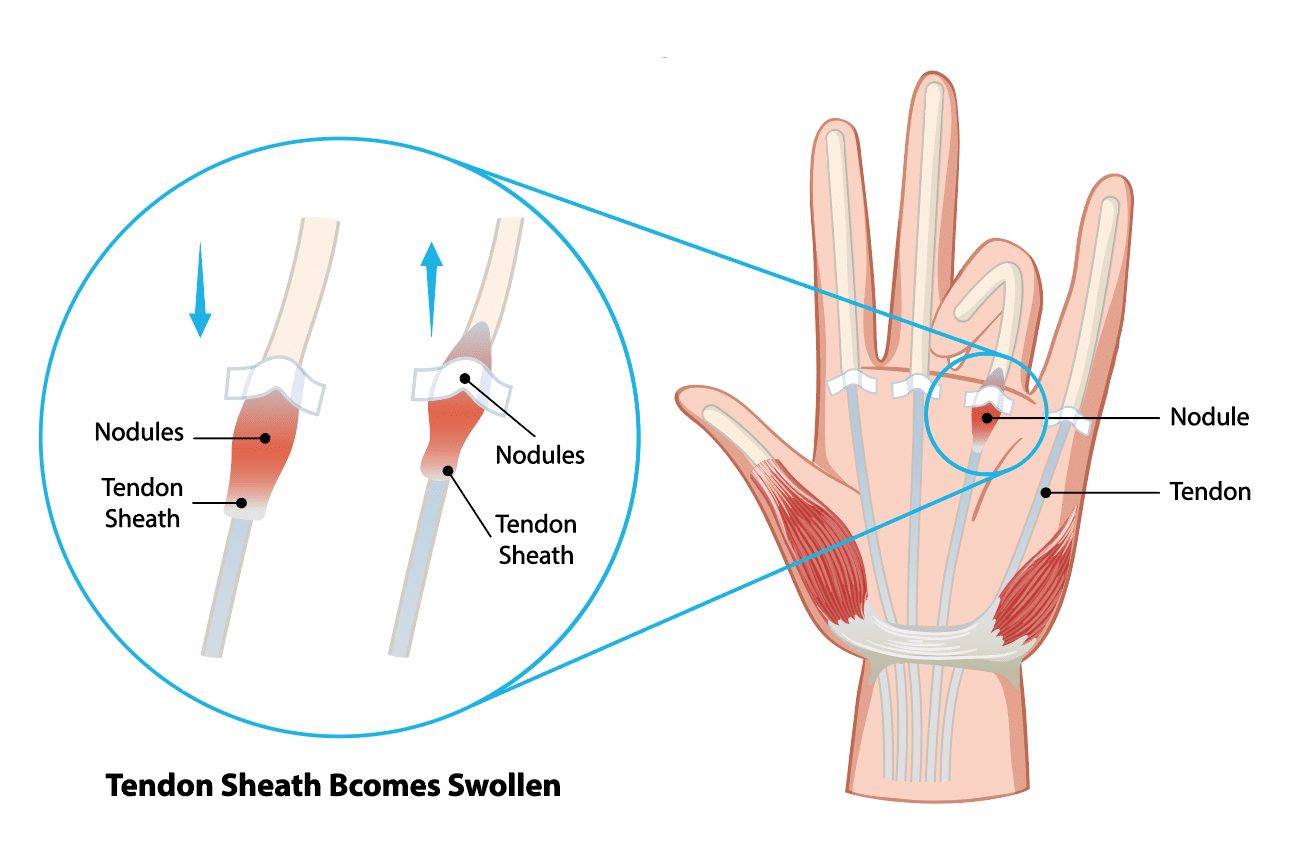
Your flexor tendons glide through tunnels in the palm called pulleys. With trigger finger, the tendon lining and the A1 pulley at the base of the affected finger or thumb become irritated and thickened. That narrowing makes the tendon catch as it moves, which creates clicking or locking.
Medical term: stenosing tenosynovitis, which means a tight tendon tunnel that limits smooth motion.
Most often involves the ring finger, middle finger, or thumb, but any digit can be affected.
The problem sits at the palm-side base of the finger where the tendon first enters the sheath.
Common Signs and Symptoms
Most people notice symptoms gradually, developing over days or weeks rather than all at once. At first, you may feel stiffness when you wake up, which improves as you use your hand. You might also notice a dull ache at the base of the finger near the palm, and a tendency for the finger to catch or click as you move it.
Clicking, catching, or popping when bending or straightening the finger or thumb
Pain or tenderness at the base of the finger on the palm side
Stiffness, especially in the morning
A small, tender bump in the palm that moves with the finger
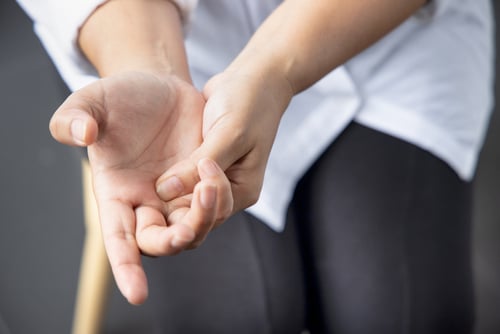
Locking in a bent position that may suddenly release or require the other hand to straighten
Why Does Trigger Finger Happen?
Several factors can irritate or swell the tendon and its sheath, which tightens the space the tendon needs to glide.
Repetitive gripping or tool use that stresses the palm
Inflammatory conditions, such as rheumatoid arthritis
Diabetes, which can affect tendon health and healing
Coexisting hand issues like carpal tunnel syndrome or De Quervain’s tendinopathy
A prior hand injury or local swelling around the tendon sheath
How Trigger Finger Is Diagnosed
Diagnosis relies on what you tell the clinician and a careful examination of the hand. The doctor checks for tenderness over the A1 pulley, watches how the finger moves, and may feel a small lump along the tendon. Imaging tests are not usually needed unless the exam is unclear.
Tenderness over the A1 pulley at the base of the affected digit
Clicking, catching, or locking is observed with active motion
A small, moving nodule in the tendon may be felt
Ultrasound can be used in select cases to assess the tendon sheath
Doctors differentiate trigger finger from conditions like Dupuytren’s contracture, which pulls the finger down but does not cause tendon catching
Nonsurgical Treatment Options
Many people improve without surgery, especially when care starts early. The goals are to calm irritation, help the tendon glide smoothly, and reduce stress on the pulley. You may change how you use your hand, rest the affected finger with a removable splint, and work with a therapist. In some cases, a corticosteroid injection helps reduce swelling and catching.
Activity changes: limit prolonged gripping, take breaks, and use tools with larger, cushioned handles
Splinting: a removable splint, often worn at night, can rest the tendon and reduce morning stiffness
Anti-inflammatory strategies: ice and over-the-counter medications as directed by your clinician
Hand therapy: guided stretching, gentle tendon gliding, and education on joint protection
Corticosteroid injection: a targeted injection into the tendon sheath can reduce swelling and catching. Possible side effects include temporary soreness, skin lightening or thinning near the site, and a short-term rise in blood sugar in people with diabetes.
Helpful Daily Habits
Switch tasks or hands to limit repeated gripping
Use pens, kitchen tools, and garden tools with wider handles
Warm up the hand with a gentle motion before heavier use
Practice tendon-gliding exercises from your care team
What To Avoid For Now
Forceful or prolonged squeezing, like heavy pruning or weight handles without padding
Repeating the same grip task without breaks
Sleeping with the finger curled tightly
Pushing through painful locking episodes
Surgical Treatment When Needed
If symptoms persist, the finger locks frequently, or injections and splinting do not help, surgery can be a good option. The procedure is called an A1 pulley release. The surgeon widens the tight opening at the base of the finger so the tendon can glide smoothly again.
Typically performed with local anesthesia as an outpatient
Open or percutaneous techniques are used based on your anatomy and the surgeon's preference
Finger motion usually begins the same day to limit stiffness
Expected recovery includes temporary tenderness in the palm and progressive return to daily tasks
Risks include infection, stiffness, scar tenderness, and nerve irritation, which are uncommon
Choosing a Treatment Path
Your care plan is tailored to how your hand feels, your medical history, and what you want to return to doing. The plan explains options from less invasive treatments to surgery and describes what to expect at different stages. You and your clinician work together to choose the best path for you.
Situation
First Steps
If Symptoms Persist
Mild clicking and morning stiffness
Activity changes, splinting, ice, hand therapy
Consider corticosteroid injection
Frequent triggering that interferes with work or self-care
Corticosteroid injection and targeted therapy
Discuss surgical release
Locked finger or long-standing symptoms
Prompt evaluation by a hand specialist
Surgical release is often recommended
Recovery and Returning to Activity
After treatment, moving the hand in a steady, gentle way helps the tendon glide smoothly and reduces stiffness. Whether you had nonsurgical care or surgery, follow the recommended exercises and gradually return to daily tasks. Protect the palm from heavy pressure until it feels comfortable and strong again.
Follow your home exercise program and protect the palm from heavy pressure until it is comfortable
Ease back into gripping tasks with larger-handled tools and frequent rest breaks
Let your care team know if locking returns or if stiffness limits progress
When To See a Hand Specialist
Schedule an evaluation if any of the following apply:
Triggering lasts more than a few weeks or is getting worse
You need your other hand to unlock the finger
Pain or stiffness interferes with work, sports, or daily tasks
You have diabetes or rheumatoid arthritis, and the symptoms are persistent
Care at Princeton Orthopaedic Associates
Princeton Orthopaedic Associates treats trigger finger with careful evaluation and a plan that fits your goals. The team offers nonoperative options first and uses precise surgical release when needed. If your finger catches, clicks, or locks, you can regain comfortable hand use. Call to schedule an appointment to begin.
This blog post is meant to be informative and should not act as a self-diagnosis tool. If you’d like to see one of our doctors, please contact us here.
Sequence rules uses cookies to track the order of requests a user has made and the time between requests and makes them available via Cloudflare Rules. This allows you to write rules that match valid or invalid sequences. The specific cookies used to validate sequences are called sequence cookies.
session
cf_ob_info
The cf_ob_info cookie provides information on: The HTTP Status Code returned by the origin web server. The Ray ID of the original failed request. The data center serving the traffic
session
cf_use_ob
The cf_use_ob cookie informs Cloudflare to fetch the requested resource from the Always Online cache on the designated port. Applicable values are: 0, 80, and 443. The cf_ob_info and cf_use_ob cookies are persistent cookies that expire after 30 seconds.
session
__cfwaitingroom
The __cfwaitingroom cookie is only used to track visitors that access a waiting room enabled host and path combination for a zone. Visitors using a browser that does not accept cookies cannot visit the host and path combination while the waiting room is active.
session
cf_chl_rc_i
These cookies are for internal use which allows Cloudflare to identify production issues on clients.
session
cf_chl_rc_ni
These cookies are for internal use which allows Cloudflare to identify production issues on clients.
session
cf_chl_rc_m
These cookies are for internal use which allows Cloudflare to identify production issues on clients.
session
__cfruid
Used by the content network, Cloudflare, to identify trusted web traffic.
session
__cf_bm
Cloudflare's bot products identify and mitigate automated traffic to protect your site from bad bots. Cloudflare places the __cf_bm cookie on End User devices that access Customer sites that are protected by Bot Management or Bot Fight Mode. The __cf_bm cookie is necessary for the proper functioning of these bot solutions.
session
__cflb
When enabling session affinity with Cloudflare Load Balancer, Cloudflare sets a __cflb cookie with a unique value on the first response to the requesting client. Cloudflare routes future requests to the same origin, optimizing network resource usage. In the event of a failover, Cloudflare sets a new __cflb cookie to direct future requests to the failover pool.
session
_cfuvid
The _cfuvid cookie is only set when a site uses this option in a Rate Limiting Rule, and is only used to allow the Cloudflare WAF to distinguish individual users who share the same IP address.
session
cf_clearance
Whether a CAPTCHA or Javascript challenge has been solved.
session
Google reCAPTCHA helps protect websites from spam and abuse by verifying user interactions through challenges.
Name
Description
Duration
_GRECAPTCHA
Google reCAPTCHA sets a necessary cookie (_GRECAPTCHA) when executed for the purpose of providing its risk analysis.
179 days
Google Tag Manager simplifies the management of marketing tags on your website without code changes.
Name
Description
Duration
cookiePreferences
Registers cookie preferences of a user
2 years
td
Registers statistical data on users' behaviour on the website. Used for internal analytics by the website operator.
session
These cookies are used for managing login functionality on this website.
Name
Description
Duration
wordpress_logged_in
Used to store logged-in users.
Persistent
wordpress_sec
Used to track the user across multiple sessions.
15 days
wordpress_test_cookie
Used to determine if cookies are enabled.
Session
WPForms is a user-friendly WordPress plugin for creating custom forms with drag-and-drop functionality.
Name
Description
Duration
wpfuuid
Used to track user interactions with forms.
11 years
Statistics cookies collect information anonymously. This information helps us understand how visitors use our website.
Google Analytics is a powerful tool that tracks and analyzes website traffic for informed marketing decisions.
Used to distinguish new sessions and visits. This cookie is set when the GA.js javascript library is loaded and there is no existing __utmb cookie. The cookie is updated every time data is sent to the Google Analytics server.
30 minutes after last activity
__utmc
Used only with old Urchin versions of Google Analytics and not with GA.js. Was used to distinguish between new sessions and visits at the end of a session.
End of session (browser)
__utmz
Contains information about the traffic source or campaign that directed user to the website. The cookie is set when the GA.js javascript is loaded and updated when data is sent to the Google Anaytics server
6 months after last activity
__utmv
Contains custom information set by the web developer via the _setCustomVar method in Google Analytics. This cookie is updated every time new data is sent to the Google Analytics server.
2 years after last activity
__utmx
Used to determine whether a user is included in an A / B or Multivariate test.
18 months
_ga
ID used to identify users
2 years
_gali
Used by Google Analytics to determine which links on a page are being clicked
30 seconds
_ga_
ID used to identify users
2 years
_gid
ID used to identify users for 24 hours after last activity
24 hours
_gat
Used to monitor number of Google Analytics server requests when using Google Tag Manager
1 minute
_gac_
Contains information related to marketing campaigns of the user. These are shared with Google AdWords / Google Ads when the Google Ads and Google Analytics accounts are linked together.
90 days
__utma
ID used to identify users and sessions
2 years after last activity
__utmt
Used to monitor number of Google Analytics server requests
10 minutes
These cookies help us measure the effectiveness of our website content and understand how visitors find and use our site. This allows us to improve the experience and provide more helpful resources.
Facebook Pixel is a web analytics service that tracks and reports website traffic.