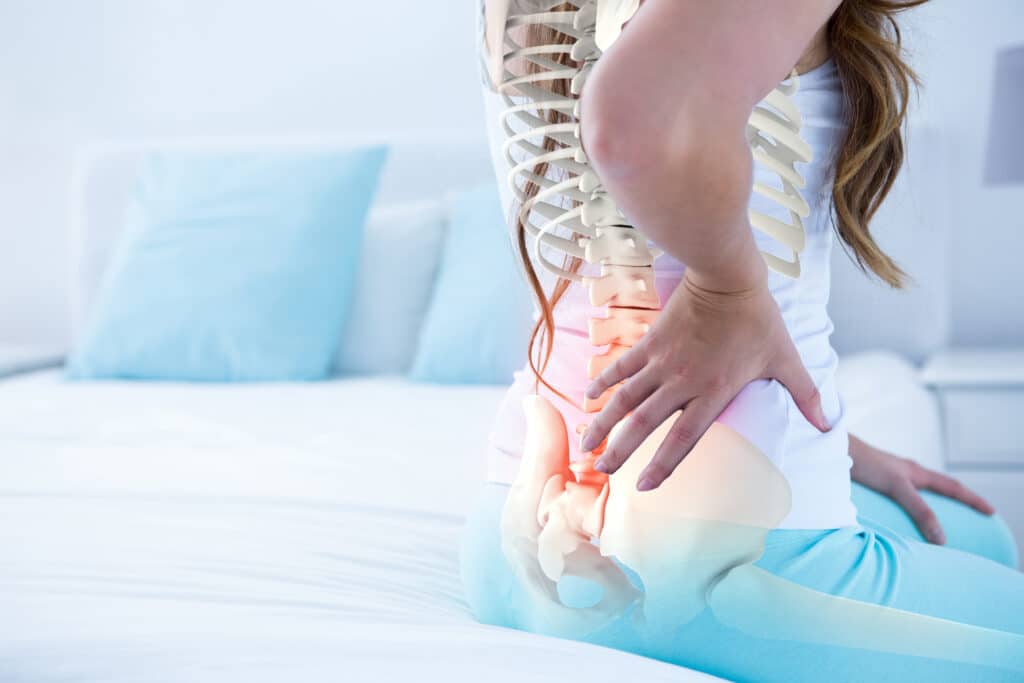
Pain that starts in the lower back or buttocks and travels down one leg is often linked to irritation or pressure on the sciatic nerve. Gentle stretching can help ease tight muscles, calm nerve sensitivity, and support a gradual return to everyday activities.
These stretches are designed to be gentle and accessible. Move slowly, stay within a comfortable range of motion, and focus on steady breathing. If any movement increases pain, tingling, or numbness, it's best to ease off or skip that stretch. Knowing when and how to stretch, along with what to avoid during flareups, can make a big difference in your recovery. If symptoms persist or worsen, it’s important to consult a medical professional.
What You Should Know
Sciatica refers to symptoms from irritation or compression of the sciatic nerve, often causing pain down the back of the leg.
Common causes include a lumbar disc herniation, spinal stenosis, or tight deep hip muscles like the piriformis.
Gentle stretching can reduce muscle guarding and help calm nerve sensitivity.
Avoid stretches that trigger sharp pain, increasing numbness, or leg weakness.
Hold most stretches 20 to 30 seconds, repeat 2 to 3 times, and practice 1 to 2 times daily as tolerated.
Seek care urgently for bowel or bladder changes, progressive weakness, or saddle numbness.
What Is Sciatica and Why Does It Hurt?
The sciatic nerve is the largest nerve in your body. It forms in the lower spine, travels through the buttock, and runs down the back of each leg. When structures around the nerve get irritated or compressed, pain can spread from the low back or hip into the thigh, calf, or foot.
Causes vary. A lumbar disc can bulge and press on the nerve root. Spinal stenosis narrows the canal that the nerves pass through. Sometimes the deep hip muscles tighten and create local nerve irritation. Your plan should match your diagnosis, which is why an exam is helpful before starting a new routine.
Before You Begin: Safe Stretching Basics
Warm up with a short walk or gentle march in place for 2 to 3 minutes.
Move slowly, breathe, and keep pain below a mild, tolerable level.
Stop immediately if pain shoots down the leg or numbness increases.
Use a towel, yoga strap, or chair for support as needed. Avoid bouncing.
Check with your clinician if you are pregnant, have osteoporosis, or recent spine surgery.
Five Gentle Stretches, Step by Step
1) Figure-4 Stretch on Back
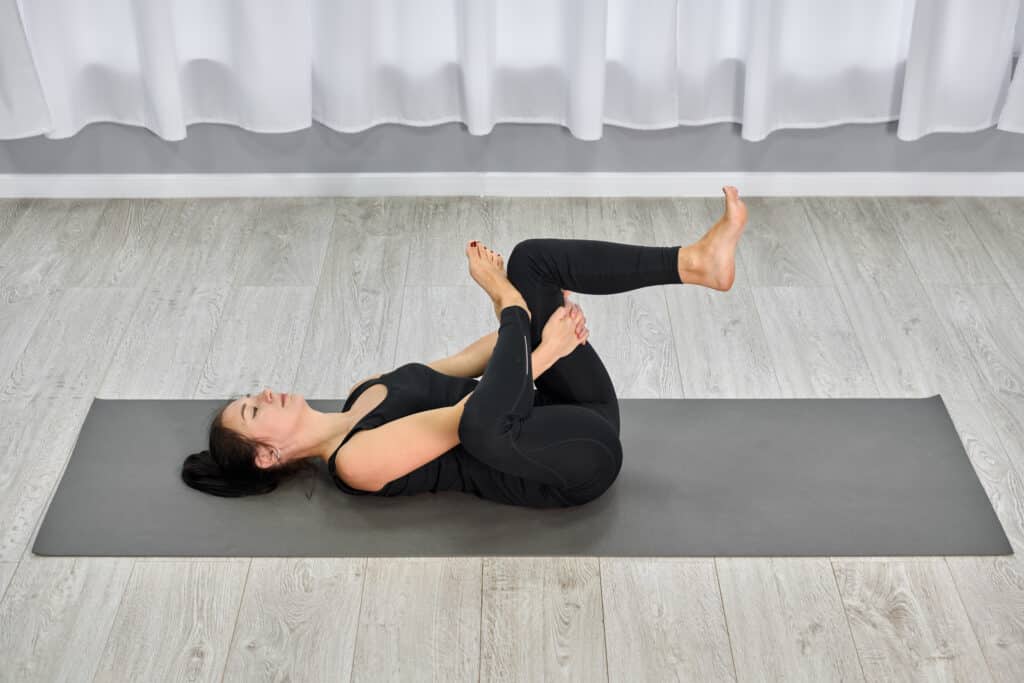
Lie on your back with knees bent and feet on the floor. Cross the ankle of your painful side over the opposite thigh.
Gently pull the uncrossed thigh toward you until you feel a stretch in the buttock.
Hold 20 to 30 seconds. Repeat 2 to 3 times.
2) Knee to Opposite Shoulder
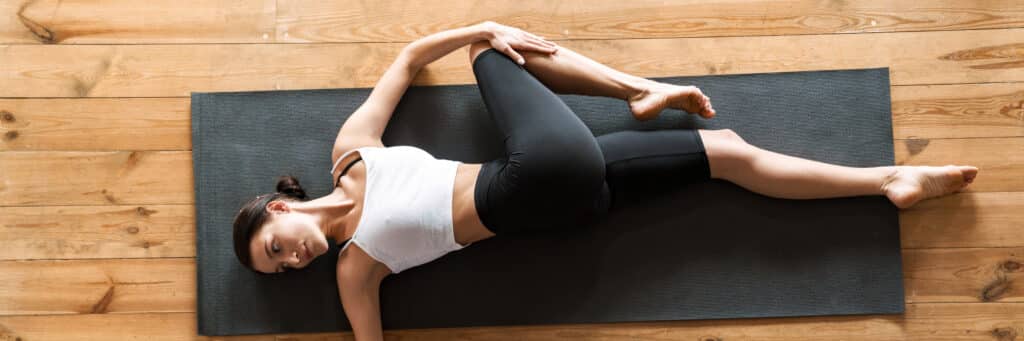
Lie on your back. Bend the knee on the painful side.
Use both hands to draw the knee across your body toward the opposite shoulder.
Stop at a comfortable stretch in the outer hip. Hold 20 to 30 seconds. Repeat 2 to 3 times.
3) Seated Hamstring Stretch
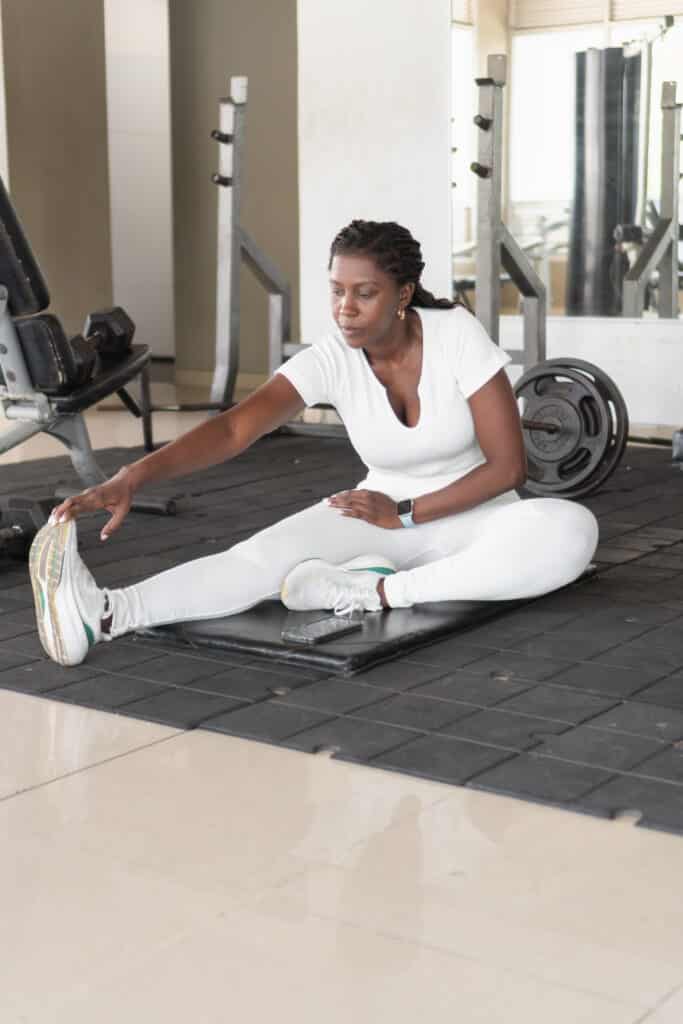
Sit on the floor with one leg extended straight and the other leg bent, with the sole of the foot resting against the inner thigh of the extended leg. Keep your back straight and shoulders relaxed.
Gently lean forward from your hips, reaching toward your shin, ankle, or foot. Stop when you feel a mild stretch in the back of your thigh. Hold for 15–30 seconds, breathing steadily. Return to upright and switch legs. Repeat 2–3 times on each side.
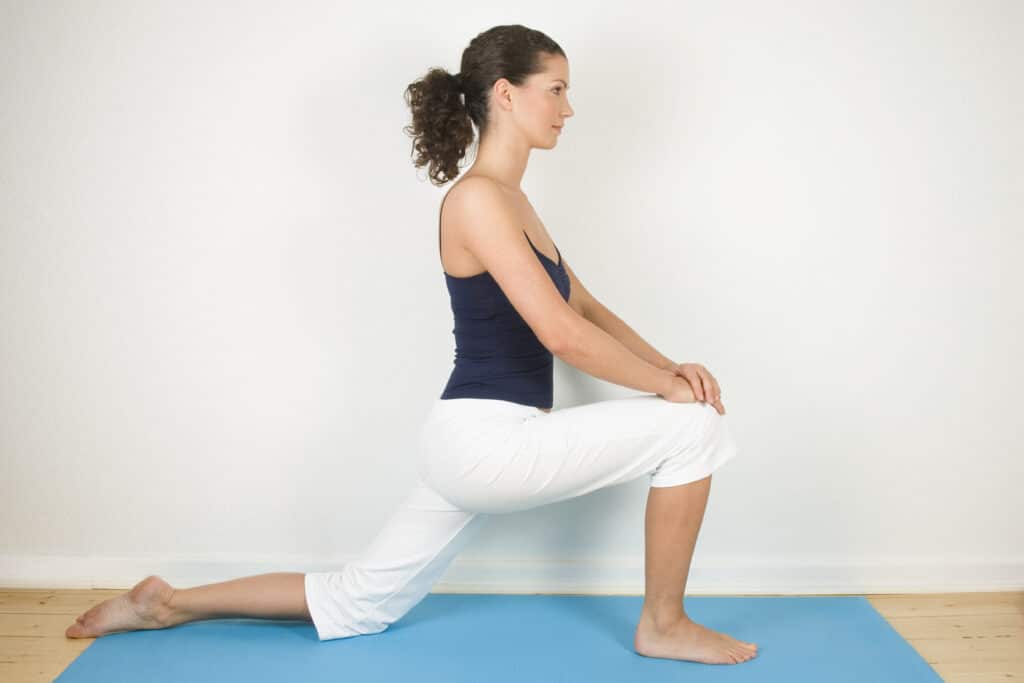
4) Half-Kneeling Hip Flexor Stretch
Kneel on one knee with the other foot in front. Tuck your tailbone slightly and gently shift your weight forward.
You should feel a stretch in the front of the hip on the kneeling side. Keep your trunk upright.
Hold 20 to 30 seconds. Repeat 2 to 3 times each side.
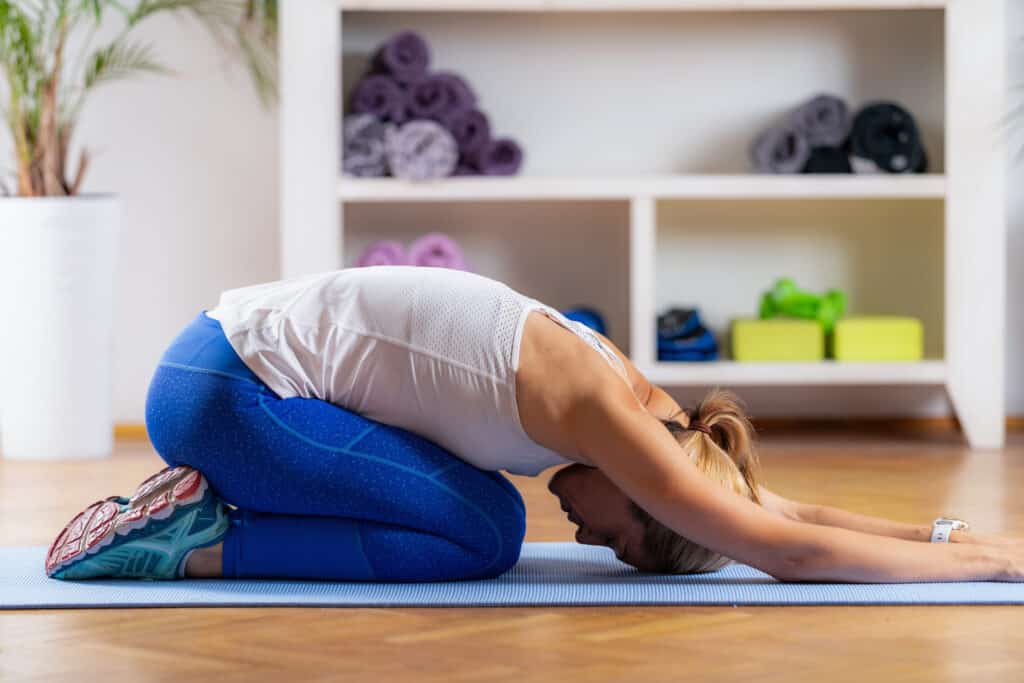
5) Child's Pose, Comfortable Range
Start on hands and knees. Sit your hips back toward your heels while reaching your arms forward.
Stay where it feels easy to breathe. If you notice leg pain or tingling increases with spinal flexion, reduce the depth or skip this position.
Hold 20 to 30 seconds. Repeat 2 to 3 times.
More Mobility Moves That Help
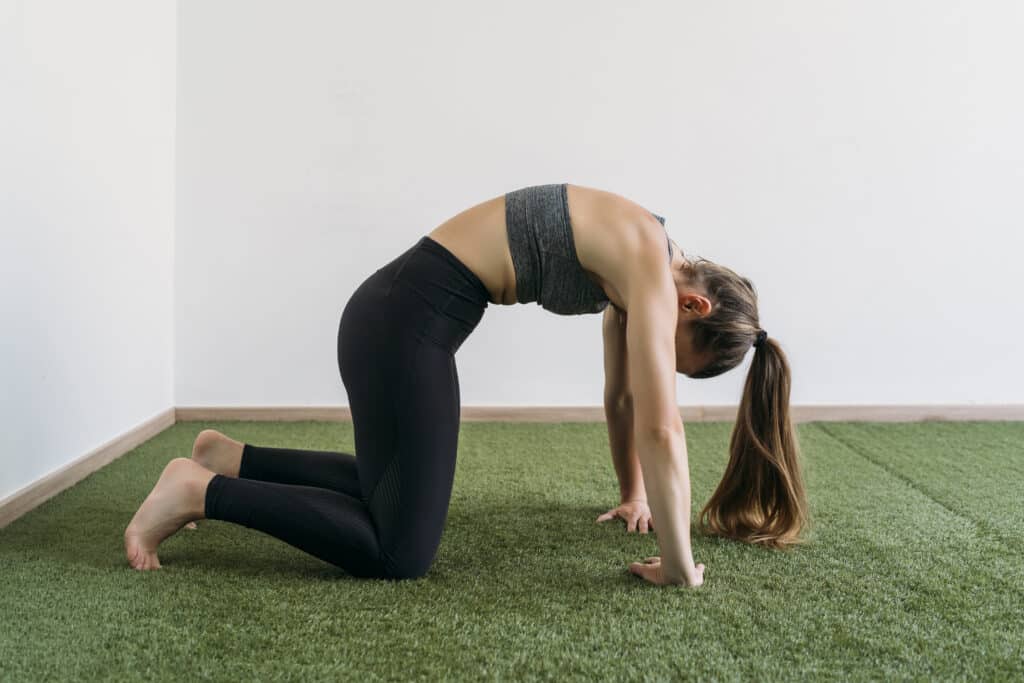
6) Cat–Cow
On hands and knees, gently arch your back toward the ceiling, then lower your belly toward the floor.
Move slowly with your breath for 30 to 60 seconds. Stop if leg pain increases.
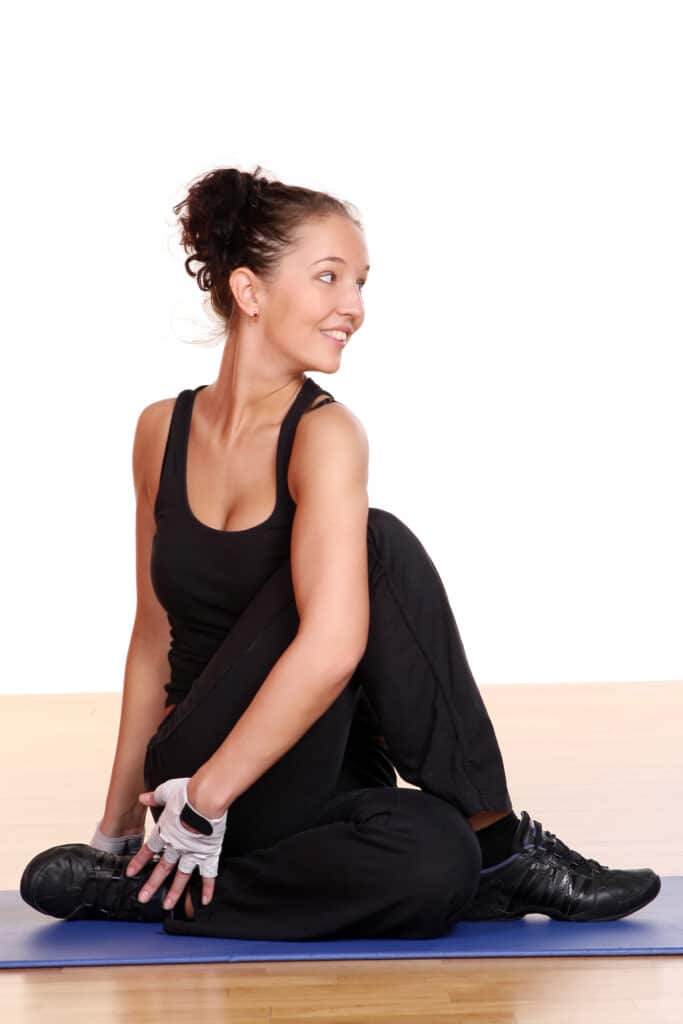
7) Seated Piriformis Stretch
Sit tall. Cross the painful-side ankle over the opposite knee.
Lean forward slightly until you feel a stretch in the buttock. Hold 20 to 30 seconds, repeat 2 to 3 times.
How Often Should You Stretch?
Consistency helps calm sensitive tissues. Use this simple guide to pace your recovery.
Stage
Frequency
Holds/Reps
Notes
Early pain
1 to 2 times daily
20 to 30 second holds, 2 to 3 sets
Stay gentle, avoid positions that trigger leg pain
Improving
Daily or every other day
Progress range as comfort allows
Add short walks and easy core work
Maintenance
3 to 5 days per week
Brief routine after activity
Keep flexibility in hips, hamstrings, and low back
What To Avoid During a Flare
Movements that sharply increase leg pain, tingling, or numbness
Heavy lifting with a rounded back
Prolonged sitting without breaks
Bouncing or forcing deeper stretches
Deep spinal flexion or sustained forward bending if it increases leg symptoms.
When To See a Doctor
Get medical care promptly if any of the following occur:
New or worsening leg weakness
Loss of bowel or bladder control
Numbness in the groin or inner thighs
Severe pain after a fall or injury
Pain that does not improve over several weeks despite rest and gentle care
Common Triggers and Risk Factors
Prolonged sitting or long commutes
Repetitive bending or lifting without proper mechanics
Sudden increase in activity or deconditioning
Tight hips and hamstrings that limit normal movement
Age-related spinal changes such as stenosis
Beyond Stretching: What Else Helps
Short, frequent walks to keep joints and nerves moving
Ice or heat for comfort based on your preference
Over-the-counter anti-inflammatory medication if your doctor approves
Physical therapy for targeted mobility, core and hip strength, and body mechanics
Ergonomic changes at work and frequent position changes
Care With Princeton Orthopaedic Associates
If sciatic pain is limiting your day, we can help you find the cause and build a plan that fits your life. Our clinicians guide you on safe exercises, posture, and next steps if additional treatment is needed. Schedule an evaluation to get moving comfortably again.
This blog post is meant to be informative and should not act as a self-diagnosis tool. If you’d like to see one of our doctors, please contact us here.
Hip Flexor Stretches: Safe, Simple Ways To Ease Tight Hips
Tightness in the front of your hips can make everyday movements like walking, running, or standing up from a chair feel stiff and uncomfortable. Understanding what your hip flexors do, why they become tight, and how to stretch them properly can help improve flexibility and ease discomfort.
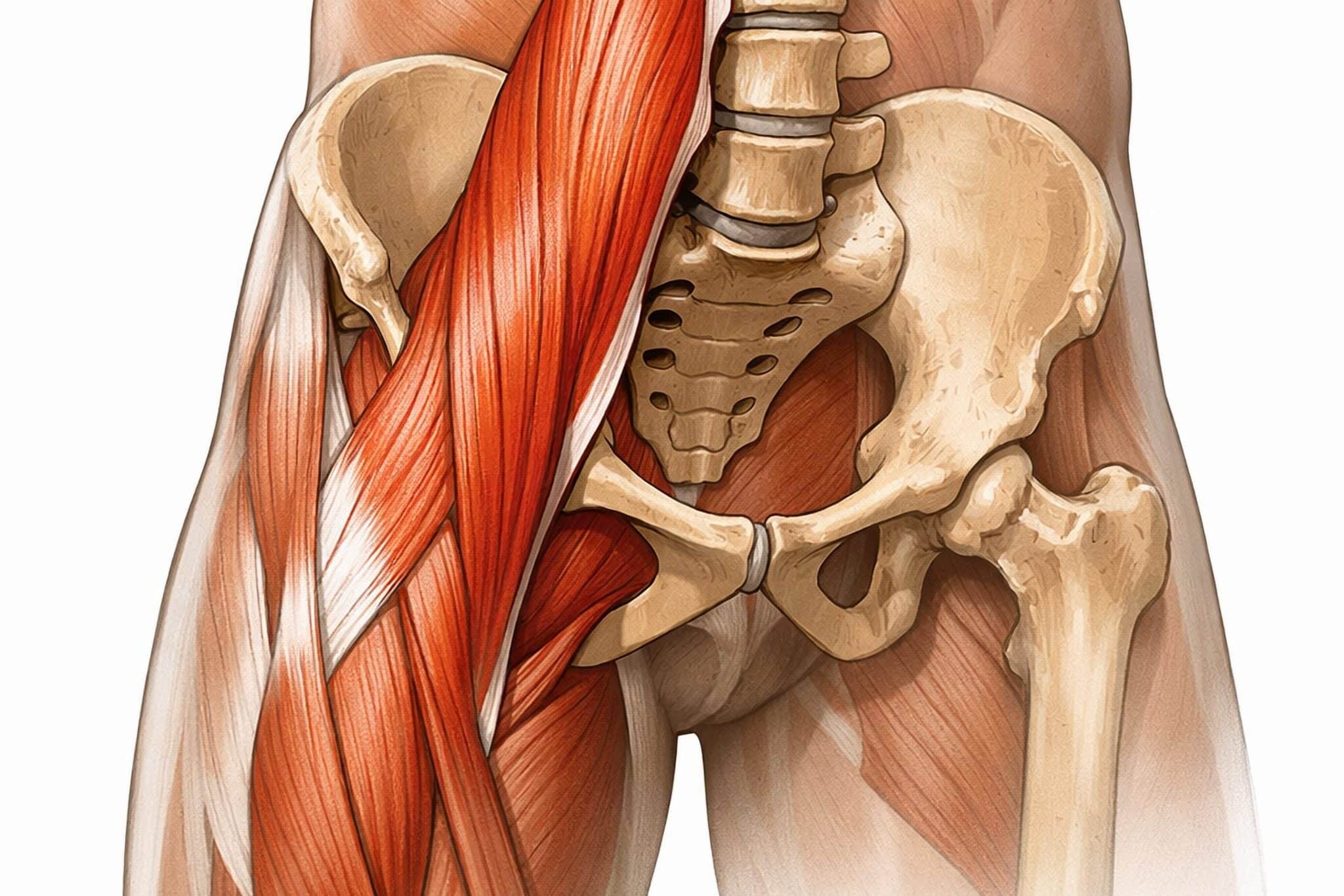
The hip flexors are a group of muscles located at the front of the hip that play a key role in lifting the knee and bending at the waist. The iliopsoas and rectus femoris are among the most important of these muscles. Prolonged sitting, repetitive activity, or a sudden increase in physical demand can cause these muscles to become shortened and sore. With gentle, consistent stretching and mindful movement habits, you can usually restore mobility and reduce tightness.
How Do You Know Your Hip Flexors Are Tight?
You might notice stiffness in the front of your hip or groin after sitting, or discomfort when you step into a long stride. Other common clues include:
Tight or pinching feeling at the front of the hip, especially when standing up from a chair
Low back or front-of-hip discomfort after long periods of sitting
Difficulty straightening the hip fully when walking or climbing stairs
Reduced hip extension while running or pushing off during strides
Standing Lunge With Support
Using the standing lunge with support can help you ease into a hip stretch when kneeling is painful or unstable. This option lets you keep your balance with a chair, table, or counter, which can reduce strain in the knee and back. Start gently, stand tall, and focus on the stretch in the front of the hip. Move slowly and breathe evenly as you feel the stretch deepen.
Stand in a short lunge with the right foot back and the left foot forward. Hold a counter or chair for balance.
Tuck the pelvis and lightly squeeze the right glute. Keep your chest tall.
Gently shift weight forward until you feel a stretch at the front of the right hip.
Hold 20 to 30 seconds. Repeat 2 to 4 times per side.
Good choice if kneeling is uncomfortable or you need extra support.
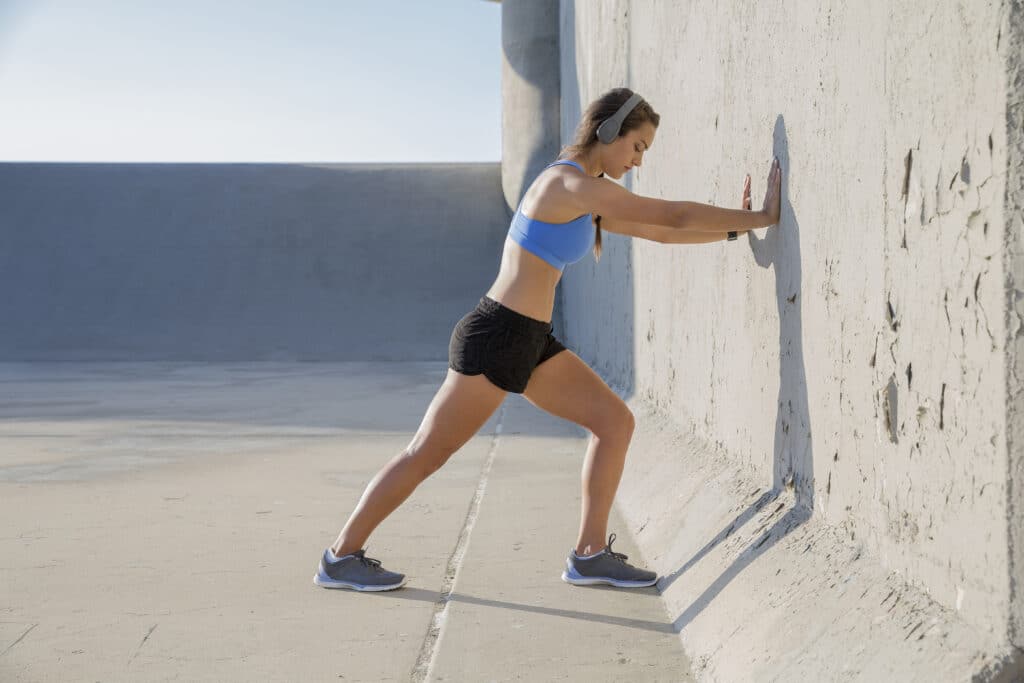
Wall or Couch Stretch
Use extra knee padding, and skip this variation if you have patellofemoral pain or knee osteoarthritis. Discontinue if knee pressure or pain persists.
This position also lengthens the rectus femoris, a front thigh muscle that acts as a hip flexor.
How Long And How Often Should You Stretch?
Consistency matters more than intensity when you stretch. A steady, gentle routine helps you move well and stay safe. Use the guide below to build a simple plan that fits your day. Start small with short holds and few days per week, then build up as you feel comfortable and your mobility improves.
Goal
Time
Frequency
Notes
General flexibility
20 to 30 seconds per hold
1 to 2 times daily
2 to 4 rounds per side
Warm up
5 to 10 seconds gentle holds
Before activity
Prioritize movement quality and posture
Mobility maintenance
20 seconds
3 to 5 days per week
Pair with hip and core strengthening
Quick Warm-Up Ideas Before You Stretch
2 to 3 minutes of easy walking or marching in place
Gentle leg swings front to back, holding a counter for balance
Pelvic tilts while standing to find a comfortable neutral spine
Before sports or vigorous activity, prioritize dynamic warm-ups (e.g., marching, leg swings, hip circles). If you include static stretches, keep them brief and gentle.
Safety Checks And When To Modify
If you feel a pinching sensation at the front of the hip (especially with a history of femoroacetabular impingement or labral irritation), reduce the range, keep the pelvis gently tucked, or choose a different variation.
When To See An Orthopaedic Specialist
Schedule an evaluation at Princeton Orthopaedic Associates if any of the following apply:
Hip or groin pain that lasts more than a week or keeps returning
Pain that limits walking, stairs, running, or daily activities
Numbness, tingling, or pain that travels into the thigh or back
Clicking or snapping at the hip that is painful
We can confirm the cause of your symptoms, teach you the right technique, and build a plan that combines stretching with strength and movement training so your progress lasts.
The Bottom Line
Hip flexor stretches work best when they’re gentle, well aligned, and consistent. Start with the half-kneeling stretch, focus on pelvic position, and progress to standing or wall variations as you improve. If pain persists, our team is here to help you move with confidence again.
This blog post is meant to be informative and should not act as a self-diagnosis tool. If you’d like to see one of our doctors, please contact us here.
IT Band Stretches: Simple, Safe Moves to Ease Outer Knee and Hip Tightness
f the outside of your knee or hip feels tight or sore, your iliotibial band (IT band) may be involved. You can safely reduce that tension with targeted stretches, proper use of foam rolling, and consistent practice for meaningful relief.
Follow step-by-step stretches that target the muscles connected to the IT band, try a quick 10-minute routine, and be aware of common mistakes to avoid. It’s also important to know when it’s time to see a specialist at Princeton Orthopaedic Associates.
What Your IT Band Does and Why It Feels Tight
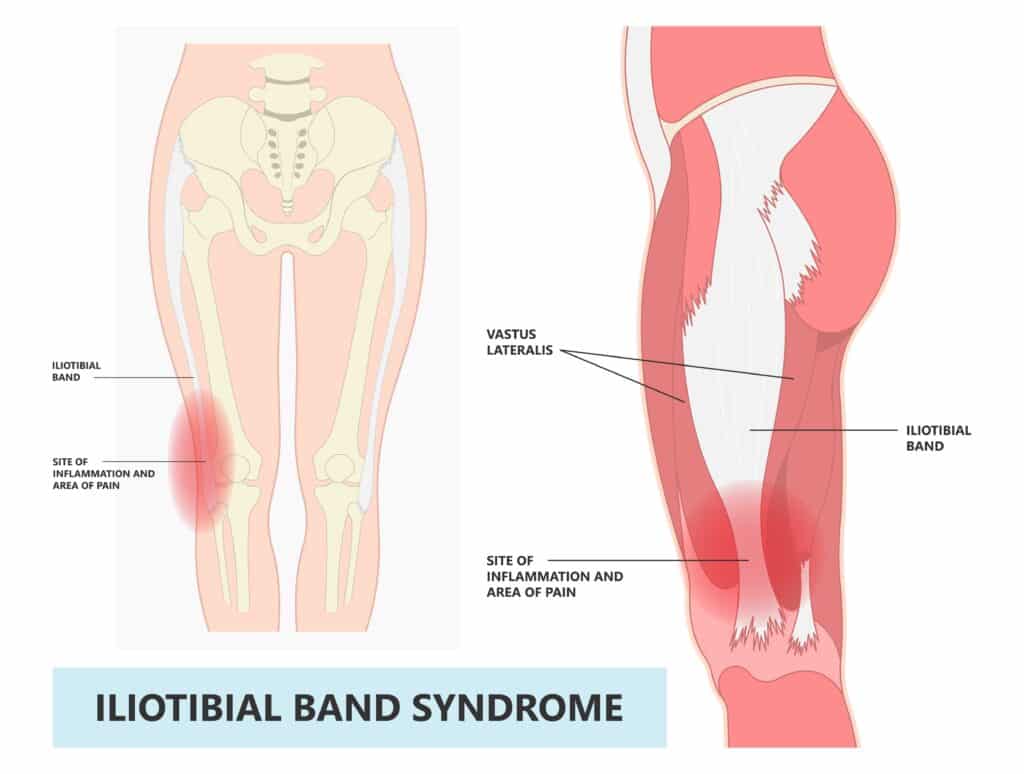
The IT band is a strong band of tissue on the outside of your thigh from your hip to just below the knee. It helps steady the knee while you move. Because it’s not a muscle, you can’t stretch the IT band itself like a hamstring or quad. Instead, you’ll get relief by improving mobility in the muscles that connect to it: the tensor fasciae latae (TFL), glutes, quadriceps, and hamstrings.
Tightness is often linked to repeating the same moves over and over, sitting for long periods, or muscle imbalances around the hip and knee.
Gentle stretching plus smart strengthening offers longer-lasting relief than stretching alone.
Discomfort should feel like a mild, tolerable stretch in the muscle. Sharp or joint pain means stop.
Before You Start: Safety Tips
Warm up with 3 to 5 minutes of easy movement: a short walk or gentle cycling.
Move slowly, avoid bouncing, and breathe normally through each stretch.
Hold each stretch 20 to 30 seconds. Repeat 2 to 3 times per side.
You should feel a comfortable stretch, not tingling, numbness, or sharp pain.
If you have a recent injury, significant swelling, or a joint replacement, ask your clinician which stretches are right for you.
Targeted Stretches That Help Ease IT Band Related Tightness
1) Standing TFL and Outer Hip Stretch (Wall Support)
Stand tall beside a wall for balance. The leg closest to the wall will be your back leg.
Cross the inside leg behind the outside leg. Gently tuck your pelvis under.
Lean your upper body away from the wall until you feel a stretch along the outer hip and upper thigh of the back leg.
Hold 20 to 30 seconds. Repeat 2 to 3 times per side.
2) Seated Figure-4 Glute Stretch
Sit near the front of a sturdy chair, feet flat.
Place your right ankle over your left knee (a figure-4 position). Keep your back tall.
Gently hinge forward from your hips until you feel a stretch in the right glute and outer hip.
Hold 20 to 30 seconds. Repeat 2 to 3 times per side.
3) Half-Kneeling Hip Flexor Stretch With Side Reach
Kneel on a pad with your right knee down and left foot forward.
Gently tuck your pelvis under and shift forward slightly until you feel a front-hip stretch on the right side.
To target the TFL a bit more, reach your right arm overhead and lean your torso slightly to the left.
Hold 20 to 30 seconds. Repeat 2 to 3 times per side.
4) Standing Quadriceps Stretch
Stand and hold a counter or wall for balance.
Bend your right knee and hold your ankle or use a strap. Keep your knees close together.
Gently tuck your pelvis under and avoid arching your low back. You should feel the stretch in the front of the thigh.
Hold 20 to 30 seconds. Repeat 2 to 3 times per side.
5) Supine Hamstring Stretch With Strap
Lie on your back with one knee bent and foot on the floor. Loop a strap around the other foot.
Straighten the strapped leg toward the ceiling until you feel a stretch along the back of the thigh. Keep your knee slightly soft if needed.
Hold 20 to 30 seconds. Repeat 2 to 3 times per side.
Your 10-Minute Stretch Routine: At a Glance
Use this quick reference to build a consistent routine. Aim for most days of the week.
Area
Stretch
Hold
Reps/Side
Frequency
TFL/Outer Hip
Standing cross-over lean
20 to 30 sec
2 to 3
5 to 7 days/week
Glutes
Seated figure-4
20 to 30 sec
2 to 3
5 to 7 days/week
Hip Flexor
Half-kneel with side reach
20 to 30 sec
2 to 3
5 to 7 days/week
Quadriceps
Standing quad stretch
20 to 30 sec
2 to 3
5 to 7 days/week
Hamstring
Supine strap stretch
20 to 30 sec
2 to 3
5 to 7 days/week
Foam Rolling: Where It Helps
Foam rolling can help ease soreness and improve movement around the IT band. Focus on the muscles that affect the IT band instead of pressing directly on the band itself. Move slowly, breathe normally, and stop if anything sharp or lingering hurts. This simple tool can make it easier to glide through stretches and daily activities with less tension in the area.
Glutes: sit on the roller, angle to one side, and work the outer glute area.
Lateral quadriceps: roll the outer front thigh just ahead of the IT band.
TFL (front outer hip): use a small ball or roller to gently address the muscle near the bony front of the hip.
Move slowly for 30 to 60 seconds per area. Avoid direct pressure over the outside of the knee.
Stop if you feel sharp, nerve-like, or lingering pain.
Strength Also Matters
Having balanced strength around your hips and core helps protect the IT band. When the hips and trunk are strong, less stress reaches the outer thigh, and symptoms are less likely to come back. Add simple movements a few days a week to build support and stability for your legs and lower back.
Clamshells and side-lying leg lifts for the gluteus medius.
Bridges or banded bridges for the gluteus maximus.
Lateral band walks and mini-squats with good knee alignment.
Hip hikes on a step and single-leg balance drills.
Start 2 to 3 days per week. Focus on quality form, not speed.
Common Stretching Mistakes
Forcing deep stretches that create sharp pain.
Bouncing or holding your breath.
Ignoring the hips and focusing only on the knee.
Skipping strength work that supports long-term results.
When to Pause and See a Clinician
If any of these signs show up, pause your stretches and seek a checkup. A quick evaluation can stop a small issue from turning into a longer lasting problem. Listening to your body now may save you from more pain later.
Pain lasts more than 1 to 2 weeks despite rest and stretching.
Night pain, swelling, or warmth around the knee or hip.
Catching, locking, or a feeling that the knee might give way.
Numbness or tingling down the leg.
Recent fall or a new injury.
History of hip or knee replacement: confirm safe options with your surgeon or physical therapist.
If you’re unsure which stretches are best for you, our team can help. Sports medicine specialists and physical therapists at Princeton Orthopaedic Associates can tailor a plan to your goals and activity level.
This blog post is meant to be informative and should not act as a self-diagnosis tool. If you’d like to see one of our doctors, please contact us here.
Gentle Neck and Back Stretches You Can Do At Home
If your neck or back feels tight, daily tasks like work, sleep, and exercise can become more difficult. This simple guide offers safe stretches to ease stiffness, improve posture, and help you move more comfortably. You'll learn when to stretch, how long to hold each stretch, and when it might be time to consult a clinician or physical therapist.
Before You Start: Safe Stretching Basics
Move slowly and stay in a comfortable stretch, not in pain. You should feel gentle tension that eases with steady breathing.
Hold most stretches 15 to 30 seconds, repeat 2 to 4 times per side, once or twice daily.
Stop and contact a clinician if you notice numbness, tingling, weakness, or pain that spreads into an arm or leg.
If you have osteoporosis, a recent injury, surgery, or active sciatica, ask your doctor or physical therapist which movements are best for you.
A Quick Daily Routine
Warm up with a short walk around the room for 1 to 2 minutes.
Do the neck sequence below, then the back sequence.
Finish with 3 slow breaths, in through your nose and out through your mouth, to help muscles relax.
Neck Stretches
These movements target common areas of tightness that can contribute to neck pain, tension headaches, and poor posture.
1) Chin Tucks
Sit or stand tall. Gently draw your chin straight back, as if making a small double chin. Keep your eyes level.
Hold 3 to 5 seconds, relax. Repeat 8 to 10 times.
Helps strengthen the deep neck flexors and counters forward head posture.
2) Upper Trapezius Stretch
Sit tall and hold the edge of your chair with your right hand. Tilt your left ear toward your left shoulder to feel a stretch on the right side of your neck.
Option: Rest your left hand lightly on the right side of your head for a gentle assist. Avoid pulling.
Hold 15 to 30 seconds, repeat 2 to 4 times each side.
3) Levator Scapulae Stretch
Turn your head about 45 degrees to the left, then tuck your chin toward your left armpit.
Place your left hand lightly on the back of your head to guide the stretch. You should feel it along the back and side of the neck.
Hold 15 to 30 seconds, repeat 2 to 4 times each side.
4) Doorway Chest Stretch
Tight chest muscles can pull the shoulders forward, which can increase neck strain.
Stand in a doorway with your forearms on the doorframe and elbows at shoulder height.
Step one foot forward and gently shift your weight until you feel a stretch across the chest and front of the shoulders.
Hold 15 to 30 seconds, repeat 2 to 3 times.
Back Stretches
These stretches focus on the upper and lower back, hips, and the muscles that support your spine.
1) Cat‑Cow Mobility
Start on hands and knees. Inhale as you gently let your belly lower and lift your chest. Exhale as you round your back and tuck your chin.
Move slowly through 8 to 12 repetitions.
2) Child’s Pose
From hands and knees, sit your hips back toward your heels and reach your arms forward.
Relax your shoulders and breathe into your sides and lower back.
Hold 20 to 30 seconds, repeat 2 to 3 times.
3) Single Knee‑to‑Chest
Lie on your back with knees bent. Bring one knee toward your chest, hands on the shin or behind the thigh.
Hold 15 to 30 seconds, then switch. Repeat 2 to 4 times each side.
4) Lower Trunk Rotations
Lie on your back with knees bent and feet flat. Gently let both knees fall to one side while keeping your shoulders on the floor.
Hold 10 to 20 seconds, then switch sides. Repeat 5 to 10 times total.
5) Prone Press‑Ups
The prone press up can help ease stiffness in the lower back for some people. If you feel more pain in your legs, numbness, tingling, or a change in how your legs or feet feel during the move, stop right away. Do not push through nerve symptoms, and talk with your clinician before trying again.
Lie on your stomach and prop up on your elbows, letting your low back relax.
Option: Press into your hands to raise your chest a bit higher if comfortable. Keep hips on the floor.
Hold 5 to 10 seconds, repeat 8 to 10 times.
6) Hamstring Stretch
Lie on your back. Loop a towel or strap around one foot and gently straighten the knee toward the ceiling until you feel a stretch in the back of the thigh.
Keep the other leg bent for comfort. Hold 15 to 30 seconds, switch sides, repeat 2 to 3 times.
7) Figure‑4 Hip Stretch
Lie on your back, cross your right ankle over your left knee. Lift the left leg and hold behind the thigh.
Feel the stretch in the right hip or buttock. Hold 15 to 30 seconds, switch sides, repeat 2 to 3 times.
How Often Should You Stretch?
Doing stretches regularly matters more than doing long, hard sessions. If you practice a little every day, you are more likely to keep your joints flexible and your back strong. Use the chart below to plan how often you stretch, how long to hold each stretch, and how many times to repeat.
Goal
Frequency
Hold Time
Repetitions
Ease stiffness
Daily or 5 days per week
15 to 30 seconds
2 to 4 per side
Posture support
Daily micro‑breaks
5 to 10 seconds for resets
Little and often throughout the day
Warm up
Before activity
Gentle, shorter holds
8 to 10 easy reps of mobility moves
Ergonomic Habits That Help
Set a reminder to stand and move for 1 to 2 minutes every 30 to 60 minutes.
Keep screens at eye level and your keyboard close so your shoulders stay relaxed.
Use a supportive chair, and place feet flat on the floor or on a small footrest.
Choose a pillow height that keeps your neck in a neutral position.
When To Contact Princeton Orthopaedic Associates
If your pain lasts more than a week or two despite trying home care, or if it wakes you at night or keeps you from daily tasks, you should seek an evaluation. Call if you notice numbness, tingling, weakness, or new changes in bowel or bladder control, as these need urgent attention.
Pain lasts more than 1 to 2 weeks despite home care.
Pain wakes you at night or limits daily tasks.
You notice numbness, tingling, or weakness in an arm or leg.
Pain began after a fall or accident.
There are changes in bowel or bladder control. This is urgent and needs immediate care.
Our team can diagnose the source of pain, tailor a stretching and strengthening plan, and coordinate physical therapy when needed.
Next Step
If your neck or back pain keeps returning, a personalized plan usually helps most. Schedule an exam with Princeton Orthopaedic Associates so we can identify what is driving your symptoms and guide you through the right exercises for long‑term relief.
This blog post is meant to be informative and should not act as a self-diagnosis tool. If you’d like to see one of our doctors, please contact us here.
Gout: Symptoms, Risks, Testing, and Treatment
Gout is a common type of inflammatory arthritis that causes sudden, intense joint pain and swelling. In this guide, you will learn what gout is, why it happens, who is at higher risk, how we diagnose it, and the treatments that help you feel better and prevent future flares.
What Is Gout?
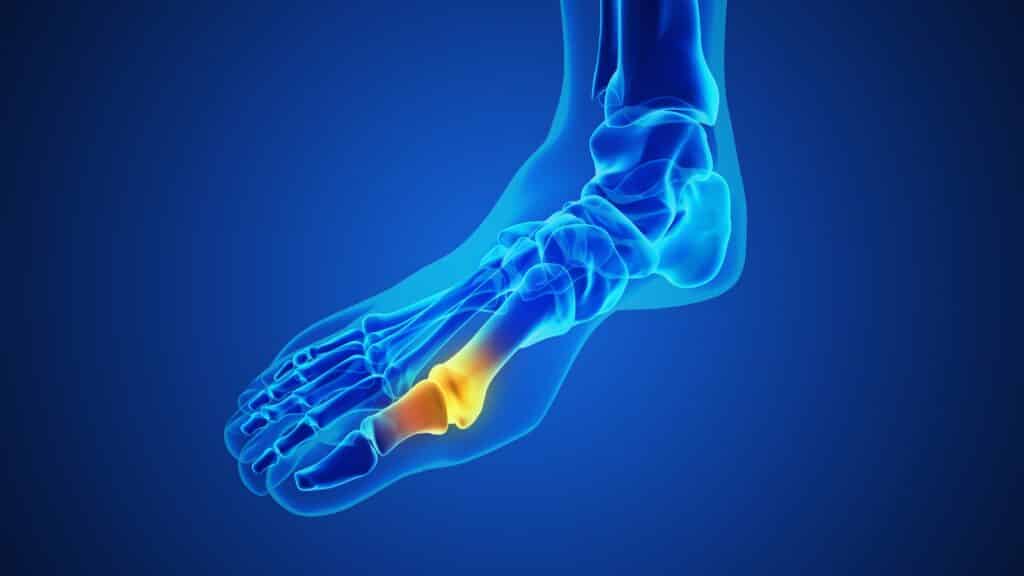
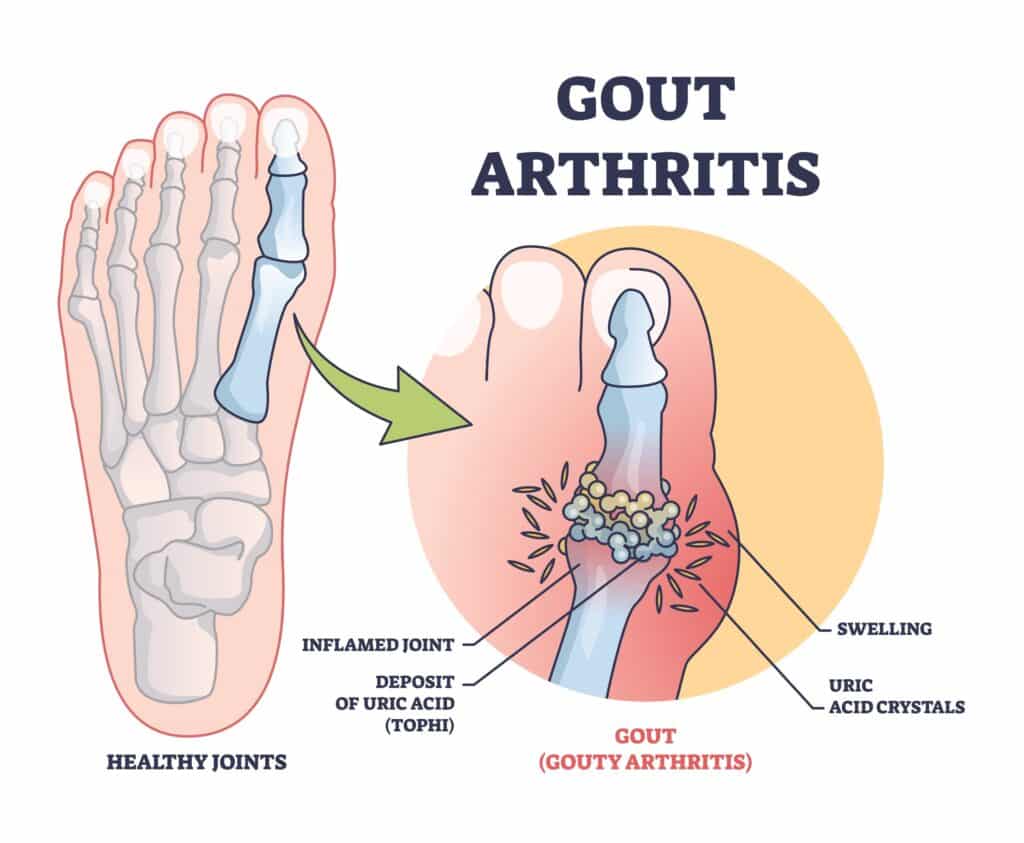
Gout happens when uric acid builds up in the blood and forms needle-like crystals inside a joint. Your immune system reacts to those crystals, which triggers sudden pain, redness, heat, and swelling. The big toe is the classic spot, but gout can affect the midfoot, ankle, knee, wrist, fingers, and elbow.
How Gout Feels
Sudden, severe pain that often starts at night.
Redness, warmth, and swelling at one joint.
Extreme tenderness where even a bedsheet can hurt.
Stiffness and limited motion during and after a flare.
With long-standing gout, firm bumps under the skin called tophi can develop.
Why Gout Happens
Uric acid forms when your body breaks down purines, which are found naturally in your tissues and in certain foods. When production is high or your kidneys don’t clear enough uric acid, crystals can deposit in joints and surrounding tissues. Cold areas like the big toe are common sites for crystal formation.
Who Is at Higher Risk?
Age and sex: more common in men and after menopause in women
Family history of gout or high uric acid
Chronic kidney disease or reduced kidney function
Metabolic conditions: obesity, insulin resistance, high blood pressure, high triglycerides
Medications: diuretics for blood pressure, low-dose aspirin, cyclosporine, tacrolimus
Dietary factors: frequent alcohol use, especially beer and spirits, red and organ meats, certain seafoods like anchovies and shellfish, and sugar-sweetened beverages with fructose
When to Seek Care
If you notice a new hot, swollen joint or have repeated gout flares, seek care promptly from a clinician or urgent care provider. Early evaluation helps confirm that gout is the cause, guides fast pain relief, prevents infection or other problems, and protects the joint from lasting damage. A clinician will review your health history and medicines to choose safe, effective treatment and avoid drug interactions.
Severe joint pain with redness and warmth
Fever or feeling unwell along with a hot, swollen joint can signal a joint infection (septic arthritis). Seek urgent same-day medical evaluation to rule out infection before receiving steroid injections or NSAID-only treatment.
Recurrent attacks in the same or different joints
Hard nodules near joints or the ear rim that may be tophi
How We Diagnose Gout
During your visit, a clinician will look at the painful joint and review your overall health, symptoms, and medicines. The best way to confirm gout is to take a tiny sample of joint fluid and check it under a microscope for uric acid crystals. This test helps rule out infection and other problems that can look like gout.
Joint aspiration and crystal analysis when possible
Blood tests, including uric acid level, kidney function, and markers of inflammation
Imaging when needed: ultrasound can show a double contour sign, X-rays reveal long-term changes, and specialized CT may identify crystal deposits
Treating an Acute Gout Flare
Flares respond best when treatment starts early. The main goal is to ease pain quickly, reduce swelling, and lower inflammation while protecting the affected joint from more harm. Your doctor will tailor medicines to your health history and current medicines to ensure safety and effectiveness and help you return to daily activities.
Anti-inflammatory medicines such as NSAIDs, if safe for you
Colchicine, especially when started soon after symptoms begin
Corticosteroids by mouth or a targeted joint injection
Rest, elevation, and ice for comfort
Do not stop your long-term urate-lowering medicine during a flare unless your doctor advises it. Let us know at the first sign of a flare so we can tailor treatment to your health history and medications.
Preventing Future Attacks
If you have repeated flares, tophi, kidney stones from uric acid, or moderate to advanced chronic kidney disease, you may benefit from urate-lowering therapy. The aim is to keep your blood uric acid below target so crystals dissolve and flares fade over time.
Topic
Key Points
Who Should Start Urate-Lowering Therapy
2 or more flares per year, tophi, uric acid kidney stones, or chronic kidney disease stage 3 or higher
First-Line Medicine
Allopurinol is typically first choice. Start low and increase gradually. Febuxostat is another option if needed. In patients with established cardiovascular disease, febuxostat carries an FDA boxed warning for increased risk of cardiovascular death. Use only after shared decision-making, and consider allopurinol first. Allopurinol can rarely cause severe cutaneous adverse reactions. Consider HLA-B*58:01 testing in high-risk groups (e.g., Han Chinese, Thai, Korean patients with CKD, and African American patients) before starting therapy.
Other Options
Probenecid may help if kidney function is adequate. Pegloticase is reserved for severe, refractory cases. Less effective with moderate-to-severe CKD; avoid or use cautiously in patients with a history of uric acid kidney stones; review for drug–drug interactions.
Target Uric Acid
Under 6 mg/dL is the usual goal. Under 5 mg/dL may be used if tophi are present.
Flare Prevention When Starting Therapy
Low-dose colchicine or an NSAID is often used for several months to reduce flare risk during dose adjustments.
Daily Steps That Help
Maintain a healthy weight and stay active within comfort
Limit alcohol, especially beer and spirits
Moderate high-purine foods like red and organ meats and certain seafoods
Cut back on sugar-sweetened drinks, especially those with fructose
Drink water regularly and review medications with your doctor
Possible Complications If Gout Is Not Treated
Tophi that can erode bone and limit joint motion
Progressive joint damage and arthritis
Uric acid kidney stones
How Princeton Orthopaedic Associates Can Help
Our team evaluates the painful joint, confirms the diagnosis, and builds a treatment plan that eases pain fast and prevents future attacks. When appropriate, we can perform joint aspiration or an image-guided injection and coordinate long-term urate-lowering therapy with your broader care team.
If you think you're having a gout flare or you've had recurrent attacks, schedule an evaluation. Getting ahead of flares now helps protect your joints for the long term.
This blog post is meant to be informative and should not act as a self-diagnosis tool. If you’d like to see one of our doctors, please contact us here.
Why Does My Knee Pop? Common Causes and When to Get Help
Learn why knees sometimes pop, when it’s usually harmless, and when it may signal a problem. Common causes include gas bubbles or tendons snapping, but popping can also point to joint issues. Explore simple at-home steps that may help, and know when it’s time to see a clinician.
If you hear occasional popping without pain, it is usually not serious. But if popping comes with pain, swelling, instability, or locking, you should seek evaluation so we can find the cause and plan treatment.
Quick Overview: What This Post Covers
What makes knees pop.
How to tell harmless popping from trouble.
Simple self-care and when to see a specialist.
Tests and treatments your clinician may use.
How we approach diagnosis and recovery at Princeton Orthopaedic Associates.
Common, Usually Harmless Causes of Knee Popping
Sometimes popping is simply noise from normal joint movement. A few common benign reasons include:
Gas bubbles forming and popping inside the joint fluid, which can create a cracking sound
Tendons or ligaments snapping briefly as they shift over bone when the joint moves
Rough surfaces rubbing in a joint with age-related wear; osteoarthritis can also have inflammatory flares and management depends on symptoms and function
Painless popping alone is not known to cause arthritis; however, if popping is accompanied by pain, swelling, instability, or limits on function, you should have it evaluated.
When Popping May Mean a Problem
Popping that comes with other symptoms may point to an underlying injury. Watch for these signs:
Sharp or persistent pain at the time of popping
Visible swelling or the knee feeling hot
A feeling that the knee gives way, locks, or will not fully bend or straighten
Pain or instability that limits walking or daily activities
Those symptoms suggest we should examine the joint to look for cartilage injuries, meniscal tears, ligament strain, loose fragments, or significant joint inflammation.
Emergency or Urgent Signs
If any of the following occur after a pop, get urgent or emergency care rather than waiting for a routine appointment:
A loud pop during an injury followed by immediate swelling and inability to bear weight
Visible deformity or suspected patellar dislocation
The knee is locked and you cannot fully straighten it - true mechanical locking
Severe pain after trauma or when a fracture is suspected
A hot, very painful swollen knee with fever or chills, or a swollen painful knee in someone who is immunocompromised - possible septic arthritis
What Might Be Causing Painful Popping?
Several common issues can cause painful popping. These include damage to soft tissues, cartilage problems, and mechanical irritation around the joint.
Meniscal tears. A torn meniscus can catch or lock and may produce a pop with pain.
Ligament sprains. A sudden twist or direct blow can cause ligament stretching and an audible pop.
Patellar tracking issues and patellar instability or dislocation. If the kneecap moves unevenly or subluxes, you may feel or hear snapping and experience pain.
Loose bodies or osteochondral injury. Cartilage or bone fragments can catch in the joint and cause painful popping or locking.
Cartilage wear. As cartilage thins with age or injury, joint surfaces can make noise and become painful.
How We Evaluate Popping Knees
Your clinician will take a careful history and perform a focused exam to check motion, stability, and areas of tenderness. That helps narrow down likely causes.
Imaging and tests are selected based on the history and exam. X-rays are often first-line after trauma to assess for fracture and alignment; X-rays do not show soft tissues. MRI is ordered when the exam or history suggest soft tissue injury such as meniscus or ligament tears, cartilage damage, or when mechanical symptoms persist. Ultrasound can be useful for dynamic snapping and for evaluating superficial tendon or bursal problems.
Test
What it shows
X-ray
Bone alignment, fracture, and evidence of arthritis; does not show soft tissues
MRI
Soft tissues like meniscus, ligaments, and cartilage; used when exam or history suggest soft tissue injury or persistent mechanical symptoms
Ultrasound
Tendon or bursa irritation near the knee and useful for dynamic snapping
At-home Steps You Can Try First
If popping is mild and not accompanied by the concerning signs above, try conservative care while watching symptoms. Small changes often help.
Rest from the activity that triggers the sound for a few days
Ice the area for 10 to 15 minutes if there is pain or swelling
Over-the-counter nonsteroidal anti-inflammatory drugs may reduce pain; avoid NSAIDs if you have a history of gastrointestinal ulcers or bleeding, kidney disease, are taking blood thinners, are in late pregnancy, or have an NSAID allergy. If NSAIDs are not appropriate, consider acetaminophen after checking with your provider
Start gentle strengthening and mobility work for hips, quads, and hamstrings; a physical therapist can guide this
When You Should Schedule an Exam
Contact us for an evaluation if you have persistent pain, swelling, catching or locking, repeated giving way, or if symptoms prevent daily tasks. Early assessment helps us treat the cause and reduce the chance of longer term issues.
Who to See at Princeton Orthopaedic Associates
Specialty
Why you would see them
Sports Medicine
Non surgical evaluation for tendon, ligament, and meniscal problems
Orthopaedic Surgeon
Persistent mechanical symptoms or when surgery may be needed
Physical Therapist
Rehabilitation to improve strength, control, and movement patterns
What to Expect from Treatment
Treatment depends on the diagnosis. Many causes improve with a planned rehab program that reduces pain, restores motion, and strengthens supporting muscles. When structural damage is severe, surgical options may be discussed.
Conservative care first: activity modification, medication, targeted therapy
Procedures: injections may help for persistent inflammation
Surgery: reserved for clear mechanical problems or unresolving structural injury
If you want to discuss symptoms, we make it easy to schedule an exam. A focused visit helps us determine what is normal and what needs treatment so you can get back to your routine with confidence.
This blog post is meant to be informative and should not act as a self-diagnosis tool. If you’d like to see one of our doctors, please contact us here.
Treating Runner's Knee Through Strengthening Exercises
Effective exercises for runner's knee focus on strengthening muscles around the knee, improving flexibility, and enhancing stability. These exercises reduce stress on the kneecap and improve joint alignment. Runner's knee exercises are the cornerstone of your knee rehabilitation.
Straight Leg Raises
Purpose: Strengthens the quadriceps without placing stress on the knee joint.
How-To:
Lie flat on your back with one leg bent and the other straight.
Tighten the muscles in your straight leg and lift it to the height of the bent knee.
Hold for 2–3 seconds, then slowly lower the leg. Repeat 10–15 times per leg.
Why It Works for Runner's Knee:
Strengthens the quadriceps to support the knee.
Improves joint stability without bending the knee.
Reduces stress on the patellofemoral joint
Mini Squats
Purpose: Builds strength in key knee-supporting muscles while avoiding excessive stress.
How-To:
Stand with feet shoulder-width apart, near a chair or wall for balance.
Slowly squat down to about a 45-degree angle, keeping your knees aligned over your toes.
Hold for 1–2 seconds, then return to standing. Repeat 10–15 times.
Why It Works for Runner's Knee:
Strengthens the quadriceps, hamstrings, and glutes.
Helps stabilize the knee joint during movement.
Promotes proper alignment to reduce knee strain.
Clamshells
Purpose: Strengthens hip muscles to improve knee alignment and stability.
How-To:
Lie on your side with knees bent at a 90-degree angle.
Keeping your feet together, lift the top knee as high as possible without moving your pelvis.
Lower the knee slowly. Repeat 10–15 times per side.
Why It Works for Runner's Knee:
Targets the gluteus medius for better hip stability.
Prevents inward knee movement that strains the joint.
Enhances overall leg alignment during activities.
Step-Ups
Purpose: Strengthens lower-body muscles while mimicking functional movements.
How-To:
Stand in front of a sturdy step or platform.
Step onto the platform with one foot, driving through your heel to bring the other foot up.
Step back down with the same foot and repeat. Perform 10–12 reps per leg.
Why It Works for Runner's Knee:
Builds strength in the quadriceps, glutes, and calves.
Encourages proper knee tracking over the toes.
Improves balance and stability in functional movement.
Quadriceps Stretch
Purpose: Relieves tightness in the thigh muscles to reduce stress on the knee.
How-To:
Stand on one leg, holding onto a wall or chair for support.
Pull the opposite foot toward your glutes, keeping your knees close together.
Hold for 20–30 seconds, then switch sides.
Why It Works for Runner's Knee:
Loosens tight quadriceps that can pull on the kneecap.
Improves flexibility and joint movement.
Reduces strain on the patellofemoral joint.
Hamstring Stretch
Purpose: Reduces tension in the back of the thigh to improve knee alignment.
How-To:
Sit on the floor with one leg extended and the other bent.
Reach toward the toes of the extended leg while keeping your back straight.
Hold for 20–30 seconds, then switch legs.
Why It Works for Runner's Knee:
Loosens tight hamstrings that can pull the knee out of alignment.
Enhances flexibility and joint mobility.
Helps balance muscle tension around the knee.
Calf Stretch
Purpose: Eases tension in the lower leg to reduce stress on the knee.
How-To:
Stand facing a wall, placing your hands on it for support.
Step one foot back, keeping it straight, while bending the front knee.
Press the back heel into the floor and hold for 20–30 seconds. Switch legs.
Why It Works for Runner's Knee:
Loosens tight calves to improve shock absorption.
Enhances lower leg alignment during activity.
Reduces stress transmitted to the knee joint.
Single-Leg Balance
Purpose: Enhances knee stability and improves proprioception.
How-To:
Stand on one leg with your hands on your hips or out for balance.
Hold for 20–30 seconds, gradually increasing the time as your balance improves.
For added difficulty, try closing your eyes or standing on a soft surface.
Why It Works for Runner's Knee:
Strengthens stabilizing muscles around the knee and ankle.
Improves body awareness and balance.
Reduces improper knee alignment during movement.
Side-Lying Leg Lifts
Purpose: Strengthens outer thigh muscles for improved knee tracking.
How-To:
Lie on your side with your legs straight.
Lift the top leg slowly, keeping it in line with your body.
Lower it back down without letting it rest. Repeat 10–15 times per side.
Why It Works for Runner's Knee:
Strengthens the outer thigh to stabilize the knee.
Reduces lateral instability.
Improves overall knee alignment during movement.
IT Band Foam Rolling
Purpose: Relieves tension in the iliotibial band to reduce knee strain.
How-To:
Lie on your side with a foam roller under the outer thigh.
Roll slowly from your hip to just above the knee, pausing on tight spots.
Perform for 1–2 minutes per side.
Why It Works for Runner's Knee:
Loosens the IT band, which can pull on the knee.
Improves flexibility and reduces friction around the knee joint.
Enhances mobility for smoother movement patterns.
The Achilles tendon is a strong band of tissue that connects the muscles in your calf to your heel bone. It is the largest tendon in your body and is important for activities like walking, running, and jumping because it helps your foot push off the ground. The Achilles tendon is made up of two main muscle groups: the gastrocnemius and the soleus. These muscles work together to help you move and keep your ankle stable. Since the Achilles tendon is used a lot during physical activities, it can get injured or develop problems, such as Achilles tendonitis or ruptures. That’s why it’s important to take care of it and keep it flexible.
Living with Achilles Tendon Pain
Imagine waking up in the morning, swinging your feet out of bed, and feeling a sharp, persistent pain at the back of your ankle. You stand up, but each step feels like a battle, with every move reminding you that something isn’t quite right. Whether you’re an athlete or simply someone going about your regular daily activities, dealing with Achilles tendon pain can severely impact your life. Whether it's climbing stairs to walking short distances, every motion becomes a conscious, painful effort. Over time, the discomfort can worsen, which makes it difficult for you to carry out even the simplest tasks, like getting out of bed or standing for extended periods.
Although achilles tendon injuries range in severity, they are all disruptive. Understanding the causes of issues, symptoms, and treatment options can help you prevent long-term damage and help you manage the pain effectively.
The Achilles tendon, which is the strongest and largest tendon in the body, connects your calf muscles to your heel bone. It transmits the force generated by your muscles to your foot and plays an essential role in walking, running, and jumping. You can imagine that the importance of this tendon also makes it vulnerable to a range of injuries due to overuse, improper footwear, and sudden stress.
The most common Achilles tendon injuries include:
Achilles Tendonitis: Inflammation of the tendon, often caused by repetitive strain or overuse. It is common among runners, athletes, and those who engage in high-impact activities without proper warm-up or technique.
Achilles Tendon Rupture: A rupture is a partial or complete tear of the tendon, often caused by sudden, forceful movements, such as jumping or pivoting quickly. Ruptures are more severe and typically require medical intervention.
Achilles Tendonosis: Degeneration of the tendon tissue due to chronic overuse or untreated tendonitis. This condition leads to stiffness and reduced mobility and increases the risk of rupture.
Symptoms: How to Identify Achilles Tendon Issues
Achilles tendon problems are characterized by pain and stiffness, but depending on the type of injury, the location and intensity of your pain can vary.
Common symptoms include:
Pain: The pain is usually localized to the back of the ankle, just above the heel. In the case of Achilles tendonitis, the pain may worsen during physical activity or after long periods of inactivity, such as when getting up after sitting for an extended time. In more severe cases, like a rupture, you may experience sudden, sharp pain and even hear a popping sound.
Swelling: Swelling around the Achilles tendon is another hallmark sign of injury. This swelling can occur with tendonitis or a tear and is often accompanied by warmth and tenderness in the affected area.
Stiffness: Stiffness in the morning or after resting is a common symptom, especially with Achilles tendonitis. If your condition worsens, it becomes more difficult to flex your foot or walk without discomfort.
Weakness: You may notice weakness in your calf muscles, making it hard to stand on your tiptoes or push off your foot while walking.
Why Does Achilles Tendon Pain Occur?
Achilles tendon pain occurs primarily due to inflammation, degeneration, or tearing of the tendon fibers. These injuries tend to form because of repetitive stress, improper biomechanics, or sudden high-impact movements.
Some causes of Achilles tendon pain:
Overuse: Overuse such as repetitive movements in sports, exercise, or even daily tasks can put excessive stress on the Achilles tendon. If you increase their training intensity too quickly,you are at higher risk.
Sudden Movements: Quick, sudden movements like jumping, pivoting, or pushing off forcefully during activities like basketball, tennis, or running can lead to tendon tears.
Tight Muscles: Tight calf muscles or inadequate stretching can increase strain on the tendon, making it more susceptible to injury.
Improper Footwear: Wearing shoes that lack proper support or cushioning can misalign the feet and increase stress on the Achilles tendon.
Age: As we age, the Achilles tendon becomes less flexible and more prone to injury, particularly in individuals who remain active without proper conditioning.
Meet Our Sports Medicine Doctors
Preventing Achilles Tendon Injuries
Preventing Achilles tendon injuries requires a combination of good habits and awareness of your body’s limits.
Here are some effective prevention strategies:
Stretch Regularly: By regularly stretching your calf muscles and Achilles tendon you will help to maintain flexibility. Focus on slow, controlled stretches, especially before and after exercise.
Strengthening Exercises: Strengthen your calf muscles with exercises such as heel raises and resistance band workouts. Stronger muscles will help support the tendon and reduce the risk of injury.
Gradual Progression: Gradually increase your workout or training levels to allow your body to adapt. Suddenly increasing the intensity or duration of your physical activities can cause issues, so make sure to avoid those.
Wear Supportive Footwear: Invest in shoes that provide proper support and cushioning for your feet. This is especially important for athletes and those who spend long periods on their feet.
How to Care for Achilles Tendon Injuries
If you’ve injured your Achilles tendon, it’s crucial to address it immediately to prevent further damage. Here are key steps for caring for Achilles tendon issues:
At-Home Treatments
Rest: Limit activities that put a strain on the Achilles tendon. Avoid running, jumping, or engaging in high-impact sports until the pain subsides.
Ice Therapy: Apply ice to the affected area for 15-20 minutes, multiple times daily, to reduce inflammation and swelling.
Compression: Use a compression bandage. This helps to support the tendon and minimize your swelling.
Elevation: Elevate your foot whenever possible to reduce swelling.
Over-the-Counter Pain Relief: Non-steroidal anti-inflammatory drugs (NSAIDs) like ibuprofen can help manage pain and inflammation.
What to Avoid
Sudden Movements: Avoid sudden, jerky movements that can strain the tendon further.
Prolonged Immobility: While rest is important, prolonged immobility can lead to stiffness. Engage in gentle range-of-motion exercises to keep the tendon flexible.
Exercises for Recovery and Prevention
Incorporating specific exercises can aid in recovery and prevent future injuries:
Heel Raises:
Stand on a step with your heels hanging off the edge. Slowly rise onto your toes, then lower your heels below the level of the step. This exercise strengthens the calf muscles and Achilles tendon.
Towel Stretch:
Sit with your legs extended our in front of you and loop a towel around the ball of your foot. Gently pull the towel towards you while you keep your knee straight.
Eccentric Calf Raises:
Stand on one leg, rise onto your toes, and slowly lower yourself down. This exercise focuses on strengthening the tendon while it lengthens.
When to Seek Help from a POA Orthopaedic Surgeon
While at-home care can often alleviate mild Achilles tendon pain, certain symptoms indicate the need for professional intervention:
Persistent Pain: If the pain doesn’t improve with rest and at-home treatment, it’s time to see an orthopaedic specialist.
Sudden Injury: If you experience a sudden, sharp pain or hear a popping sound, seek urgent care immediately, as these are signs of an Achilles tendon rupture.
Inability to Walk: If you’re unable to walk without significant pain or weakness, it’s critical to see a specialist.
What Type of Orthopaedic Surgeon Should You See?
For Achilles tendon issues, you will want to consult with a sports medicine specialist or a foot and ankle specialist. These surgeons have specific expertise in treating tendon injuries and can offer tailored treatment plans based on your condition.
Medical Treatment from an Orthopaedic Surgeon
When you visit a POA orthopaedic surgeon, the treatment plan may include:
Physical Therapy: Tailored exercises assigned to you to improve flexibility, strength, and mobility.
Immobilization: Preventing movement by using a cast, brace, or walking boot allows the tendon to heal.
Surgery: In severe cases of Achilles tendon rupture, surgery may be necessary to repair the torn tendon. The surgeon will reattach the tendon and prescribe a rehabilitation plan for recovery.
When to Seek Urgent Care
If you suspect a rupture or experience intense, sudden pain, don’t wait—seek urgent medical attention. Ruptured tendons require immediate intervention to avoid long-term disability.
Need Care Now? POA Has Six Urgent Care Facilities
Monroe
11 Centre Drive Monroe Twp., NJ 08831
Plainsboro
5 Plainsboro Road, Suite 100 Plainsboro, NJ 08536
Robbinsville
1 Union Street Suite 305 Robbinsville, NJ 08691
Princeton
325 Princeton Avenue Princeton, NJ 08540
Hillsborough
315 US Highway 206 Hillsborough Township, NJ 08844
Achilles tendon injuries can be debilitating, but with proper care and timely treatment, they are manageable. If you’re dealing with persistent Achilles tendon pain or suspect a rupture, it’s essential to schedule an appointment with one of POA’s highly trained orthopaedic surgeons. Whether you need physical therapy, non-invasive treatments, or surgical intervention, our specialists are here to guide you every step of the way. Don’t let Achilles tendon pain keep you from living your life—contact POA today to schedule your consultation.
This blog post is meant to be informative and should not act as a self-diagnosis tool. If you’d like to see one of our doctors, please contact us here.
If you're experiencing pain in the front of your lower leg, especially after running or engaging in high-impact activities, you could be dealing with shin splints. Shin splints affect many athletes, hikers, and fitness enthusiasts, causing discomfort and sometimes even limiting physical activity. If you're struggling with shin pain, you're not alone. But what are shin splints? Let's take a look at shin splints, what causes them, and how to recognize the symptoms and prevent them in the future.
What Are Shin Splints?
Shin splints, formally known as medial tibial stress syndrome (MTSS), refer to the pain felt along the inner edge of the shinbone (tibia). This condition happens when the muscles, tendons, and bone tissue around the tibia become overworked due to repetitive stress. Usually, shin splints occur in runners, but anyone participating in physical activities like hiking, basketball, or dance can develop this type of leg pain.
Shin Splints Symptoms
Recognizing the symptoms of shin splints is key to getting the right treatment.
The most common symptoms include:
A dull, aching pain in the shin: This pain is typically located along the front or inner part of the lower leg and can intensify during or after exercise.
Tenderness or soreness along the shinbone: Pressing on the affected area often causes discomfort.
Swelling in the lower leg: Some people experience mild swelling in the shins, particularly after exercising.
Shin pain that worsens with activity: As the condition progresses, the pain may worsen during physical activities like running or jumping and may persist even during rest
If you're experiencing any of these symptoms, it's important to take steps to reduce the pain and prevent further damage.
What Causes Shin Splints?
The primary cause of shin splints is repetitive stress to the lower leg. This stress can lead to inflammation of the muscles and tendons surrounding the shinbone, causing pain.
Some of the most common causes of shin splints include:
Sudden increases in physical activity: Ramping up your workout intensity or duration too quickly can place extra stress on your shins.
Running on hard surfaces: Pavement or concrete surfaces don't absorb impact well, increasing stress on your legs.
Improper footwear: Wearing worn-out or unsupportive shoes can contribute to shin splints.
Flat feet or high arches: These foot conditions can alter your biomechanics, placing more stress on the shins.
Poor running form: Incorrect running technique, such as overstriding or landing too heavily on your heels, can lead to shin pain.
Understanding the causes of your shin splints is important to help you prevent future occurrences.
Need Care Now? POA Has Six Urgent Care Facilities
Monroe
11 Centre Drive Monroe Twp., NJ 08831
Plainsboro
5 Plainsboro Road, Suite 100 Plainsboro, NJ 08536
Robbinsville
1 Union Street Suite 305 Robbinsville, NJ 08691
Princeton
325 Princeton Avenue Princeton, NJ 08540
Hillsborough
315 US Highway 206 Hillsborough Township, NJ 08844
If you're wondering how to get rid of shin splints, the good news is that in most cases they can be treated at home with simple home remedies and changes to your workout routine.
Here are ways to care for shin splints at home:
Rest: The most important aspect of treating shin splints is giving your legs time to heal. Avoid high-impact activities that aggravate the pain, like running or jumping.
Ice the affected area: Apply ice packs to your shins for 15-20 minutes several times a day. This helps to reduce inflammation and pain.
Compression: Wearing compression sleeves can help reduce swelling and provide support to the affected area.
Elevation: Elevating your legs after exercise can help decrease swelling and improve circulation.
Over-the-counter pain relievers: Non-steroidal anti-inflammatory drugs (NSAIDs) like ibuprofen can reduce pain and inflammation.
How to Prevent Shin Splints
Preventing shin splints is crucial to avoiding recurrent pain.
Here are some strategies to keep your shin splints at bay:
Wear proper footwear: Invest in supportive running shoes. Get fitted for shoes that provide adequate cushioning and stability for your specific feet. Shoes that are worn-out and have lost their cushining and support can fail to properly absorb the impact of your foot hitting the ground. When that shock isn't absorbed by your shoes, it transfers more stress to your lower legs, increasing the risk of develping shin splints. Shoes that don’t provide adequate arch support or cushioning can contribute to shin splints, especially if you have flat feet, high arches, or other foot mechanics issues. Shoes designed specifically for your foot type and activity level can help distribute the forces evenly and prevent overloading your shins.
Stretch and strengthen: Regularly stretching your calves and strengthening the muscles in your lower legs can hlep improve flexibility and reduce your risk of developing shin splints.
Run on softer surfaces: Whenever possible, run on grass, trails, or a track instead of concrete or asphalt. Running on these softer surfaces can help reduce the impact on your legs, as these surfaces absorb more shock. This will lessen the stress put on your shinbones and surrounding tissues, lowering the likelihoo of developing shin splints. Running on hard surfaces increases your risk of developing shin splints. Surfaces like concrete and asphalt don’t absorb the impact of your steps, meaning the force is transmitted back up through your legs, putting additional stress on your muscles and bones which can lead to inflammation and pain in your shins.
Ease into new workouts: Gradually increase the intensity and duration of your exercise routine to give your body time to adapt.
Improve your running form: Pay attention to your stride and landing mechanics. Landing softly and maintaining a shorter stride can help distribute impact more evenly.
Dealing with Shin Splints: When to See a Specialist
If your shin splints aren't improving with rest and home treatment, or if the pain becomes severe, it may be time to see a sports medicine specialist. A sports med doctor can help determine if your shin splints are caused by an underlying issue like a stress fracture, or they may suggest more advanced treatment options.
Here are signs you should see a sports medicine doctor:
Pain persists despite rest and home care.
You experience severe pain even when not exercising.
Swelling in the shin area is increasing.
There's concern about a potential stress fracture.
Sports medicine specialists can perform imaging tests like X-rays or MRIs to rule out more serious injuries. They may also recommend other treatments such as physical therapy to help you strengthen the muscles around your shins, custom orthotics to correct any biomechanical issues, or even gait analysis to improve your running form.
What is Gait Analysis?
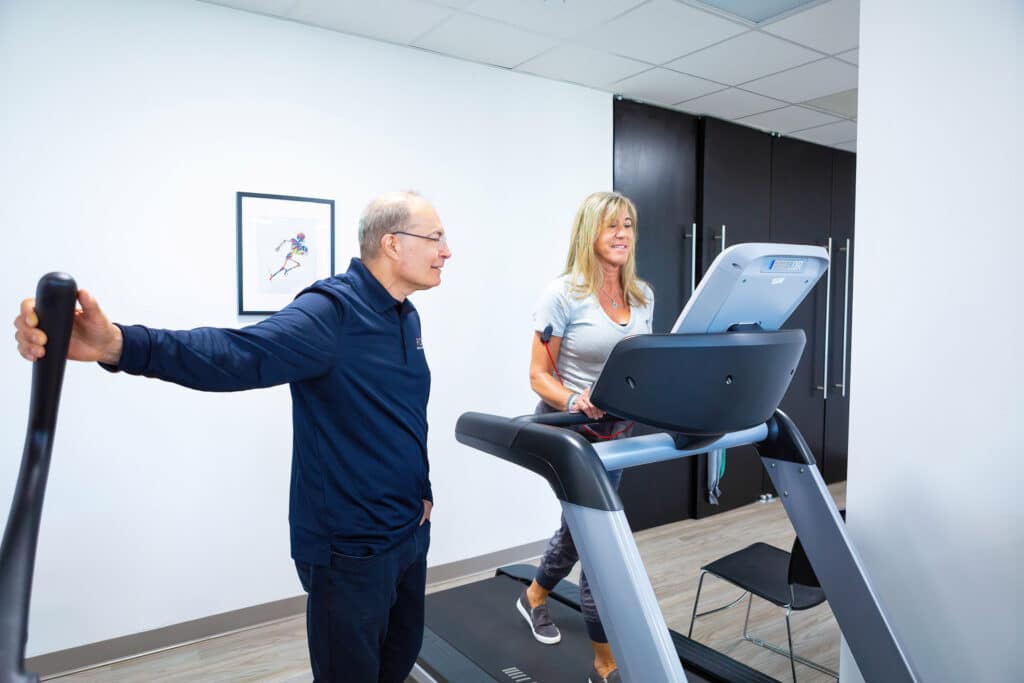
Gait analysis is a way of studying how you walk or run to understand your movement patterns. It looks at how your feet hit the ground, how your legs move, and how your body stays balanced. The goal is to identify any imbalances or issues that could lead to injuries, like shin splints or knee pain.
During a gait analysis, a specialist might watch you walk or run or use technology like a treadmill and cameras to get a detailed view. Based on the results, they might recommend specific shoes, insoles, or exercises to improve your form and reduce the risk of injury.
Meet Our Sports Medicine Doctors
Advanced Treatment Options for Shin Splints
If basic treatments aren't effective, your specialist may suggest advanced interventions. These may include:
Physical therapy: A physical therapist can guide you through exercises that strengthen the muscles supporting your shins and improve your flexibility.
Custom orthotics: If flat feet or high arches are contributing to your shin splints, custom shoe inserts can provide the support you need.
Long-Term Treatment and Prevention
Once you've recovered from shin splints, it's important to make long-term adjustments to avoid future injuries. Follow these tips:
Stick to a well-rounded workout routine: To help give our legs a break from high-impact activities you can ncorporate low-impact exercises like cycling or swimming into your routine.
Continue strengthening and stretching: Regularly strengthening the muscles in your legs and stretching your calves and Achilles tendons can reduce stress on your shins.
Cross-train: Mix up your workouts with different types of exercise to avoid overloading your shins with repetitive impact.
Shin Splints Don't Have to Hold You Back
Shin splints can definitely be painful and frustrating especially if you're in the middle of training, but with the right treatment and preventative strategies, you can recover and get back to your favorite activities. Remember, rest is key to healing, and making gradual changes, instead of sudden, to your workout routine can help you avoid shin splints in the future. If your symptoms persist, don't hesitate to seek help from a sports medicine specialist, who can provide a tailored treatment plan to get you back on track.
This blog post is meant to be informative and should not act as a self-diagnosis tool. If you’d like to see one of our doctors, please contact us here.
You Tore a Muscle - Now What?
Muscle tears, a common concern for many, can disrupt your routine and hinder daily activities. We'll unravel the intricacies of muscle tears—defining what they are, examining causes, understanding symptoms, and crucially, guiding you on when it's suitable for at-home treatment versus seeking professional assistance to heal a torn muscle. A comprehensive understanding of the severity of a muscle tear is vital for targeted treatment and a swift recovery.
What is a Torn Muscle?
Before we unravel the dynamics of a muscle tear, it's essential to grasp the basics. A torn muscle, scientifically known as a muscle strain or rupture, refers to the damage or tearing of muscle fibers. Muscles are bundles of fibers that work harmoniously to facilitate movement. When these fibers are subjected to excessive force or stretched beyond their capacity, they can sustain microscopic or macroscopic tears.
Why you can trust us:
We have experienced orthopedic doctors who can help you with muscle tears and other orthopaedic injuries.
Our doctors have decades of combined experience.
We have a whole-body health approach and provide personalized care and customized treatment.
Here are common symptoms associated with a muscle tear:
PAIN
Persistent or acute pain, especially during movement or when pressure is applied to the affected area.
SWELLING
Persistent or acute pain, especially during movement or when pressure is applied to the affected area.
BRUISING
Discoloration or bruising may occur due to internal bleeding caused by the tear.
MUSCLE WEAKNESS
Reduced strength in the injured muscle, making it challenging to perform regular activities.
LIMITED RANGE OF MOTION
Difficulty moving the affected muscle or joint due to pain and stiffness.
CRAMPING OR MUSCLE SPASMS
Uncontrollable contractions or spasms in the injured muscle.
TENDERNESS TO TOUCH
Increased sensitivity and tenderness when touching or applying pressure to the affected area.
MUSCLE DEFORMITY
In severe cases, a visible deformity or irregular shape in the muscle may be noticeable.
It's important to note that the severity of symptoms can vary based on the extent of the muscle tear, ranging from mild discomfort to significant pain and functional limitations. If you suspect a muscle tear, seeking professional medical advice is crucial for an accurate diagnosis and appropriate, timely treatment.
How Does a Muscle Tear Happen?
Muscle tears can occur for various reasons, often associated with sudden or forceful movements.
Here are some common scenarios:
Overexertion: Pushing your muscles beyond their limits, especially during intense workouts or physical activities, can lead to tears.
Trauma: Direct impact or injury to a muscle, such as a fall or collision, can cause tearing.
Improper Warm-up: Inadequate warm-up before physical activities can leave muscles less flexible and more prone to tears.
Repetitive Strain: Engaging in repetitive motions, common in certain sports or occupational activities, may contribute to muscle tears over time.
Why Does a Torn Muscle Happen?
Understanding the factors that contribute to muscle tears is crucial for prevention.
Some common reasons include:
Age: As we age, our muscles may lose elasticity and become more susceptible to tears.
Dehydration: Inadequate hydration can impair muscle function, making them more prone to injuries.
Muscle Imbalances: Weak or tight muscles can create imbalances, increasing the risk of tears.
Fatigue: Tired muscles are more vulnerable to injuries, emphasizing the importance of rest and recovery.
What Do You Do For A Torn Muscle
Determining whether to treat a muscle tear at home or seek professional help depends on the severity of the injury. Here are some things to consider when thinking about fixing a torn muscle at home or deciding when to see an orthopedic doctor for a torn muscle.
The path for fixing a torn muscle depends on the severity of the muscle tear.
Mild Muscle Tear (Grade I):
Symptoms: Mild pain, minimal swelling.
Treatment: Rest, ice, compression, and elevation (R.I.C.E). Over-the-counter pain relievers may be sufficient.
Moderate Muscle Tear (Grade II):
Symptoms: Noticeable pain, swelling, and potential bruising.
Treatment: R.I.C.E, but medical evaluation is advisable. Physical therapy may be recommended.
Severe Muscle Tear (Grade III):
Symptoms: Intense pain, significant swelling, and possible muscle deformity.
Treatment: Seek immediate medical attention. Surgical intervention may be necessary.
How Bad is My Muscle Tear?
Assessing the severity of a muscle tear involves considering both symptoms and functional limitations:
Severe: Excruciating pain, potential inability to use the affected muscle.
Swelling:
Mild: Minimal swelling.
Moderate: Noticeable swelling around the injured area.
Severe: Pronounced swelling, potential deformity.
Functional Limitations
Mild: Minimal impact on movement.
Moderate: Difficulty moving the affected muscle.
Severe: Complete loss of function, inability to bear weight.
In conclusion, a muscle tear is a nuanced injury that requires careful consideration of its nature and severity for effective management. While mild muscle tears can often be treated at home with rest and self-care measures, for moderate to severe muscle tears with moderate to severe symptoms, we recommend seeing an orthopaedic doctor. Listening to your body, seeking timely medical advice, and following a structured recovery plan are key steps toward fixing a muscle tear and reclaiming your active lifestyle. Remember, patience and proper care are your allies on the road to recovery.