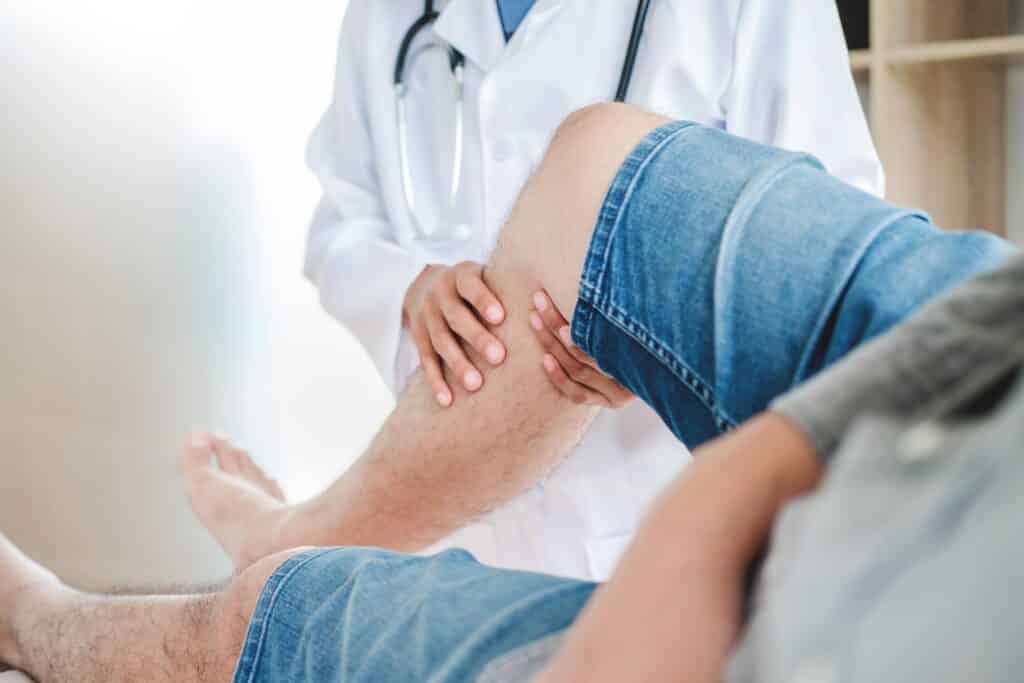
An injury can cause knee pain to appear all at once, or it may be the result of an underlying condition and general wear and tear that has set in over time. Given the complexity of the joint and its role in everything from walking and climbing stairs to bending and general activity, such discomfort is bound to have an impact on day to day living.
While a course of rest, some modification of one’s activities and rehabilitation will see to it that certain knee issues are resolved, there are cases that call for timely medical intervention. This is particularly true when one is dealing with recurrent pain, swelling, an inability to put weight on the leg or a sense of instability.
To get the proper treatment and make a safe return to being active, it is important first to have an understanding of what might be behind the symptoms.
Senior holding his painful knee
Important Points About Knee Pain
Knee pain may be caused by an injury, overuse, arthritis, tendon problems, bursitis, or irritation in the kneecap joint.
Symptoms such as swelling, locking, catching, or the knee giving way can point to a more specific knee condition.
Pain in the front of the knee is often linked to the kneecap and can become worse with stairs, squatting, or sitting for long periods.
Sudden pain after twisting, pivoting, or a direct blow may suggest a ligament, cartilage, or meniscus injury.
Age, activity level, body mechanics, and prior injury all play a role in knee pain.
Many knee problems can be treated without surgery through physical therapy, anti-inflammatory treatment, bracing, and changes in activity.
Osteoarthritis becomes more common with age and can cause stiffness, swelling, and pain during activity.
Overuse injuries are common in both athletes and non-athletes, especially when movement patterns or muscle support are off balance.
You should seek medical care if pain is severe, your knee is unstable, or symptoms do not improve.
Early evaluation can help prevent minor knee issues from becoming long-term problems.
Why Knee Pain Is So Common
As one of the body’s largest joints, the knee is put to work on a daily basis and must take on considerable force. For it to function without issue, it depends on an interplay of bones, cartilage, ligaments, tendons, muscles and bursae, or cushioning sacs.
Should any of those components become overloaded, inflamed, injured or simply worn out, pain is the result. One can often discern the source of the problem from where the pain is felt, the manner in which it came on and what kind of activity tends to aggravate it.
How Doctors Think About Knee Pain
One way to categorise knee pain is by its location and whether it came on as a result of an injury or in a more gradual fashion. Take front-of-knee pain, for instance; that can be indicative of patellofemoral issues. Then there is the matter of pain along the joint line which might give one cause for concern regarding a meniscus tear or arthritis.
The nature of the symptoms also tells you something. A case of swelling setting in right after an injury is likely to mean there is some damage within the joint. On the other hand, if the pain has been getting worse over the course of several months, it is more in keeping with what one would expect from overuse, degeneration or arthritis.
Frequent Causes of Knee Pain
There are many possible reasons for knee pain. Some are related to sports and trauma, while others are tied to wear and tear, biomechanics, or inflammation.
Condition
What It Means
Common Symptoms
Sprain or strain
Stretching or tearing of a ligament, tendon, or muscle
Pain, swelling, tenderness, limited motion
Meniscus tear
Injury to the cartilage that cushions the knee joint
Joint line pain, swelling, catching, locking
Ligament injury
Damage to structures such as the ACL, PCL, MCL, or LCL
Instability, swelling, pain after a twist or impact
Patellofemoral pain
Irritation involving the kneecap and the groove it moves through
Front knee pain, pain with stairs, squatting, and sitting
Tendinitis
Inflammation or irritation of a tendon
Pain with activity, tenderness, soreness near tendon
Bursitis
Inflammation of a small fluid-filled sac near the joint
Localized swelling, warmth, pain with pressure or movement
Osteoarthritis
Breakdown of joint cartilage over time
Stiffness, swelling, aching, reduced mobility
Fracture
A broken bone around the knee
Severe pain, swelling, inability to bear weight
Injuries That Can Trigger Sudden Knee Pain
Acute knee pain often starts after a specific event. A fall, collision, twist, awkward landing, or sudden stop can injure soft tissue or bone in and around the knee.
Ligament injuries: These include injuries to the ACL, PCL, MCL, and LCL. They may cause a pop, rapid swelling, or a feeling of knee instability.
Meniscus tears: The meniscus is a C-shaped piece of cartilage that helps cushion the joint. A tear can happen with twisting and may cause pain, swelling, or locking.
Tendon injuries: Tendons connect muscle to bone. Sudden force can strain or tear them, leading to pain and weakness.
Fractures: A direct blow or fall can lead to a broken kneecap or fracture of the bones around the joint.
Conditions That Cause Knee Pain Over Time
Not all knee pain starts with an injury. In many cases, symptoms develop gradually due to repetitive stress, joint aging, muscle imbalances, or inflammation.
Osteoarthritis: This is one of the most common causes of chronic knee pain. It happens when joint cartilage wears down, often leading to aching, stiffness, and swelling.
Patellofemoral pain syndrome: This refers to pain around or behind the kneecap. It can be linked to overuse, muscle imbalance, alignment issues, or cartilage irritation.
Tendinitis: Repeated strain can irritate the patellar tendon or quadriceps tendon, especially in people who jump, run, kneel, or climb often.
Bursitis: Kneeling for long periods or repeated pressure on the front of the knee can inflame a bursa and cause visible swelling and soreness.
Iliotibial band-related pain: Irritation along the outer side of the knee may develop with repetitive movement, especially in runners and cyclists.
What the Symptoms May Feel Like
Knee pain can feel very different depending on the cause. The symptoms may be sharp or dull, constant or only present during certain activities.
Aching or stiffness, especially in the morning or after sitting
Swelling around the joint
Pain with stairs, squatting, kneeling, or getting up from a chair
Clicking, catching, or locking
A sense that the knee may buckle or give way
Tenderness in one small area or pain deep inside the knee
Difficulty fully straightening or bending the knee
When an injury is accompanied by marked swelling, a deformity that can be seen, or the knee is hot or red and swollen, it is best to opt for an urgent or emergency medical assessment over routine care. The same applies if one has a fever or cannot put weight on the leg. In particular, a very swollen, hot and red knee in the presence of fever or general malaise may be a sign of infection and warrants immediate evaluation.
How Knee Pain Is Diagnosed
We typically start a comprehensive evaluation by having you tell us your story. It is important for us to understand the nature of the pain, its location and what movements aggravate or relieve it, as well as when it first set in and if an injury was involved.
From there the physical exam will cover such things as strength, alignment and joint stability, not to mention any swelling or tenderness and how much range of motion is present. In some cases, should the symptoms warrant it, we will put you down for an X-ray or MRI to get a better view of the bone, cartilage or soft tissue.
What Your Evaluation May Include
Review of when symptoms began and how they have changed
Physical exam of the knee and nearby joints
Assessment of walking, strength, flexibility, and stability
X-rays when arthritis or fracture is a concern
MRI when soft tissue injury, cartilage damage, or meniscus tears are suspected
Treatment Options for Knee Pain
Treatment depends on the cause of your knee pain, its severity, and how much it affects your daily life. Many patients improve with non-surgical care, especially when treatment starts early.
Treatment
How It Helps
When It May Be Used
Rest and activity changes
Reduces strain on the knee
Overuse pain, early flare-ups, and minor injuries
Ice and anti-inflammatory treatment
Helps calm pain and swelling. Anti-inflammatory medicines such as NSAIDs may help some patients, but they are not safe for everyone.
Acute injuries and inflamed conditions. People with kidney disease, stomach ulcers or bleeding risk, use of blood thinners, significant heart disease, uncontrolled high blood pressure, or pregnancy should ask a clinician before using NSAIDs.
Physical therapy
Improves strength, flexibility, and movement patterns
Many knee conditions, including arthritis and overuse injuries
Bracing or support
Adds stability or unloads part of the joint
Instability, arthritis, or return to activity
Injections
May reduce inflammation or pain in selected cases
Certain arthritic or inflammatory conditions
Surgery
Repairs or reconstructs damaged structures when needed
Some fractures, ligament tears, meniscus tears, or advanced joint damage
Non-Surgical Care Often Starts Here
Reduce or pause activities that clearly worsen the pain
Use ice after activity if swelling is present
Begin guided exercises to restore motion and support around the knee
Address hip, core, and leg strength if mechanics are contributing
Consider footwear, surfaces, training load, and work demands
When Knee Surgery May Be Considered
There are instances where conservative measures are not enough to bring about an improvement in certain knee conditions. In such cases, one might be advised to have surgery. This is typically the course of action when faced with severe arthritis, marked structural damage or instability, and pain that is persistent enough to take a toll on one’s quality of life.
As for the procedure itself, what is called for will hinge on the diagnosis. Options can be as varied as arthroscopic work or a full joint replacement for advanced arthritis, up to ligament reconstruction. The objective is to put together a care plan that is suited to the condition at hand as well as your own activity level.
When You Should See a Knee Specialist
You should schedule an evaluation if your knee pain is severe, keeps returning, or affects your ability to move normally. Even if symptoms seem manageable at first, ongoing pain can lead to compensation and additional strain elsewhere.
Pain lasts more than several days or continues to worsen
You notice swelling, warmth, or reduced range of motion
Your knee feels unstable, locks, or gives way
You cannot return to exercise, work, or daily activity comfortably
Useful for non-surgical management and rehabilitation planning
Getting Back to Comfortable Movement
There is no denying that knee pain has a way of getting in the way of everyday activities, be it walking or exercising, and can affect one’s work, sleep and general confidence when on the move. Fortunately, with proper evaluation and a sound care plan, the underlying causes of such pain are often amenable to effective treatment.
Should the symptoms fail to abate, an exam is in order to get to the bottom of what is behind the knee pain.
This blog post is meant to be informative and should not act as a self-diagnosis tool. If you’d like to see one of our doctors, please contact us here.
Sequence rules uses cookies to track the order of requests a user has made and the time between requests and makes them available via Cloudflare Rules. This allows you to write rules that match valid or invalid sequences. The specific cookies used to validate sequences are called sequence cookies.
session
cf_ob_info
The cf_ob_info cookie provides information on: The HTTP Status Code returned by the origin web server. The Ray ID of the original failed request. The data center serving the traffic
session
cf_use_ob
The cf_use_ob cookie informs Cloudflare to fetch the requested resource from the Always Online cache on the designated port. Applicable values are: 0, 80, and 443. The cf_ob_info and cf_use_ob cookies are persistent cookies that expire after 30 seconds.
session
__cfwaitingroom
The __cfwaitingroom cookie is only used to track visitors that access a waiting room enabled host and path combination for a zone. Visitors using a browser that does not accept cookies cannot visit the host and path combination while the waiting room is active.
session
cf_chl_rc_i
These cookies are for internal use which allows Cloudflare to identify production issues on clients.
session
cf_chl_rc_ni
These cookies are for internal use which allows Cloudflare to identify production issues on clients.
session
cf_chl_rc_m
These cookies are for internal use which allows Cloudflare to identify production issues on clients.
session
__cfruid
Used by the content network, Cloudflare, to identify trusted web traffic.
session
__cf_bm
Cloudflare's bot products identify and mitigate automated traffic to protect your site from bad bots. Cloudflare places the __cf_bm cookie on End User devices that access Customer sites that are protected by Bot Management or Bot Fight Mode. The __cf_bm cookie is necessary for the proper functioning of these bot solutions.
session
__cflb
When enabling session affinity with Cloudflare Load Balancer, Cloudflare sets a __cflb cookie with a unique value on the first response to the requesting client. Cloudflare routes future requests to the same origin, optimizing network resource usage. In the event of a failover, Cloudflare sets a new __cflb cookie to direct future requests to the failover pool.
session
_cfuvid
The _cfuvid cookie is only set when a site uses this option in a Rate Limiting Rule, and is only used to allow the Cloudflare WAF to distinguish individual users who share the same IP address.
session
cf_clearance
Whether a CAPTCHA or Javascript challenge has been solved.
session
Google reCAPTCHA helps protect websites from spam and abuse by verifying user interactions through challenges.
Name
Description
Duration
_GRECAPTCHA
Google reCAPTCHA sets a necessary cookie (_GRECAPTCHA) when executed for the purpose of providing its risk analysis.
179 days
Google Tag Manager simplifies the management of marketing tags on your website without code changes.
Name
Description
Duration
cookiePreferences
Registers cookie preferences of a user
2 years
td
Registers statistical data on users' behaviour on the website. Used for internal analytics by the website operator.
session
These cookies are used for managing login functionality on this website.
Name
Description
Duration
wordpress_logged_in
Used to store logged-in users.
Persistent
wordpress_sec
Used to track the user across multiple sessions.
15 days
wordpress_test_cookie
Used to determine if cookies are enabled.
Session
WPForms is a user-friendly WordPress plugin for creating custom forms with drag-and-drop functionality.
Name
Description
Duration
wpfuuid
Used to track user interactions with forms.
11 years
Statistics cookies collect information anonymously. This information helps us understand how visitors use our website.
Google Analytics is a powerful tool that tracks and analyzes website traffic for informed marketing decisions.
Used to distinguish new sessions and visits. This cookie is set when the GA.js javascript library is loaded and there is no existing __utmb cookie. The cookie is updated every time data is sent to the Google Analytics server.
30 minutes after last activity
__utmc
Used only with old Urchin versions of Google Analytics and not with GA.js. Was used to distinguish between new sessions and visits at the end of a session.
End of session (browser)
__utmz
Contains information about the traffic source or campaign that directed user to the website. The cookie is set when the GA.js javascript is loaded and updated when data is sent to the Google Analytics server
6 months after last activity
__utmv
Contains custom information set by the web developer via the _setCustomVar method in Google Analytics. This cookie is updated every time new data is sent to the Google Analytics server.
2 years after last activity
__utmx
Used to determine whether a user is included in an A / B or Multivariate test.
18 months
_ga
ID used to identify users
2 years
_gali
Used by Google Analytics to determine which links on a page are being clicked
30 seconds
_ga_
ID used to identify users
2 years
_gid
ID used to identify users for 24 hours after last activity
24 hours
_gat
Used to monitor number of Google Analytics server requests when using Google Tag Manager
1 minute
_gac_
Contains information related to marketing campaigns of the user. These are shared with Google AdWords / Google Ads when the Google Ads and Google Analytics accounts are linked together.
90 days
__utma
ID used to identify users and sessions
2 years after last activity
__utmt
Used to monitor number of Google Analytics server requests
10 minutes
These cookies help us measure the effectiveness of our website content and understand how visitors find and use our site. This allows us to improve the experience and provide more helpful resources.
Facebook Pixel is a web analytics service that tracks and reports website traffic.