Tailbone Pain Can Make Sitting, Driving, and Daily Life Uncomfortable
There is a certain difficulty to everyday tasks when one has tailbone pain, or coccydynia. Sitting at work, rising from the bed, even just leaning back in a chair can become trying. While it often follows an injury such as a fall or is a consequence of childbirth, there are times it will develop with no obvious cause.
The tailbone is the lowest part of the spine and what bears your weight when you sit or recline. An irritation or injury to that small region is felt all the more acutely since any movement tends to put pressure on it.
Understanding the symptoms and what might be behind them is useful in determining whether home care will suffice or if a trip to the doctor is in order. For the most part, treatment is a matter of easing the pressure and letting the inflammation subside. Should the pain persist or have a habit of returning, a specialist can pinpoint the source and advise on how best to proceed.
Key Facts to Know About Tailbone Pain
What You Should Know
Tailbone pain is called coccydynia, which means pain in the coccyx, or tailbone.
Common causes include falls, direct impact, prolonged sitting on hard surfaces, and childbirth.
Pain is often worst when sitting, leaning back, or moving from sitting to standing.
Symptoms may improve with activity changes, cushions, heat or ice, and anti-inflammatory medication when appropriate.
Persistent pain may be related to joint inflammation, abnormal movement of the tailbone, or less commonly, another underlying condition.
Evaluation may include a physical exam and imaging if symptoms don’t improve or if the cause isn’t clear.
Treatment can include physical therapy, medication, activity modification, and in select cases, injections or surgery.
You should seek medical care if pain is severe, lasts for weeks, or is accompanied by fever, numbness, weakness, or bowel or bladder changes.
What Is the Tailbone?
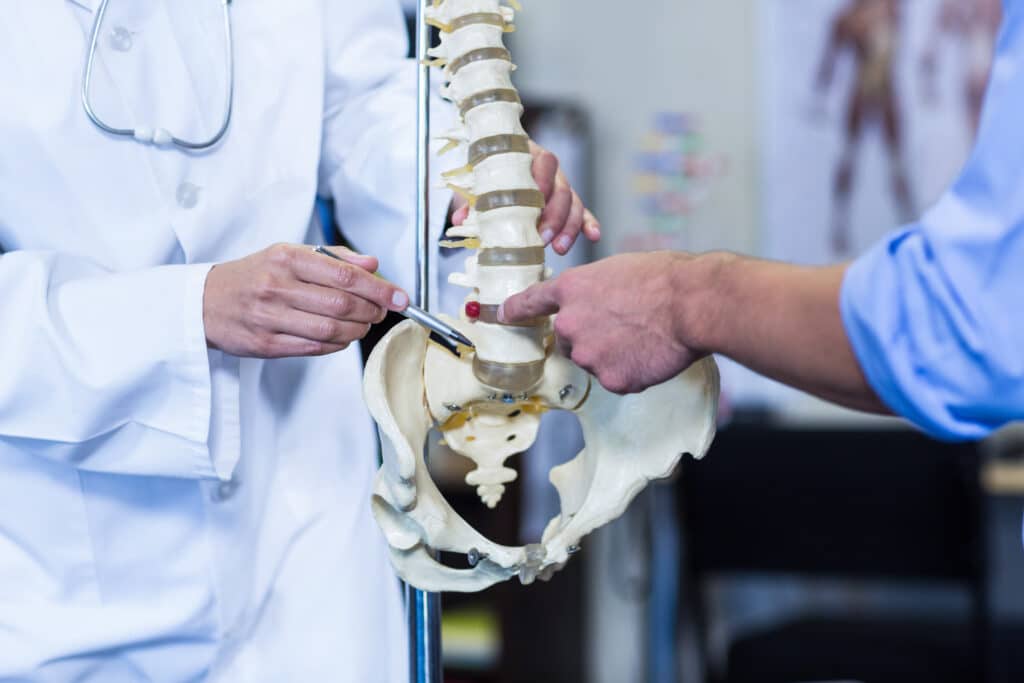
At the base of the spine is the coccyx, a small triangular bone more commonly known as the tailbone. Composed of a number of tiny segments, it is positioned directly under the sacrum, the wide bone that lies between the hips.
Do not let its size fool you; the tailbone is put to good use. It acts as an anchor for the ligaments and tendons of the pelvic floor, among other things, and is there to take some of the weight when one is seated and leaning back.
This is also what makes it so sensitive. The area is subject to pressure in the sitting position, so even a little bit of irritation can be enough to put a crimp in your day. For that reason, pain in the tailbone has a way of interfering with sleep, exercise and travel, not to mention work.
What Does Tailbone Pain Feel Like?
Tailbone pain usually feels like a deep ache or sharp soreness at the very bottom of the spine. Many people notice it most when sitting on a hard chair, leaning backward, or standing up after sitting for a while.
Pain centered at the tailbone
Worse discomfort with sitting or rising from a chair
Tenderness when touching the area
Pain during bowel movements or sexual activity in some cases
More discomfort with long drives or prolonged sitting
Some people feel pain most of the time, while others notice it mainly with pressure or in certain positions. Symptoms can range from mild irritation to more severe pain that disrupts daily routines.
Common Causes of Tailbone Pain
There are few more common causes of tailbone pain than a direct injury. A hard fall on ice, or even an awkward landing in a seated position, is enough to bruise the area and put a strain on the tissues around it.
Then there is the matter of childbirth, which can place its own pressure on the coccyx and adjacent ligaments. And for some, the symptoms may be set off by the cumulative effect of sitting too long on a surface that is hard or too narrow.
Falls or direct trauma
Childbirth
Prolonged sitting
Inflammation of the tailbone joint or nearby soft tissue
Abnormal motion of the coccyx
Less commonly, infection or tumor
When Tailbone Pain Happens Without a Clear Injury
For some, coccydynia is not the result of any one particular incident or accident. The pain may be more insidious in nature, developing gradually as the tailbone endures its share of pressure.
One might put undue strain on the coccyx through body mechanics and posture, or by way of irritation to the soft tissue and adjacent joints. That is why a thorough examination is called for if the symptoms are not abating as they should.
How Tailbone Pain Is Evaluated
In the course of an examination, a provider is likely to first put some questions to you as to when the pain set in and what aggravates it. They will want to know if there was any inciting incident such as a fall or childbirth. The physical exam itself might involve a check for tenderness and an assessment of the lower back and pelvis for other potential causes of the discomfort.
Evaluation Step
What It Helps Identify
Medical history
Recent injury, childbirth, prolonged sitting, or symptom pattern
Physical exam
Tenderness, swelling, and whether pain is truly coming from the tailbone
X-rays or other imaging
Fracture, alignment problems, or unusual movement of the coccyx when needed
Further testing in selected cases
Possible infection, tumor, or another uncommon cause
Ways to Relieve Tailbone Pain at Home
There are simple measures one can take to put less strain on the coccyx and soothe any irritation, and for many it is an effective way to find relief. The objective is to let the area have some respite by steering clear of postures that would only aggravate it. In terms of comfort, such minor adjustments can be all it takes to make a world of difference.
Use a cushion made to offload direct pressure from the coccyx, such as a coccyx-relief cushion or a wedge cushion with a rear cut-out
Lean forward slightly when sitting if that feels more comfortable
Avoid sitting for long stretches without standing up and moving around
Try ice or heat, depending on which feels better for your symptoms
Use anti-inflammatory medication only if it is appropriate for you and recommended by your doctor
These steps are often enough for mild cases, especially soon after an injury. If pain does not clearly improve, it is best to get evaluated rather than pushing through discomfort.
Medical Treatment for Lasting Tailbone Pain
If symptoms continue, treatment may go beyond home care. The best option depends on the cause of your pain, how long symptoms have been going on, and how much it affects daily function.
Physical therapy to improve posture, sitting mechanics, and surrounding muscle tension
Medication for pain and inflammation when appropriate
Targeted injections in select cases when pain remains significant
Surgery in rare cases when symptoms are severe, persistent, and caused by a problem unlikely to improve with other care
Most people do not need surgery. Conservative treatment is usually tried first, and many patients improve once pressure and inflammation are addressed.
When to See a Doctor
You should not ignore tailbone pain that is intense, keeps coming back, or makes it hard to sit, work, travel, or sleep comfortably.
Pain that lasts more than a few weeks
Severe pain after a fall or other injury
Fever, redness, or drainage near the area
Numbness, weakness, or pain that seems to involve the legs
Changes in bowel or bladder function
Pain that is getting worse, especially at night or when you are resting
Unexplained weight loss
A history of cancer
Immunosuppression, such as from certain medicines or conditions
Symptoms that do not improve with rest and pressure relief
These signs can mean you need more evaluation to rule out a fracture, infection, or another condition affecting the area.
What Recovery May Look Like
Recovery depends on the cause of the pain and how long symptoms have been present. A bruise or mild strain may improve with time and pressure relief, while ongoing irritation can take longer and may need more structured treatment.
Situation
General Recovery Pattern
Notes
Mild irritation or bruise
Often improves over weeks; some cases take longer
Pressure relief and activity changes are usually helpful
Ongoing inflammation
May last weeks to months
May need medical evaluation and physical therapy
Persistent or unusual symptoms
Varies depending on the cause
Further testing may be needed to guide treatment
Getting Help for Tailbone Pain
There is no reason to let tailbone pain get in the way of your day to day routine; have it looked at. We will put you through an examination to see if the source of the discomfort is the coccyx or some other adjacent structure, and from there can point you in the direction of treatments that will ease your symptoms and make sitting and moving about more comfortable.
For a proper diagnosis and a plan of action suited to your case, we recommend making an appointment for an exam should you be dealing with any lingering pain at the base of the spine.
This blog post is meant to be informative and should not act as a self-diagnosis tool. If you’d like to see one of our doctors, please contact us here.
Sequence rules uses cookies to track the order of requests a user has made and the time between requests and makes them available via Cloudflare Rules. This allows you to write rules that match valid or invalid sequences. The specific cookies used to validate sequences are called sequence cookies.
session
cf_ob_info
The cf_ob_info cookie provides information on: The HTTP Status Code returned by the origin web server. The Ray ID of the original failed request. The data center serving the traffic
session
cf_use_ob
The cf_use_ob cookie informs Cloudflare to fetch the requested resource from the Always Online cache on the designated port. Applicable values are: 0, 80, and 443. The cf_ob_info and cf_use_ob cookies are persistent cookies that expire after 30 seconds.
session
__cfwaitingroom
The __cfwaitingroom cookie is only used to track visitors that access a waiting room enabled host and path combination for a zone. Visitors using a browser that does not accept cookies cannot visit the host and path combination while the waiting room is active.
session
cf_chl_rc_i
These cookies are for internal use which allows Cloudflare to identify production issues on clients.
session
cf_chl_rc_ni
These cookies are for internal use which allows Cloudflare to identify production issues on clients.
session
cf_chl_rc_m
These cookies are for internal use which allows Cloudflare to identify production issues on clients.
session
__cfruid
Used by the content network, Cloudflare, to identify trusted web traffic.
session
__cf_bm
Cloudflare's bot products identify and mitigate automated traffic to protect your site from bad bots. Cloudflare places the __cf_bm cookie on End User devices that access Customer sites that are protected by Bot Management or Bot Fight Mode. The __cf_bm cookie is necessary for the proper functioning of these bot solutions.
session
__cflb
When enabling session affinity with Cloudflare Load Balancer, Cloudflare sets a __cflb cookie with a unique value on the first response to the requesting client. Cloudflare routes future requests to the same origin, optimizing network resource usage. In the event of a failover, Cloudflare sets a new __cflb cookie to direct future requests to the failover pool.
session
_cfuvid
The _cfuvid cookie is only set when a site uses this option in a Rate Limiting Rule, and is only used to allow the Cloudflare WAF to distinguish individual users who share the same IP address.
session
cf_clearance
Whether a CAPTCHA or Javascript challenge has been solved.
session
Google reCAPTCHA helps protect websites from spam and abuse by verifying user interactions through challenges.
Name
Description
Duration
_GRECAPTCHA
Google reCAPTCHA sets a necessary cookie (_GRECAPTCHA) when executed for the purpose of providing its risk analysis.
179 days
Google Tag Manager simplifies the management of marketing tags on your website without code changes.
Name
Description
Duration
cookiePreferences
Registers cookie preferences of a user
2 years
td
Registers statistical data on users' behaviour on the website. Used for internal analytics by the website operator.
session
These cookies are used for managing login functionality on this website.
Name
Description
Duration
wordpress_logged_in
Used to store logged-in users.
Persistent
wordpress_sec
Used to track the user across multiple sessions.
15 days
wordpress_test_cookie
Used to determine if cookies are enabled.
Session
WPForms is a user-friendly WordPress plugin for creating custom forms with drag-and-drop functionality.
Name
Description
Duration
wpfuuid
Used to track user interactions with forms.
11 years
Statistics cookies collect information anonymously. This information helps us understand how visitors use our website.
Google Analytics is a powerful tool that tracks and analyzes website traffic for informed marketing decisions.
Used to distinguish new sessions and visits. This cookie is set when the GA.js javascript library is loaded and there is no existing __utmb cookie. The cookie is updated every time data is sent to the Google Analytics server.
30 minutes after last activity
__utmc
Used only with old Urchin versions of Google Analytics and not with GA.js. Was used to distinguish between new sessions and visits at the end of a session.
End of session (browser)
__utmz
Contains information about the traffic source or campaign that directed user to the website. The cookie is set when the GA.js javascript is loaded and updated when data is sent to the Google Analytics server
6 months after last activity
__utmv
Contains custom information set by the web developer via the _setCustomVar method in Google Analytics. This cookie is updated every time new data is sent to the Google Analytics server.
2 years after last activity
__utmx
Used to determine whether a user is included in an A / B or Multivariate test.
18 months
_ga
ID used to identify users
2 years
_gali
Used by Google Analytics to determine which links on a page are being clicked
30 seconds
_ga_
ID used to identify users
2 years
_gid
ID used to identify users for 24 hours after last activity
24 hours
_gat
Used to monitor number of Google Analytics server requests when using Google Tag Manager
1 minute
_gac_
Contains information related to marketing campaigns of the user. These are shared with Google AdWords / Google Ads when the Google Ads and Google Analytics accounts are linked together.
90 days
__utma
ID used to identify users and sessions
2 years after last activity
__utmt
Used to monitor number of Google Analytics server requests
10 minutes
These cookies help us measure the effectiveness of our website content and understand how visitors find and use our site. This allows us to improve the experience and provide more helpful resources.
Facebook Pixel is a web analytics service that tracks and reports website traffic.