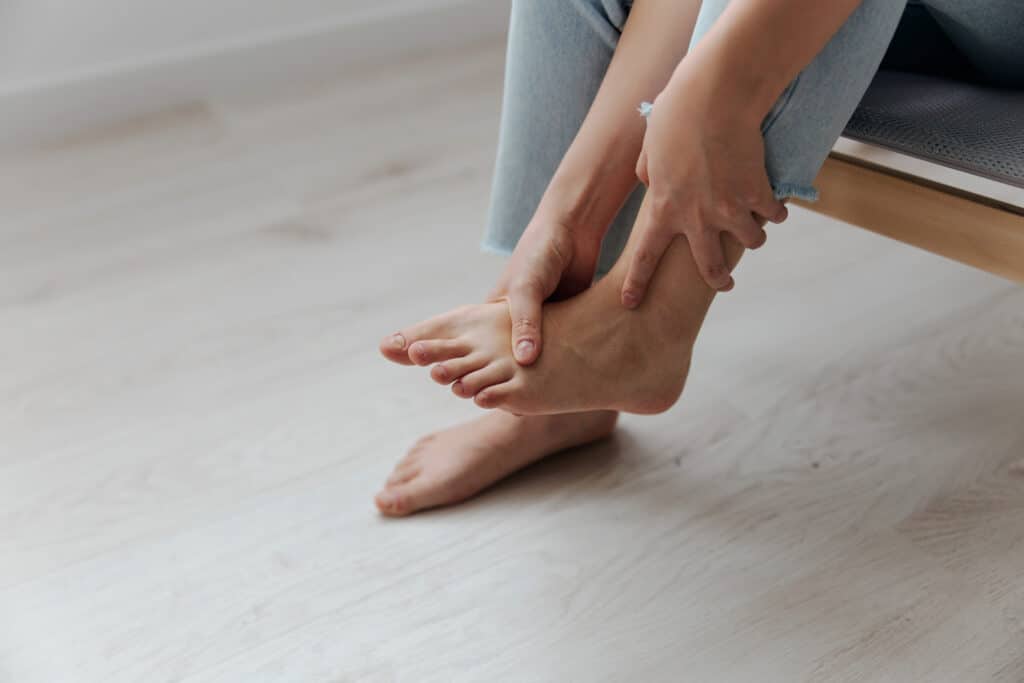
Numbness in feet often gets ignored, usually because it doesn't hurt. Here's the order we'd work through it: what to track at home, how to check your shoes, which symptoms need care the same day, what the location tells us, how we protect a foot that can't feel, and what an exam with our team involves.
Loss of feeling changes how you walk. You push off differently, your balance shifts a little, and small cuts or blisters go unnoticed because nothing tells you they're there. That's the real risk. We'd rather see you early.
The short version
Footwear is a common reason feet and toes lose feeling, and it's often the simplest thing to change.
Where the numbness sits on your foot points us toward which nerve is involved.
Diabetes is a common cause of nerve damage in the feet, and the early changes can be easy to miss.
Some numbness is an emergency: sudden onset, spreading numbness, weakness, or a pale and cold foot.
Many causes respond to non-surgical care, starting with shoes, inserts, and activity changes.
A foot you can't feel needs a daily look, because wounds won't announce themselves.
Step 1: Track when the numbness in feet shows up
Numbness that comes and goes has a story attached to it, and the pattern often points us toward the cause faster than any single test will. If none of the urgent symptoms below apply, spend a few days paying attention before your visit. Keep notes on your phone as things happen, rather than trying to remember later. These are the details that help us most:
Which toes or which part of the foot loses feeling
What you were doing when it started, including the shoes you had on
How long it lasts, and whether it fades within minutes or sticks around for hours
Whether anything brings the feeling back, such as taking off your shoes or standing up and moving
Whether burning, tingling, weakness, swelling, or color changes come along with it
Whether it happens in one foot or both
Takeaway: a week of notes turns "my toes feel funny" into something we can actually test.
Step 2: Check the shoes before you blame the nerve
Shoes that are short, narrow, or shallow squeeze the nerves that run between the long bones of the forefoot and across the top of the foot. Runners often notice it first as tingling in the toes on a long run. That often means the shoe is too short or too narrow, though it's worth an exam if it keeps happening. Use these checks the next time you buy:
What to check
What a good fit looks like
Time of day
Shop late in the day or after a workout, when your feet have swollen to their largest.
Measuring
Stand while both feet are measured, then fit the larger foot. Re-measure yearly, since feet change with age.
Toe room
About half an inch, roughly a thumb's width, between your longest toe and the end of the shoe.
Width
The widest part of the shoe should sit where the ball of your foot is widest.
Depth
Deep enough that your toes aren't pressed against the top, especially with hammertoes or a bunion.
Break-in
Don't count on the upper stretching later. It should feel right in the store.
Narrow toe boxes and taller heels push the toes together and crowd the nerves. A cast or a wrap that's too snug can do the same to blood flow. Cold matters too. Cold injury to the toes can also affect feeling.
Takeaway: if the numbness eases within minutes of pulling your shoes off, footwear is the first suspect.
Step 3: Rule out the symptoms that need care today
Most numbness isn't an emergency. A few combinations are, and they're worth knowing by heart before you decide to wait out the weekend. Numbness that arrives suddenly deserves more concern than numbness that crept in over months, and anything paired with weakness should be looked at quickly.
What you notice
What to do
Numbness with facial drooping, slurred speech, vision change, or sudden weakness on one side
Call 911. These are stroke warning signs.
Leg numbness with back pain plus loss of bladder or bowel control
Emergency care now. This can mean serious pressure on the nerves in the low back.
Numbness that begins suddenly and spreads up the leg
Emergency care.
Trouble lifting the front of your foot (foot drop), or new stumbling
Urgent evaluation for a nerve problem that's progressing.
Numbness after a fall, a crash, or a direct injury to the back or leg
Urgent evaluation.
A foot that turns cold, pale, or bluish
Urgent evaluation for blood flow.
A sore, blister, or crack on a numb foot that isn't healing
Call us promptly. Sooner if you have diabetes.
Numbness that keeps returning, lasts more than a few days, or changes how you walk
Schedule an exam with our foot and ankle team.
Takeaway: sudden, spreading, or weak is the phrase to remember. Those go to the front of the line.
Step 4: Notice where the numbness sits
Sensation travels from your toes up through the leg, into the spine, and on to the brain, so trouble anywhere along that path can leave a foot feeling dull. Nerves do cover predictable territory, though. The patterns below are ones we see often, and they're a starting point for the exam rather than a diagnosis you can make at home.
Where you feel it
What we often look for
Sole, arch, or heel, worse after standing or activity and easier with rest
Tarsal tunnel syndrome, where a nerve is squeezed as it passes the inner ankle
Ball of the foot, with burning or a pebble-in-the-sock feeling
A neuroma, meaning thickened tissue around a nerve between the long forefoot bones
Inside edge of the big toe
A bunion and shoe pressure irritating the skin and nerve along that edge
Top of the foot or the top of the toes
A nerve crossing the front of the ankle, pinched by laces, straps, or swelling
Both feet, beginning in the toes, often more noticeable at night
Peripheral neuropathy, often related to diabetes
Numbness that travels from the low back or buttock down the leg
An irritated nerve root in the lumbar spine, including narrowing around the nerves
One toe after a stubbing, a drop, or a repetitive training injury
A fracture or a bruised nerve close to the injury
Numbness in feet also shows up with problems that have nothing to do with the foot's structure. Some medical conditions, certain medicines, and low vitamin levels can also affect the nerves. When the picture points that way, we'll work with your primary care provider.
Takeaway: point to the exact spot at your visit. That one gesture narrows the list quickly.
Step 5: Protect a foot that can't feel
Pain is a warning system. When it goes quiet, your eyes and hands have to do that job instead, and a short nightly routine is enough to cover it. Tie the check to something you already do, like taking your shoes off, so it doesn't get skipped. Here's a simple routine:
Sit down in good light with both shoes and socks off
Look at the tops, sides, heels, and soles, and separate the toes to see between them
Use a hand mirror on the floor, or your phone camera, for the bottoms you can't see
Watch for cuts, blisters, redness, swelling, cracked skin, darkened patches, or drainage
Run your hand over each foot, feeling for hot spots, lumps, or an area that's cooler than the rest, and compare one foot to the other
Wash with lukewarm water, dry carefully between the toes, and moisturize dry skin but not between the toes
Check your socks for holes or rough seams, and reach inside your shoes for pebbles, curled insoles, or worn lining
Wear shoes or protective slippers instead of going barefoot
If you have diabetes, have your feet checked regularly by a professional, and more often if you already have nerve changes or a history of sores. That exam checks pulses, sensation, nails, and the shape of your foot. Don't trim calluses or corns yourself with blades or medicated pads.
Takeaway: two minutes a night catches the wound you'd never feel.
Step 6: Come in and let us test the nerve
We start with your history and the notes you brought, then look at the skin, the nails, and the shape of your foot. We check the pulses, press along the inner ankle and the forefoot to see if we can reproduce your symptoms, and watch you walk.
Sensation testing is simple and painless. We check whether you can feel light touch and vibration in different parts of the foot. We'll also check strength and reflexes.
From there, X-rays can show a bunion, a fracture, or crowding in the forefoot. Nerve testing measures how well signals travel along a nerve, and we'll look at the low back when the pattern suggests the trouble starts higher up. If your case is a complicated one, we'll sort that out together in the exam room.
Takeaway: testing sensation is quick, and it gives us a starting point to compare against later.
Step 7: Start with the care that doesn't involve surgery
Treatment follows the cause, and for many foot and ankle causes the first round is non-surgical. Many patients feel better once pressure comes off the nerve and the irritation has time to settle. What we suggest depends on your exam and your activities. It also depends on what you've already tried on your own.
Roomier shoes with a wider, deeper toe box and a lower heel
An over-the-counter arch support or a custom orthotic to change how load spreads across the foot
A metatarsal pad to take pressure off an irritated nerve in the ball of the foot
Lacing changes so nothing presses on the top of the foot
A stretch of lower-impact activity, with rest and elevation after you've been on your feet, and ice only if we've said it's safe for your feet
Anti-inflammatory medicine, when your doctor says it's appropriate for you
Physical therapy for foot and ankle strength, flexibility, and balance
A brace, a splint, or a short period in a cast or boot to rest a compressed nerve
A steroid injection in selected cases, to calm inflammation around the nerve
Steady management of blood sugar, thyroid function, or a vitamin deficiency alongside your primary care provider
Surgery enters the picture when a nerve stays compressed despite good non-surgical care, or when the structure of the foot is the problem. Correcting a bunion or releasing a tight tunnel around a nerve can take the pressure off. Nerve recovery can be slow, and feeling doesn't always come back fully. That's part of why we'd rather see you before the numbness has been there for years.
Takeaway: pressure off the nerve comes first. Procedures are for the cases that don't respond.
Step 8: Keep it from coming back
Once symptoms settle, the habits that got you there tend to creep back in. Worn shoes lose their support quietly. Training volume climbs faster than your feet adapt. A little maintenance protects the ground you gained:
Replace shoes once the cushioning packs down or the tread wears unevenly
Have your feet measured each year, and bring your orthotics along when you try shoes on
Build mileage and intensity gradually rather than in jumps
Keep working on balance and lower leg strength, which matters more once sensation is reduced
Light the stairs and hallways well at home, and keep the floor clear of things you could trip on
Stay on top of any condition affecting your nerves or circulation
Takeaway: the shoe you bought last spring may not be the shoe that's helping you now.
Let's find out what's behind it
If numbness in feet or toes keeps returning, comes with weakness, or has started changing how you walk, our foot and ankle team would like to take a look. Bring your notes and bring the shoes you wear most. Schedule Exam with Princeton Orthopaedic Associates, and we'll work through it with you.
This blog post is meant to be informative and should not act as a self-diagnosis tool. If you’d like to see one of our doctors, please contact us here.
Sequence rules uses cookies to track the order of requests a user has made and the time between requests and makes them available via Cloudflare Rules. This allows you to write rules that match valid or invalid sequences. The specific cookies used to validate sequences are called sequence cookies.
session
cf_ob_info
The cf_ob_info cookie provides information on: The HTTP Status Code returned by the origin web server. The Ray ID of the original failed request. The data center serving the traffic
session
cf_use_ob
The cf_use_ob cookie informs Cloudflare to fetch the requested resource from the Always Online cache on the designated port. Applicable values are: 0, 80, and 443. The cf_ob_info and cf_use_ob cookies are persistent cookies that expire after 30 seconds.
session
__cfwaitingroom
The __cfwaitingroom cookie is only used to track visitors that access a waiting room enabled host and path combination for a zone. Visitors using a browser that does not accept cookies cannot visit the host and path combination while the waiting room is active.
session
cf_chl_rc_i
These cookies are for internal use which allows Cloudflare to identify production issues on clients.
session
cf_chl_rc_ni
These cookies are for internal use which allows Cloudflare to identify production issues on clients.
session
cf_chl_rc_m
These cookies are for internal use which allows Cloudflare to identify production issues on clients.
session
__cfruid
Used by the content network, Cloudflare, to identify trusted web traffic.
session
__cf_bm
Cloudflare's bot products identify and mitigate automated traffic to protect your site from bad bots. Cloudflare places the __cf_bm cookie on End User devices that access Customer sites that are protected by Bot Management or Bot Fight Mode. The __cf_bm cookie is necessary for the proper functioning of these bot solutions.
session
__cflb
When enabling session affinity with Cloudflare Load Balancer, Cloudflare sets a __cflb cookie with a unique value on the first response to the requesting client. Cloudflare routes future requests to the same origin, optimizing network resource usage. In the event of a failover, Cloudflare sets a new __cflb cookie to direct future requests to the failover pool.
session
_cfuvid
The _cfuvid cookie is only set when a site uses this option in a Rate Limiting Rule, and is only used to allow the Cloudflare WAF to distinguish individual users who share the same IP address.
session
cf_clearance
Whether a CAPTCHA or Javascript challenge has been solved.
session
Google reCAPTCHA helps protect websites from spam and abuse by verifying user interactions through challenges.
Name
Description
Duration
_GRECAPTCHA
Google reCAPTCHA sets a necessary cookie (_GRECAPTCHA) when executed for the purpose of providing its risk analysis.
179 days
Google Tag Manager simplifies the management of marketing tags on your website without code changes.
Name
Description
Duration
cookiePreferences
Registers cookie preferences of a user
2 years
td
Registers statistical data on users' behaviour on the website. Used for internal analytics by the website operator.
session
These cookies are used for managing login functionality on this website.
Name
Description
Duration
wordpress_logged_in
Used to store logged-in users.
Persistent
wordpress_sec
Used to track the user across multiple sessions.
15 days
wordpress_test_cookie
Used to determine if cookies are enabled.
Session
WPForms is a user-friendly WordPress plugin for creating custom forms with drag-and-drop functionality.
Name
Description
Duration
wpfuuid
Used to track user interactions with forms.
11 years
Statistics cookies collect information anonymously. This information helps us understand how visitors use our website.
Google Analytics is a powerful tool that tracks and analyzes website traffic for informed marketing decisions.
Used to distinguish new sessions and visits. This cookie is set when the GA.js javascript library is loaded and there is no existing __utmb cookie. The cookie is updated every time data is sent to the Google Analytics server.
30 minutes after last activity
__utmc
Used only with old Urchin versions of Google Analytics and not with GA.js. Was used to distinguish between new sessions and visits at the end of a session.
End of session (browser)
__utmz
Contains information about the traffic source or campaign that directed user to the website. The cookie is set when the GA.js javascript is loaded and updated when data is sent to the Google Analytics server
6 months after last activity
__utmv
Contains custom information set by the web developer via the _setCustomVar method in Google Analytics. This cookie is updated every time new data is sent to the Google Analytics server.
2 years after last activity
__utmx
Used to determine whether a user is included in an A / B or Multivariate test.
18 months
_ga
ID used to identify users
2 years
_gali
Used by Google Analytics to determine which links on a page are being clicked
30 seconds
_ga_
ID used to identify users
2 years
_gid
ID used to identify users for 24 hours after last activity
24 hours
_gat
Used to monitor number of Google Analytics server requests when using Google Tag Manager
1 minute
_gac_
Contains information related to marketing campaigns of the user. These are shared with Google AdWords / Google Ads when the Google Ads and Google Analytics accounts are linked together.
90 days
__utma
ID used to identify users and sessions
2 years after last activity
__utmt
Used to monitor number of Google Analytics server requests
10 minutes
These cookies help us measure the effectiveness of our website content and understand how visitors find and use our site. This allows us to improve the experience and provide more helpful resources.
Facebook Pixel is a web analytics service that tracks and reports website traffic.