Pectoralis Major Tendon Tear: Symptoms and Treatment
by Princeton Orthopaedic Associates
Pectoralis Major Tendon Injuries: What You Need to Know
A pectoralis major tendon injury affects the large chest muscle that helps you push, lift, and rotate your arm inward. These injuries often happen during weightlifting, especially the bench press. They can start as a mild strain or progress to a complete tendon tear that pulls away from the bone.
If you felt a sudden pop in your chest or shoulder and then developed pain, bruising, or weakness, it is important to be checked. Early diagnosis helps your care team decide whether rest and rehab are enough or whether surgery may be needed to restore function.
Many people notice trouble with pushing, lifting, or returning to sports and workouts. Learning common signs can help you seek care sooner and make a treatment plan that fits your needs and activity level.
Key Points About Pectoralis Major Tendon Tears
What You Should Know:
The pectoralis major is the large chest muscle that helps move and stabilize your shoulder and arm.
These injuries often happen during heavy weightlifting, especially while lowering the bar during a bench press.
A sudden pop, pain, swelling, bruising, or weakness can be signs of a tendon tear.
Some injuries are partial tears, while others are complete tears where the tendon separates from its attachment.
Prompt evaluation is important because treatment choices can be time-sensitive.
Mild injuries may improve with rest, activity changes, and physical therapy.
Complete tears may require surgery, especially for active people seeking to regain strength.
Doctors often use a physical exam and an MRI to confirm the injury. Ultrasound may help in some cases.
Without proper care, some patients are left with ongoing weakness or a chest shape change.
Recovery often includes protecting the area first, then guided rehabilitation.
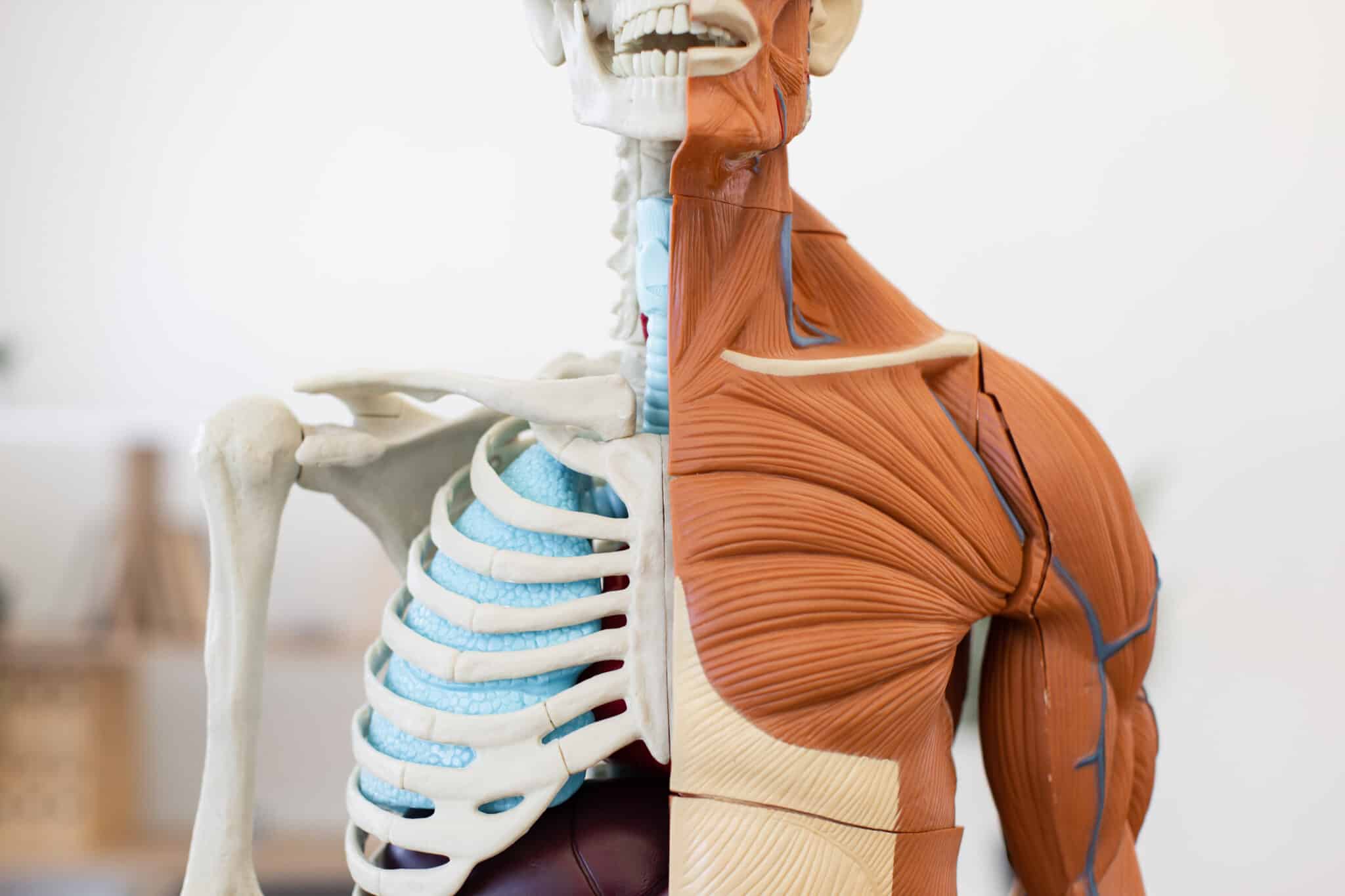
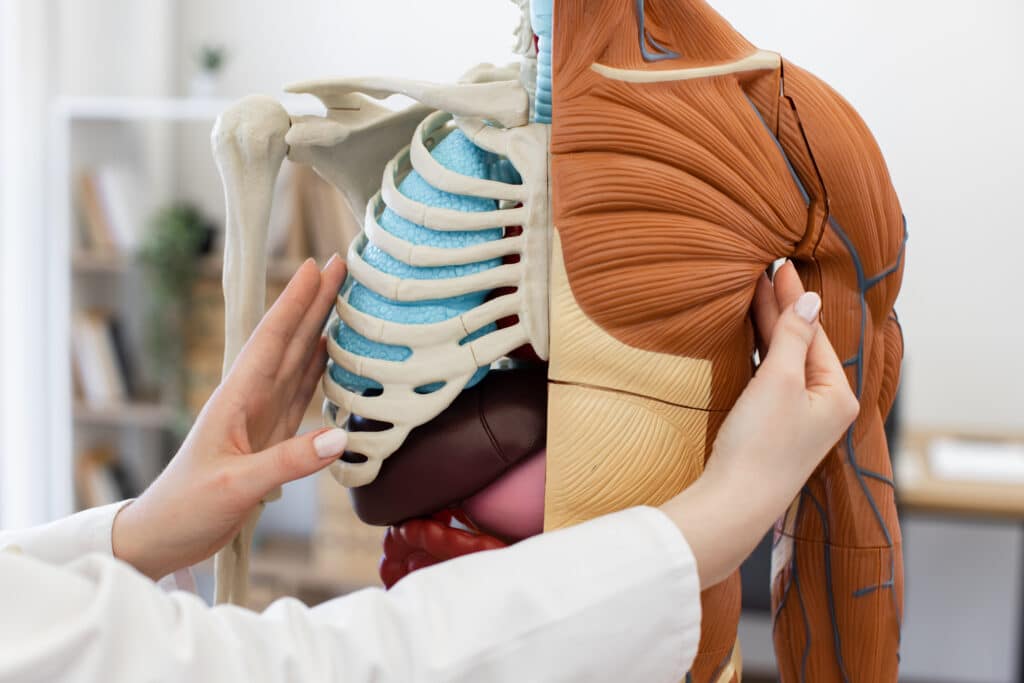
Half skeletal and muscular human anatomy model for medical study
What Is the Pectoralis Major Tendon?
The pectoralis major is the broad muscle across the front of your chest. It helps bring your arm toward your body, rotate it inward, and generate power during pushing motions.
This muscle narrows into a tendon as it approaches the upper arm bone, called the humerus. Pectoralis major tears can happen at the tendon insertion, at the musculotendinous junction, or within the muscle belly. Tendon avulsions near the humerus are common.
How These Injuries Usually Happen
Pectoralis major tendon tears are often linked to forceful activity. The classic situation is a heavy bench press, especially during the lowering phase when the muscle is stretched while still under load.
They can also happen during contact sports, wrestling, football, or other activities that place sudden stress across the chest and shoulder. Many people describe sharp pain and an immediate sense that something tore.
Common Signs and Symptoms
Symptoms can vary depending on whether the injury is a strain, a partial tear, or a full rupture. A complete tear often causes stronger pain and noticeable weakness right away, but some partial injuries may look less dramatic at first.
A sudden pop or tearing feeling in the chest or shoulder
Pain in the chest, front of the shoulder, or upper arm
Swelling and bruising, sometimes spreading down the arm
Weakness with pushing, lifting, or bringing the arm inward
A change in the contour of the chest or armpit area
Tenderness where the tendon normally attaches near the upper arm
Some patients notice one side of the chest looks flatter or uneven compared with the other side. This visible change can suggest the tendon has separated or the muscle is not working the way it should.
Who Is Most at Risk?
These injuries often occur in active adults, especially men between the ages of 20 and 40 who do strength training. Heavy bench pressing is a well-known risk factor, particularly when form breaks down under heavy load.
That said, the injury is not limited to competitive lifters. Anyone who puts a sudden, strong force across the chest and shoulder can develop a pectoralis major tendon tear.
How We Diagnose a Pectoralis Major Tear
Diagnosis starts with your story of how the injury happened and a careful physical exam. Your clinician checks for bruising, weakness, tenderness, and shape changes in the chest muscle.
MRI is commonly used to confirm the tear and tell whether it is partial or complete. It can also show where the tendon is injured and how much tissue is involved. Ultrasound may sometimes be helpful, depending on the situation.
Types of Pectoralis Major Injuries
Injury Type
What It Means
Typical Effect
Strain
The muscle or tendon is overstretched but not fully torn.
Pain and soreness, but strength may still be fairly good.
Partial tear
Only part of the tendon or muscle is torn.
Pain, weakness, and some loss of function.
Complete tear
The tendon fully separates, often near the upper arm bone.
More significant weakness, bruising, and chest contour change.
When Non-Surgical Treatment May Help
Non-surgical care may be reasonable for some partial tears, injuries in the muscle belly, or for people who do not need full strength for sports or heavy lifting. Treatment usually focuses on protecting the area, managing pain, and slowly restoring motion with physical therapy.
Short period of rest and activity modification
Sling use when recommended for comfort
Ice and other pain-control strategies
Physical therapy to improve motion and rebuild strength
Even when surgery is not needed, evaluation still matters. Some problems that feel like a strain turn out to be a tendon tear, and the treatment plan may change based on what is actually injured.
When Surgery Is More Likely to Be Recommended
Surgery may be considered for complete tendon tears, especially in active patients who want to regain strength and return to sports, weight training, or physically demanding work. The goal is to repair the tendon when it is separated, when that is appropriate for the case.
Treatment depends on tear severity, location, timing, and your activity level and goals. In many cases, repair is easier to do when evaluation happens relatively soon after the injury, before the tendon retracts and scar tissue develops. Your care team can explain what is realistic for your situation.
You should be evaluated promptly if you notice:
A pop during bench press or another forceful movement
Rapid bruising across the chest or upper arm
Visible asymmetry of the chest muscle
Sudden weakness with pushing or lifting
Early assessment helps confirm the injury and guides the treatment plan. Getting care sooner can give you more options, especially when a tear is suspected.
What Recovery Usually Involves
Recovery depends on the severity of the injury and whether surgery is performed. Healing takes time because the chest and shoulder work together for pushing, lifting, and many daily movements.
Rehabilitation often moves in stages. Early care protects the repair or allows the tear to settle. Later phases work to restore shoulder motion, rebuild strength, and gradually bring you back to sports or lifting based on guidance from your care team.
General Recovery Overview
Stage
What to Expect
Early phase
Rest, protection, pain control, and limited use of the arm.
Rehabilitation phase
Gradual return of shoulder motion and supervised strengthening.
Return to activity
Progressive increase in daily activity, gym exercises, and sports as advised by your care team.
Why Early Care Matters
A delayed diagnosis can make treatment more difficult. Over time, a torn tendon may retract, and the muscle can lose some of its normal function and look.
If you still have weakness, chest deformity, or pain after a lifting injury, do not assume it will fix itself. The right diagnosis early can help protect long-term strength and shoulder function.
When to See an Orthopaedic Specialist
You should schedule an evaluation if you had a sudden chest or shoulder injury and now have pain, bruising, weakness, or a change in chest shape. This is especially important if the injury happened during weightlifting or contact sports.
You heard or felt a pop during exercise
Your chest or upper arm bruised quickly after the injury
You have lost strength with pressing or pushing
One side of your chest looks different than the other
You are having trouble returning to work, sports, or lifting
At Princeton Orthopaedic Associates, we can examine the injury, review imaging if needed, and discuss whether non-surgical treatment or repair is the best fit for your goals. If you are worried about a possible chest tendon tear, schedule an exam so you can move forward with a clear plan.
This blog post is meant to be informative and should not act as a self-diagnosis tool. If you’d like to see one of our doctors, please contact us here.
Sequence rules uses cookies to track the order of requests a user has made and the time between requests and makes them available via Cloudflare Rules. This allows you to write rules that match valid or invalid sequences. The specific cookies used to validate sequences are called sequence cookies.
session
cf_ob_info
The cf_ob_info cookie provides information on: The HTTP Status Code returned by the origin web server. The Ray ID of the original failed request. The data center serving the traffic
session
cf_use_ob
The cf_use_ob cookie informs Cloudflare to fetch the requested resource from the Always Online cache on the designated port. Applicable values are: 0, 80, and 443. The cf_ob_info and cf_use_ob cookies are persistent cookies that expire after 30 seconds.
session
__cfwaitingroom
The __cfwaitingroom cookie is only used to track visitors that access a waiting room enabled host and path combination for a zone. Visitors using a browser that does not accept cookies cannot visit the host and path combination while the waiting room is active.
session
cf_chl_rc_i
These cookies are for internal use which allows Cloudflare to identify production issues on clients.
session
cf_chl_rc_ni
These cookies are for internal use which allows Cloudflare to identify production issues on clients.
session
cf_chl_rc_m
These cookies are for internal use which allows Cloudflare to identify production issues on clients.
session
__cfruid
Used by the content network, Cloudflare, to identify trusted web traffic.
session
__cf_bm
Cloudflare's bot products identify and mitigate automated traffic to protect your site from bad bots. Cloudflare places the __cf_bm cookie on End User devices that access Customer sites that are protected by Bot Management or Bot Fight Mode. The __cf_bm cookie is necessary for the proper functioning of these bot solutions.
session
__cflb
When enabling session affinity with Cloudflare Load Balancer, Cloudflare sets a __cflb cookie with a unique value on the first response to the requesting client. Cloudflare routes future requests to the same origin, optimizing network resource usage. In the event of a failover, Cloudflare sets a new __cflb cookie to direct future requests to the failover pool.
session
_cfuvid
The _cfuvid cookie is only set when a site uses this option in a Rate Limiting Rule, and is only used to allow the Cloudflare WAF to distinguish individual users who share the same IP address.
session
cf_clearance
Whether a CAPTCHA or Javascript challenge has been solved.
session
Google reCAPTCHA helps protect websites from spam and abuse by verifying user interactions through challenges.
Name
Description
Duration
_GRECAPTCHA
Google reCAPTCHA sets a necessary cookie (_GRECAPTCHA) when executed for the purpose of providing its risk analysis.
179 days
Google Tag Manager simplifies the management of marketing tags on your website without code changes.
Name
Description
Duration
cookiePreferences
Registers cookie preferences of a user
2 years
td
Registers statistical data on users' behaviour on the website. Used for internal analytics by the website operator.
session
These cookies are used for managing login functionality on this website.
Name
Description
Duration
wordpress_logged_in
Used to store logged-in users.
Persistent
wordpress_sec
Used to track the user across multiple sessions.
15 days
wordpress_test_cookie
Used to determine if cookies are enabled.
Session
WPForms is a user-friendly WordPress plugin for creating custom forms with drag-and-drop functionality.
Name
Description
Duration
wpfuuid
Used to track user interactions with forms.
11 years
Statistics cookies collect information anonymously. This information helps us understand how visitors use our website.
Google Analytics is a powerful tool that tracks and analyzes website traffic for informed marketing decisions.
Used to distinguish new sessions and visits. This cookie is set when the GA.js javascript library is loaded and there is no existing __utmb cookie. The cookie is updated every time data is sent to the Google Analytics server.
30 minutes after last activity
__utmc
Used only with old Urchin versions of Google Analytics and not with GA.js. Was used to distinguish between new sessions and visits at the end of a session.
End of session (browser)
__utmz
Contains information about the traffic source or campaign that directed user to the website. The cookie is set when the GA.js javascript is loaded and updated when data is sent to the Google Anaytics server
6 months after last activity
__utmv
Contains custom information set by the web developer via the _setCustomVar method in Google Analytics. This cookie is updated every time new data is sent to the Google Analytics server.
2 years after last activity
__utmx
Used to determine whether a user is included in an A / B or Multivariate test.
18 months
_ga
ID used to identify users
2 years
_gali
Used by Google Analytics to determine which links on a page are being clicked
30 seconds
_ga_
ID used to identify users
2 years
_gid
ID used to identify users for 24 hours after last activity
24 hours
_gat
Used to monitor number of Google Analytics server requests when using Google Tag Manager
1 minute
_gac_
Contains information related to marketing campaigns of the user. These are shared with Google AdWords / Google Ads when the Google Ads and Google Analytics accounts are linked together.
90 days
__utma
ID used to identify users and sessions
2 years after last activity
__utmt
Used to monitor number of Google Analytics server requests
10 minutes
These cookies help us measure the effectiveness of our website content and understand how visitors find and use our site. This allows us to improve the experience and provide more helpful resources.
Facebook Pixel is a web analytics service that tracks and reports website traffic.
therapy, knee, pain, insurance, physician, patient, health insurance, injury, board certification, wrist, orthopedic surgeon near me, surgeon, joint replacement, medicine, shoulder, orthopedic surgery, arthritis, medical specialty, health, knee replacement, physical therapy, hip, bone, bone fracture, sports injury, disease, surgery, sports medicine, telehealth, joint, ligament, hand, carpal tunnel syndrome, knee pain, osteoarthritis, medication, humana, medical school, arthroscopy, elbow, foot and ankle surgery, back pain, healthgrades, research, sprain, foot, carpal tunnel surgery, fellowship, primary care physician, hip pain, physician assistant, clinic, tendon, nerve, anterior cruciate ligament, muscle, aetna, osteoporosis, webmd, hip replacement, finger, strain, health care, syndrome, orthopaedic sports medicine, ankle, rotator cuff, bursitis, meniscus, infection, tissue, cartilage, shoulder joint, sciatica, medical history, knee doctors in my area, orthopedic doctors in my area, hand doctors in my area, hand surgeons in my area, spine doctors in my area, nearest orthopedic doctor, orthopedists in my area, shoulder doctors in my area, orthopedic dr in my area, hip doctors in my area, physical medicine and rehabilitation, pain management, doctor of medicine, podiatry, accessibility, podiatrist, compassion, patient portal, urgent care center, medical record, board certified, therapist, outpatient surgery, neck, occupational therapist, manual therapy, residency, occupational therapy, orthotics, hip fracture, princeton orthopedic associates, princeton orthopedic doctors, princeton orthopedic locations, princeton orthopedic group, princeton orthopedic urgent care, princeton ortho, princeton orthopedic princeton, princeton ortho associates, princeton orthopaedic associates neck & back institute, new jersey, princeton university, jersey, concussion, rotator cuff tear, family medicine, information, tunnel, central jersey, neurology, internal medicine, tennis elbow, plastic surgery, nursing, joint dislocation, south jersey, philadelphia, united states, penn medicine princeton medical center, princeton orthopedics, princeton orthopedics monroe