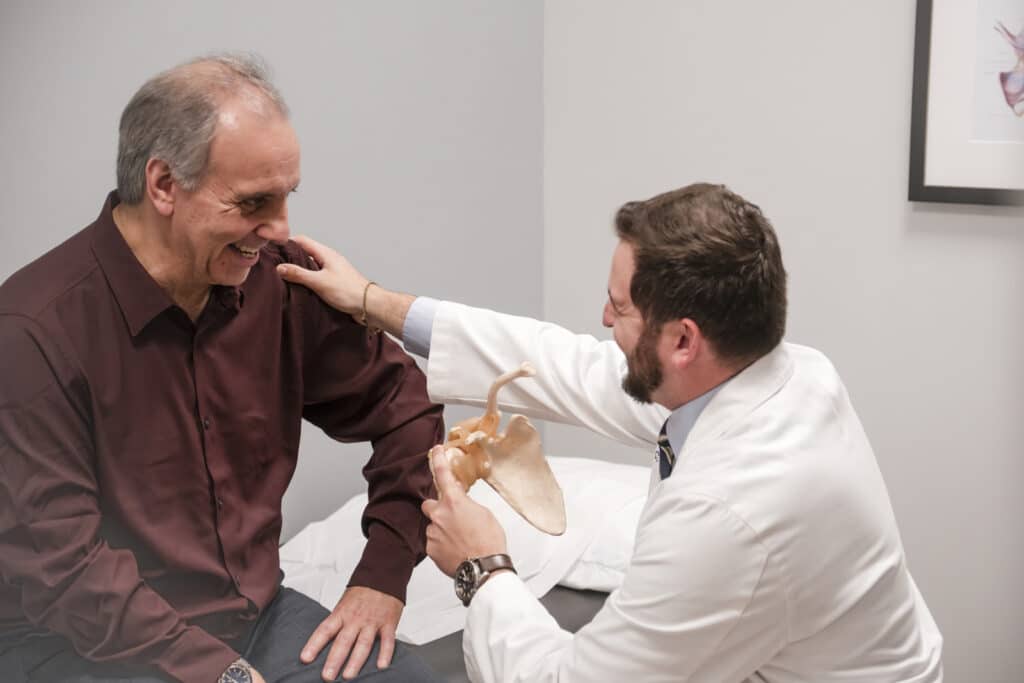
What Does A Torn Rotator Cuff Mean For You? Shoulder and Rotator Cuff Information
by Princeton Orthopaedic Associates
Shoulder pain myths we hear in clinic, and what's actually true
Shoulder pain collects bad advice faster than almost any other joint we treat. Friends hand out diagnoses, and the search results are usually worse. The same handful of beliefs come up week after week: what a scan can tell you, whether a rotator cuff tear means surgery, why frozen shoulder isn't your fault, what night pain means, and when shoulder pain isn't coming from the shoulder at all.
Reading about your shoulder never replaces an exam. It can, though, help you ask better questions.
The short version
Scans and symptoms don't always match. Rotator cuff changes show up in plenty of shoulders that don't hurt at all.
Most shoulder problems that come on without an injury start with guided exercise, not surgery.
Frozen shoulder moves through phases, and diabetes raises the risk.
Pain that wakes you up is worth telling us about.
Weakness after a fall, especially trouble raising the arm, deserves a prompt exam.
Shoulder, arm, neck or jaw pain with chest pressure, sweating or shortness of breath is an emergency. Call 911.
Pain that doesn't change when your shoulder moves may be coming from somewhere else.
poa shoulder 2026
Myth: an MRI will point straight at the problem
We wish it were that clean. Imaging shows structure, not pain, and the two don't always line up.
Rotator cuff tears are common in people with no shoulder pain at all, and they become more common with age. So a tear on a report doesn't automatically mean that tear is why you hurt.
That's why we read your images next to your story and your exam, never alone. X-rays show the bones and can spot calcium deposits. Ultrasound or MRI can help when we need a closer look at a tendon.
Myth: a rotator cuff tear always ends in surgery
Some tears do need repair. A tear that happens in a moment, from a fall or a hard pull, is different from a tendon that has frayed slowly over the years. If an injury leaves you suddenly unable to raise your arm, get it checked within days, not weeks, because timing can affect your repair options.
For the slow, wear-and-tear kind, we usually start with guided exercise and consider surgery only if you aren't improving after a few months. If pain is too strong for therapy, an injection may calm it down enough to get started. And an older surgery that shaved bone at the top of the shoulder for pinching pain generally hasn't worked better than exercise, so we rarely recommend it.
Non-surgical care isn't the same as doing nothing. A good plan includes:
Exercises that steadily strengthen the rotator cuff and the muscles around the shoulder blade
Short-term changes to overhead work and training rather than full rest
An injection in some cases, to make therapy possible
A set check-in, so you aren't left drifting without a decision
Imaging only when the answer will change the plan
Myth: frozen shoulder means you didn't move it enough
Keeping the arm still for a long time is one risk, so there's a grain of truth here. But it isn't the whole story, and people who blame themselves are usually being unfair to themselves.
Frozen shoulder happens when the lining around the joint thickens and tightens. People with diabetes or thyroid problems are more likely to get it, and so are people whose arm was kept still after surgery or an injury. The telltale sign is stiffness in every direction, even when we move your arm for you.
The phases of frozen shoulder
Phase
What people notice
Freezing
Pain builds, often worst at night, and motion starts to shrink
Frozen
Stiffness takes over while the pain often settles down
Thawing
Motion gradually returns and daily tasks get easier
It can take a year or more to run its course, and every shoulder moves at its own pace. An injection combined with physical therapy often helps with both pain and motion, and most people improve without surgery. If stiffness stays severe despite good care, we'll talk through other options. Some people are left with a little lasting stiffness, which is why we don't just wait it out.
Myth: night pain just means you slept on it wrong
Position matters, but it isn't the only thing going on. Lying on the sore side presses on irritated tendons, and the joint stays still for hours, so swelling builds. Without the day's distractions, you notice the pain more. Night pain is common with rotator cuff problems.
A few changes at bedtime can help while you wait for your appointment:
Sleep on your back instead of the painful side
Tuck a pillow under the elbow so the arm isn't dangling
If you side-sleep, lie on the good side and hug a pillow
Try a recliner or a wedge during a bad flare
Ice the shoulder in the evening for short sessions
Ask your doctor before taking over-the-counter pain medicine, especially if you have kidney or heart problems, stomach ulcers, or take blood thinners
If pain wakes you several nights a week for more than a couple of weeks, come in. Losing sleep makes recovery harder.
Myth: if it hurts in your shoulder, the shoulder is the problem
Pain can travel. A pinched nerve in the neck can send pain, tingling or weakness down the arm. The gallbladder and liver can cause pain in the right shoulder or shoulder blade. And the heart can cause pain in the shoulder, arm, back, neck or jaw, on either side. In women, older adults and people with diabetes, heart symptoms often look unusual, so don't wait for classic left-arm pain before calling 911. One clue we look for: pain from somewhere else usually doesn't change when we move your shoulder.
When shoulder pain isn't an orthopaedic appointment
What you're noticing
What to do
Shoulder, arm, back, neck or jaw pain with chest pressure, shortness of breath, sweating, nausea or lightheadedness
Call 911. Don't drive yourself.
Sudden pain at the tip of the shoulder after a hit to the belly or chest, or with severe belly pain or faintness
Go to the emergency room
Shoulder or shoulder blade pain with sudden shortness of breath, coughing up blood or chest pain
Go to the emergency room
Right shoulder pain with upper right belly pain, fever, vomiting, or yellow skin or eyes
Get medical care the same day
A red, hot, swollen shoulder with fever
Get medical care the same day
New numbness or weakness down the arm, or you can't lift the arm after a fall
See us promptly
Pain that stays the same no matter how the shoulder moves
Get it checked; the cause may be outside the joint
Myth: if you can still lift your arm, nothing's torn
Plenty of people with tears lift their arm just fine, and plenty of people who can't lift it have no tear at all. In the exam room we look at the whole pattern: what you can do on your own, what happens when we move the arm for you, where exactly it hurts, and which positions set it off. That pattern tells us more than any single test, and it's the best reason to come in rather than guess.
What a shoulder visit with our team looks like
We start with how it began, because a shoulder that gave out during one lift tells a different story than one that has ached for months. Then we test motion, strength and the positions that bring on your pain. We often take X-rays the same day, and order other imaging only when it would change what we recommend.
It helps to jot down when the pain started, which motions trigger it, how often it wakes you, what you've already tried, and what you need your shoulder to do again.
The backbone of care for most rotator cuff and stiffness problems
Orthopaedic Shoulder Specialist
Injury-related tears, dislocations, arthritis, cases that stall
For imaging review and surgery decisions when needed
Get your shoulder looked at
If your shoulder has been aching for a few weeks, waking you at night, or quietly changing how you reach and lift, we'd like to take a look. Our team will sort out what's driving the pain and build a plan around what you need your arm to do. Schedule Exam.
This blog post is meant to be informative and should not act as a self-diagnosis tool. If you’d like to see one of our doctors, please contact us here.
Sequence rules uses cookies to track the order of requests a user has made and the time between requests and makes them available via Cloudflare Rules. This allows you to write rules that match valid or invalid sequences. The specific cookies used to validate sequences are called sequence cookies.
session
cf_ob_info
The cf_ob_info cookie provides information on: The HTTP Status Code returned by the origin web server. The Ray ID of the original failed request. The data center serving the traffic
session
cf_use_ob
The cf_use_ob cookie informs Cloudflare to fetch the requested resource from the Always Online cache on the designated port. Applicable values are: 0, 80, and 443. The cf_ob_info and cf_use_ob cookies are persistent cookies that expire after 30 seconds.
session
__cfwaitingroom
The __cfwaitingroom cookie is only used to track visitors that access a waiting room enabled host and path combination for a zone. Visitors using a browser that does not accept cookies cannot visit the host and path combination while the waiting room is active.
session
cf_chl_rc_i
These cookies are for internal use which allows Cloudflare to identify production issues on clients.
session
cf_chl_rc_ni
These cookies are for internal use which allows Cloudflare to identify production issues on clients.
session
cf_chl_rc_m
These cookies are for internal use which allows Cloudflare to identify production issues on clients.
session
__cfruid
Used by the content network, Cloudflare, to identify trusted web traffic.
session
__cf_bm
Cloudflare's bot products identify and mitigate automated traffic to protect your site from bad bots. Cloudflare places the __cf_bm cookie on End User devices that access Customer sites that are protected by Bot Management or Bot Fight Mode. The __cf_bm cookie is necessary for the proper functioning of these bot solutions.
session
__cflb
When enabling session affinity with Cloudflare Load Balancer, Cloudflare sets a __cflb cookie with a unique value on the first response to the requesting client. Cloudflare routes future requests to the same origin, optimizing network resource usage. In the event of a failover, Cloudflare sets a new __cflb cookie to direct future requests to the failover pool.
session
_cfuvid
The _cfuvid cookie is only set when a site uses this option in a Rate Limiting Rule, and is only used to allow the Cloudflare WAF to distinguish individual users who share the same IP address.
session
cf_clearance
Whether a CAPTCHA or Javascript challenge has been solved.
session
Google reCAPTCHA helps protect websites from spam and abuse by verifying user interactions through challenges.
Name
Description
Duration
_GRECAPTCHA
Google reCAPTCHA sets a necessary cookie (_GRECAPTCHA) when executed for the purpose of providing its risk analysis.
179 days
Google Tag Manager simplifies the management of marketing tags on your website without code changes.
Name
Description
Duration
cookiePreferences
Registers cookie preferences of a user
2 years
td
Registers statistical data on users' behaviour on the website. Used for internal analytics by the website operator.
session
These cookies are used for managing login functionality on this website.
Name
Description
Duration
wordpress_logged_in
Used to store logged-in users.
Persistent
wordpress_sec
Used to track the user across multiple sessions.
15 days
wordpress_test_cookie
Used to determine if cookies are enabled.
Session
WPForms is a user-friendly WordPress plugin for creating custom forms with drag-and-drop functionality.
Name
Description
Duration
wpfuuid
Used to track user interactions with forms.
11 years
Statistics cookies collect information anonymously. This information helps us understand how visitors use our website.
Google Analytics is a powerful tool that tracks and analyzes website traffic for informed marketing decisions.
Used to distinguish new sessions and visits. This cookie is set when the GA.js javascript library is loaded and there is no existing __utmb cookie. The cookie is updated every time data is sent to the Google Analytics server.
30 minutes after last activity
__utmc
Used only with old Urchin versions of Google Analytics and not with GA.js. Was used to distinguish between new sessions and visits at the end of a session.
End of session (browser)
__utmz
Contains information about the traffic source or campaign that directed user to the website. The cookie is set when the GA.js javascript is loaded and updated when data is sent to the Google Analytics server
6 months after last activity
__utmv
Contains custom information set by the web developer via the _setCustomVar method in Google Analytics. This cookie is updated every time new data is sent to the Google Analytics server.
2 years after last activity
__utmx
Used to determine whether a user is included in an A / B or Multivariate test.
18 months
_ga
ID used to identify users
2 years
_gali
Used by Google Analytics to determine which links on a page are being clicked
30 seconds
_ga_
ID used to identify users
2 years
_gid
ID used to identify users for 24 hours after last activity
24 hours
_gat
Used to monitor number of Google Analytics server requests when using Google Tag Manager
1 minute
_gac_
Contains information related to marketing campaigns of the user. These are shared with Google AdWords / Google Ads when the Google Ads and Google Analytics accounts are linked together.
90 days
__utma
ID used to identify users and sessions
2 years after last activity
__utmt
Used to monitor number of Google Analytics server requests
10 minutes
These cookies help us measure the effectiveness of our website content and understand how visitors find and use our site. This allows us to improve the experience and provide more helpful resources.
Facebook Pixel is a web analytics service that tracks and reports website traffic.