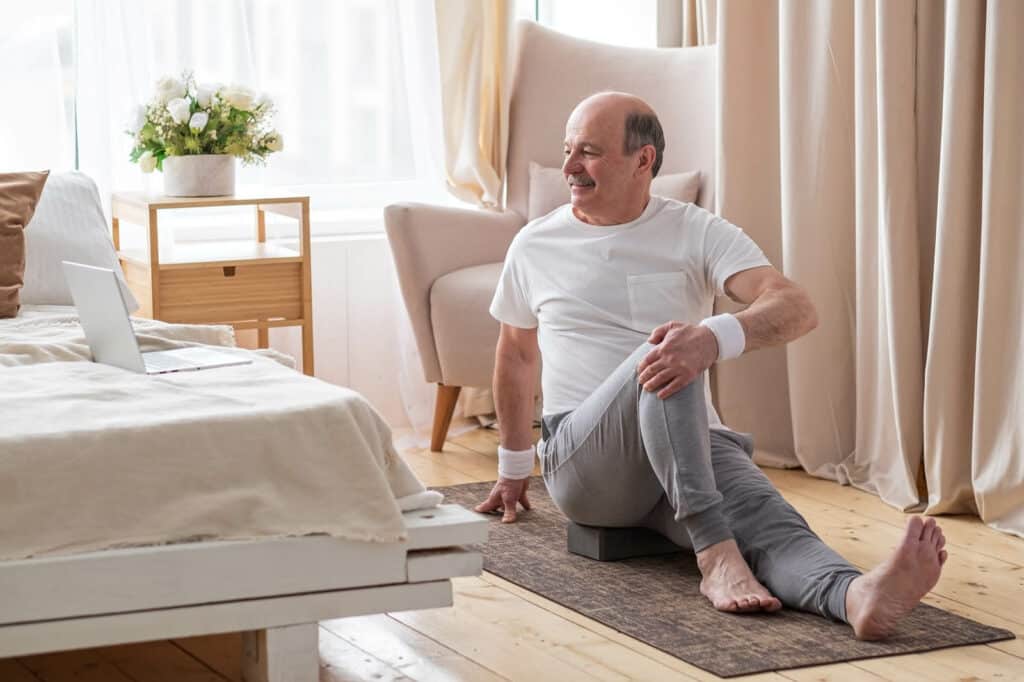
Why Does My Back Crack? What That Popping Sound Means
by Princeton Orthopaedic Associates
Your back popped when you stood up. Should you worry?
You push back from your desk after a long stretch of work, twist to grab your bag, and your lower back lets out a pop loud enough that someone else hears it. Nothing hurts. But you freeze for a second anyway, wondering if you just did something you'll regret.
Patients ask us about this all the time, usually on the way out the door from an appointment about something else. It deserves a real answer: what that pop actually is, why the same spot won't pop twice in a row, whether cracking causes arthritis, and which symptoms mean a noisy back needs a closer look.
The short answer, for most people: a painless pop is not damage.
What you should know
Painless popping in the back is common. On its own, it isn't a sign of injury.
The pop comes from a tiny pocket of gas forming inside the joint as it moves.
A joint needs a little time to reset before it pops the same way again.
Cracking your knuckles or your back has not been shown to cause arthritis.
Hearing a pop during hands-on treatment doesn't mean it worked any better.
Some wear in the back joints is normal as you get older, with or without pain.
Pain, swelling, weakness, or numbness, along with the noise, warrants an exam.
Back pain with new bladder or bowel changes needs emergency care right away.
What's actually happening when your back cracks
Your spine has small joints, and each one sits in a little fluid. When you twist or stretch, the joint surfaces can stick for a moment and then separate all at once. As they pull apart, a small pocket of gas forms in that fluid, and that's the pop you hear.
It's the same thing that happens when you crack your knuckles. Nothing is breaking, tearing or slipping out of place.
Why the same spot won't pop twice in a row
Try it and you'll notice the joint simply won't give you the sound again. The gas needs time to settle back into the fluid before it can happen again, and that reset takes a little while.
This matters for one practical reason. When people can't get the pop they want, they tend to twist harder. Forcing a joint past its comfortable range repeatedly can leave you sore or strained, so it's worth avoiding. The waiting period is just how the joint works, not a problem to solve.
Does cracking cause arthritis?
"My mother told me cracking causes arthritis." Someone told all of us that. Researchers have looked into it, mostly with knuckle cracking, and haven't found a link between the habit and arthritis.
One caution: that reassurance is about the everyday, gentle kind of cracking. It isn't a green light for forceful twisting of your own spine or neck, which carries different risks.
Does the pop mean the adjustment worked?
Many people judge hands-on treatment by whether they hear something. People tend to feel about the same afterward whether their back popped or stayed quiet.
So if you finish a hands-on care session without a sound effect, you weren't shortchanged.
What we listen for when you describe the noise
In the exam room, the sound itself tells us far less than the story around it: what you were doing, what you felt afterward, whether anything travels down a leg, and whether it's changing. Here's roughly how we sort it. It isn't a substitute for an exam.
What you notice
What it often means
What to do
One painless pop when you stretch after sitting
A normal joint pop
Nothing needed
A gritty grinding with morning stiffness that eases within half an hour
Often normal wear in the back joints
Get it checked if it limits what you do
Noise plus soreness in one spot that has built up over weeks
An irritated joint or muscle
Schedule an exam
Popping with numbness, tingling, or pain running into the leg
A possibly irritated nerve
Schedule an exam soon
New noise after a fall, a crash, or a heavy lift
Needs to be checked before you push through it
Call us
Back pain with new bladder or bowel changes, numbness around the groin, or weakness in both legs
Pressure on the nerves at the base of the spine
Go to the emergency room right away
Joint wear is common, and it's not the same thing as pain
A grinding sound makes people assume arthritis, and sometimes that's part of it. But some wear in the small joints of the back shows up on scans for most of us as we get older, including plenty of people who have no back pain at all.
That's the point we make with patients every day. Wear on a scan is a normal part of aging. How much it matters depends on how you actually feel and move, and that's what we look at.
If you're very flexible, your joints may just be louder
Some people crack constantly. They can put their palms flat on the floor with straight knees, and their elbows bend back past straight. Loose joints reach the end of their range more easily, which can mean more clicking through the spine and elsewhere.
Being flexible isn't a problem by itself, and many very flexible people never have trouble from it. It's worth a conversation if it comes with pain that keeps returning, joints that slip out of place, or frequent strains. For people in that group, building strength and control around the joints usually helps more than stretching.
Symptoms that need attention, not patience
The noise itself is rarely the emergency. What matters is what comes with it. If any of these show up along with back pain, call us or get care rather than waiting it out:
New trouble controlling your bladder or bowels, or new trouble passing urine
Numbness in the groin, buttocks, or inner thighs
Weakness in both legs, or weakness that is getting worse
Fever, chills, or a recent infection along with back pain
Weight loss you can't explain, or a history of cancer with new back pain
A serious injury, or even a minor fall if you have thin bones
Pain that is worst at night or at rest and doesn't ease when you change position
The first three can mean the nerves at the base of the spine are being squeezed. It's uncommon, but it's an emergency: go to the emergency room right away.
One more pattern worth mentioning at your visit: back pain that starts gradually before age 40, comes with morning stiffness, and feels better with activity than with rest. That combination can point to an inflammatory cause.
Should you crack your own back?
If you twist gently in your chair and something pops on its own, we're not worried. Occasional cracking that takes no real force and causes no pain is a habit, not an injury.
What we'd steer you away from is the hard version: wrenching your torso, having someone bear-hug you off the ground, or yanking your own neck around to chase a sound. Skip forceful neck twisting entirely. In rare cases it has been linked to injury to the blood vessels in the neck.
Before any forceful manipulation, whether you do it yourself or someone does it for you, talk with a clinician first if any of these apply:
Thin bones (osteoporosis) or a past fracture from a minor fall
A recent fall, spine injury, or spine surgery
Known or suspected cancer involving the spine
Inflammatory arthritis affecting the spine
New numbness, tingling, or weakness in an arm or leg
Blood thinners or a bleeding disorder
What tends to help more than the pop
People who crack their backs all day usually feel the urge after holding one position too long, and the relief from a pop fades in minutes. Changing what your back does all day often helps more than chasing the sound. Try these for a few weeks:
Get up and move for a minute or two every half hour or so during desk work
Work on gentle twisting of the upper back, since a stiff upper back pushes extra motion into the low back
Stretch the hips, which tighten with long hours of sitting
Strengthen your core and hip muscles rather than only stretching
Walk regularly, and use heat before activity if stiffness is your main complaint
Many people find the noise bothers them less once the stiffness behind it improves. If it doesn't change, or if pain is part of the picture, come in and we'll take a closer look.
Back pain tied to training, lifting, or a specific sport
Helpful when symptoms started with a change in activity
Orthopaedic spine surgeon
Nerve symptoms that won't go away, or problems that need a closer look
Surgery comes up only after other care has been tried
Let's take a look at your back
A back that has always been noisy and has never hurt is one you can probably stop thinking about. If the sound now comes with pain, stiffness that limits your day, or anything traveling into a leg, we'd rather see you than leave you wondering.
Our team will examine how your spine moves, sort out what's driving the symptoms, and build a plan around what you're trying to get back to. Schedule Exam with Princeton Orthopaedic Associates and bring your questions with you.
This information is general education and is not a substitute for an individual evaluation.
This blog post is meant to be informative and should not act as a self-diagnosis tool. If you’d like to see one of our doctors, please contact us here.
Sequence rules uses cookies to track the order of requests a user has made and the time between requests and makes them available via Cloudflare Rules. This allows you to write rules that match valid or invalid sequences. The specific cookies used to validate sequences are called sequence cookies.
session
cf_ob_info
The cf_ob_info cookie provides information on: The HTTP Status Code returned by the origin web server. The Ray ID of the original failed request. The data center serving the traffic
session
cf_use_ob
The cf_use_ob cookie informs Cloudflare to fetch the requested resource from the Always Online cache on the designated port. Applicable values are: 0, 80, and 443. The cf_ob_info and cf_use_ob cookies are persistent cookies that expire after 30 seconds.
session
__cfwaitingroom
The __cfwaitingroom cookie is only used to track visitors that access a waiting room enabled host and path combination for a zone. Visitors using a browser that does not accept cookies cannot visit the host and path combination while the waiting room is active.
session
cf_chl_rc_i
These cookies are for internal use which allows Cloudflare to identify production issues on clients.
session
cf_chl_rc_ni
These cookies are for internal use which allows Cloudflare to identify production issues on clients.
session
cf_chl_rc_m
These cookies are for internal use which allows Cloudflare to identify production issues on clients.
session
__cfruid
Used by the content network, Cloudflare, to identify trusted web traffic.
session
__cf_bm
Cloudflare's bot products identify and mitigate automated traffic to protect your site from bad bots. Cloudflare places the __cf_bm cookie on End User devices that access Customer sites that are protected by Bot Management or Bot Fight Mode. The __cf_bm cookie is necessary for the proper functioning of these bot solutions.
session
__cflb
When enabling session affinity with Cloudflare Load Balancer, Cloudflare sets a __cflb cookie with a unique value on the first response to the requesting client. Cloudflare routes future requests to the same origin, optimizing network resource usage. In the event of a failover, Cloudflare sets a new __cflb cookie to direct future requests to the failover pool.
session
_cfuvid
The _cfuvid cookie is only set when a site uses this option in a Rate Limiting Rule, and is only used to allow the Cloudflare WAF to distinguish individual users who share the same IP address.
session
cf_clearance
Whether a CAPTCHA or Javascript challenge has been solved.
session
Google reCAPTCHA helps protect websites from spam and abuse by verifying user interactions through challenges.
Name
Description
Duration
_GRECAPTCHA
Google reCAPTCHA sets a necessary cookie (_GRECAPTCHA) when executed for the purpose of providing its risk analysis.
179 days
Google Tag Manager simplifies the management of marketing tags on your website without code changes.
Name
Description
Duration
cookiePreferences
Registers cookie preferences of a user
2 years
td
Registers statistical data on users' behaviour on the website. Used for internal analytics by the website operator.
session
These cookies are used for managing login functionality on this website.
Name
Description
Duration
wordpress_logged_in
Used to store logged-in users.
Persistent
wordpress_sec
Used to track the user across multiple sessions.
15 days
wordpress_test_cookie
Used to determine if cookies are enabled.
Session
WPForms is a user-friendly WordPress plugin for creating custom forms with drag-and-drop functionality.
Name
Description
Duration
wpfuuid
Used to track user interactions with forms.
11 years
Statistics cookies collect information anonymously. This information helps us understand how visitors use our website.
Google Analytics is a powerful tool that tracks and analyzes website traffic for informed marketing decisions.
Used to distinguish new sessions and visits. This cookie is set when the GA.js javascript library is loaded and there is no existing __utmb cookie. The cookie is updated every time data is sent to the Google Analytics server.
30 minutes after last activity
__utmc
Used only with old Urchin versions of Google Analytics and not with GA.js. Was used to distinguish between new sessions and visits at the end of a session.
End of session (browser)
__utmz
Contains information about the traffic source or campaign that directed user to the website. The cookie is set when the GA.js javascript is loaded and updated when data is sent to the Google Analytics server
6 months after last activity
__utmv
Contains custom information set by the web developer via the _setCustomVar method in Google Analytics. This cookie is updated every time new data is sent to the Google Analytics server.
2 years after last activity
__utmx
Used to determine whether a user is included in an A / B or Multivariate test.
18 months
_ga
ID used to identify users
2 years
_gali
Used by Google Analytics to determine which links on a page are being clicked
30 seconds
_ga_
ID used to identify users
2 years
_gid
ID used to identify users for 24 hours after last activity
24 hours
_gat
Used to monitor number of Google Analytics server requests when using Google Tag Manager
1 minute
_gac_
Contains information related to marketing campaigns of the user. These are shared with Google AdWords / Google Ads when the Google Ads and Google Analytics accounts are linked together.
90 days
__utma
ID used to identify users and sessions
2 years after last activity
__utmt
Used to monitor number of Google Analytics server requests
10 minutes
These cookies help us measure the effectiveness of our website content and understand how visitors find and use our site. This allows us to improve the experience and provide more helpful resources.
Facebook Pixel is a web analytics service that tracks and reports website traffic.