Your back popped when you stood up. Should you worry?
You push back from your desk after a long stretch of work, twist to grab your bag, and your lower back lets out a pop loud enough that someone else hears it. Nothing hurts. But you freeze for a second anyway, wondering if you just did something you'll regret.
Patients ask us about this all the time, usually on the way out the door from an appointment about something else. It deserves a real answer: what that pop actually is, why the same spot won't pop twice in a row, whether cracking causes arthritis, and which symptoms mean a noisy back needs a closer look.
The short answer, for most people: a painless pop is not damage.
What you should know
Painless popping in the back is common. On its own, it isn't a sign of injury.
The pop comes from a tiny pocket of gas forming inside the joint as it moves.
A joint needs a little time to reset before it pops the same way again.
Cracking your knuckles or your back has not been shown to cause arthritis.
Hearing a pop during hands-on treatment doesn't mean it worked any better.
Some wear in the back joints is normal as you get older, with or without pain.
Pain, swelling, weakness, or numbness, along with the noise, warrants an exam.
Back pain with new bladder or bowel changes needs emergency care right away.
What's actually happening when your back cracks
Your spine has small joints, and each one sits in a little fluid. When you twist or stretch, the joint surfaces can stick for a moment and then separate all at once. As they pull apart, a small pocket of gas forms in that fluid, and that's the pop you hear.
It's the same thing that happens when you crack your knuckles. Nothing is breaking, tearing or slipping out of place.
Why the same spot won't pop twice in a row
Try it and you'll notice the joint simply won't give you the sound again. The gas needs time to settle back into the fluid before it can happen again, and that reset takes a little while.
This matters for one practical reason. When people can't get the pop they want, they tend to twist harder. Forcing a joint past its comfortable range repeatedly can leave you sore or strained, so it's worth avoiding. The waiting period is just how the joint works, not a problem to solve.
Does cracking cause arthritis?
"My mother told me cracking causes arthritis." Someone told all of us that. Researchers have looked into it, mostly with knuckle cracking, and haven't found a link between the habit and arthritis.
One caution: that reassurance is about the everyday, gentle kind of cracking. It isn't a green light for forceful twisting of your own spine or neck, which carries different risks.
Does the pop mean the adjustment worked?
Many people judge hands-on treatment by whether they hear something. People tend to feel about the same afterward whether their back popped or stayed quiet.
So if you finish a hands-on care session without a sound effect, you weren't shortchanged.
What we listen for when you describe the noise
In the exam room, the sound itself tells us far less than the story around it: what you were doing, what you felt afterward, whether anything travels down a leg, and whether it's changing. Here's roughly how we sort it. It isn't a substitute for an exam.
What you notice
What it often means
What to do
One painless pop when you stretch after sitting
A normal joint pop
Nothing needed
A gritty grinding with morning stiffness that eases within half an hour
Often normal wear in the back joints
Get it checked if it limits what you do
Noise plus soreness in one spot that has built up over weeks
An irritated joint or muscle
Schedule an exam
Popping with numbness, tingling, or pain running into the leg
A possibly irritated nerve
Schedule an exam soon
New noise after a fall, a crash, or a heavy lift
Needs to be checked before you push through it
Call us
Back pain with new bladder or bowel changes, numbness around the groin, or weakness in both legs
Pressure on the nerves at the base of the spine
Go to the emergency room right away
Joint wear is common, and it's not the same thing as pain
A grinding sound makes people assume arthritis, and sometimes that's part of it. But some wear in the small joints of the back shows up on scans for most of us as we get older, including plenty of people who have no back pain at all.
That's the point we make with patients every day. Wear on a scan is a normal part of aging. How much it matters depends on how you actually feel and move, and that's what we look at.
If you're very flexible, your joints may just be louder
Some people crack constantly. They can put their palms flat on the floor with straight knees, and their elbows bend back past straight. Loose joints reach the end of their range more easily, which can mean more clicking through the spine and elsewhere.
Being flexible isn't a problem by itself, and many very flexible people never have trouble from it. It's worth a conversation if it comes with pain that keeps returning, joints that slip out of place, or frequent strains. For people in that group, building strength and control around the joints usually helps more than stretching.
Symptoms that need attention, not patience
The noise itself is rarely the emergency. What matters is what comes with it. If any of these show up along with back pain, call us or get care rather than waiting it out:
New trouble controlling your bladder or bowels, or new trouble passing urine
Numbness in the groin, buttocks, or inner thighs
Weakness in both legs, or weakness that is getting worse
Fever, chills, or a recent infection along with back pain
Weight loss you can't explain, or a history of cancer with new back pain
A serious injury, or even a minor fall if you have thin bones
Pain that is worst at night or at rest and doesn't ease when you change position
The first three can mean the nerves at the base of the spine are being squeezed. It's uncommon, but it's an emergency: go to the emergency room right away.
One more pattern worth mentioning at your visit: back pain that starts gradually before age 40, comes with morning stiffness, and feels better with activity than with rest. That combination can point to an inflammatory cause.
Should you crack your own back?
If you twist gently in your chair and something pops on its own, we're not worried. Occasional cracking that takes no real force and causes no pain is a habit, not an injury.
What we'd steer you away from is the hard version: wrenching your torso, having someone bear-hug you off the ground, or yanking your own neck around to chase a sound. Skip forceful neck twisting entirely. In rare cases it has been linked to injury to the blood vessels in the neck.
Before any forceful manipulation, whether you do it yourself or someone does it for you, talk with a clinician first if any of these apply:
Thin bones (osteoporosis) or a past fracture from a minor fall
A recent fall, spine injury, or spine surgery
Known or suspected cancer involving the spine
Inflammatory arthritis affecting the spine
New numbness, tingling, or weakness in an arm or leg
Blood thinners or a bleeding disorder
What tends to help more than the pop
People who crack their backs all day usually feel the urge after holding one position too long, and the relief from a pop fades in minutes. Changing what your back does all day often helps more than chasing the sound. Try these for a few weeks:
Get up and move for a minute or two every half hour or so during desk work
Work on gentle twisting of the upper back, since a stiff upper back pushes extra motion into the low back
Stretch the hips, which tighten with long hours of sitting
Strengthen your core and hip muscles rather than only stretching
Walk regularly, and use heat before activity if stiffness is your main complaint
Many people find the noise bothers them less once the stiffness behind it improves. If it doesn't change, or if pain is part of the picture, come in and we'll take a closer look.
Back pain tied to training, lifting, or a specific sport
Helpful when symptoms started with a change in activity
Orthopaedic spine surgeon
Nerve symptoms that won't go away, or problems that need a closer look
Surgery comes up only after other care has been tried
Let's take a look at your back
A back that has always been noisy and has never hurt is one you can probably stop thinking about. If the sound now comes with pain, stiffness that limits your day, or anything traveling into a leg, we'd rather see you than leave you wondering.
Our team will examine how your spine moves, sort out what's driving the symptoms, and build a plan around what you're trying to get back to. Schedule Exam with Princeton Orthopaedic Associates and bring your questions with you.
This information is general education and is not a substitute for an individual evaluation.
This blog post is meant to be informative and should not act as a self-diagnosis tool. If you’d like to see one of our doctors, please contact us here.
A pop, fast swelling, and a knee that still walks
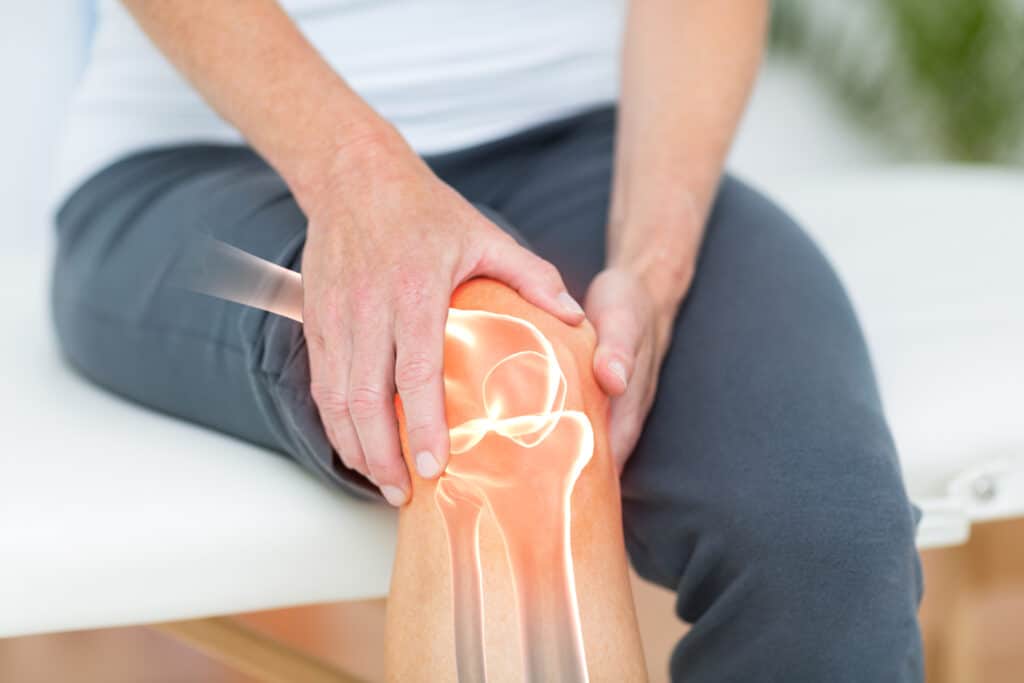
An ACL tear usually happens without contact: a plant and turn, an awkward landing, or a sudden stop. Many people feel or hear a pop, and the knee swells within a few hours. What catches them off guard is that they can often stand up and walk on it.
We see this pattern in our exam rooms almost every week, in athletes and in people who were only stepping off a curb. Clinicians typically follow same course: settle swelling, conduct a careful exam, image when needed, and start rehab before surgery decisions.
The short version? Walking on it proves very little. A knee that pops and then swells fast deserves an exam.
Quick answers first
A pop during a twist, then swelling within a few hours, is one of the more telling patterns we see with an ACL tear.
Fast swelling after a knee injury is often blood inside the joint, not ordinary puffiness. That's why the knee feels tight and full.
Many people with a torn ACL can still walk. Being able to walk doesn't rule anything out.
Most ACL injuries happen without contact, during cutting, pivoting, landing, or a hard stop.
A cold, pale, blue, or numb foot, an obviously deformed knee, or a knee that may have dislocated, which usually means several ligaments tore at once, is an emergency. Go straight to the emergency department, because the popliteal artery and the nerves behind the knee can be injured.
A knee stuck in a bent position that won't straighten is urgent rather than an emergency. It often means a bucket handle meniscus tear has flipped into the joint, and it should be seen within a day or two.
ACL tears often come with a meniscus or cartilage injury, which is one reason imaging matters.
Getting the swelling down and the quad muscle working before any surgery is part of the plan, not a delay.
Growing kids and teens are handled differently than adults, and waiting it out has its own risks.
Returning to pivoting sports is based on how the knee performs, not only on the calendar.
Why the knee swells so fast, and what that swelling really is
The ACL has its own small blood supply. When it tears, those vessels tear with it, and blood collects inside the joint capsule. We call that a hemarthrosis: blood in the joint.
Speed is the clue. A knee that fills up within a few hours of a twisting injury is behaving differently from a knee that gets mildly puffy overnight, and that quick, tight swelling raises our concern for an injury inside the joint. The ACL is one of the most common culprits, though a meniscus tear or a break in the bone can do the same thing.
Blood in a joint also hurts in a particular way. The knee feels stiff and full. Bending it is uncomfortable, and straightening it all the way can feel impossible for a few days.
The first 48 hours at home
What you do in the first couple of days won't repair a ligament, but it can keep the knee calmer and make your exam more useful to us. The goal is simple: settle the swelling and pain, and avoid a second injury on a knee that can't protect itself yet. Here's how we'd coach a patient who called us from the parking lot after a game.
Do this now
Hold off on this
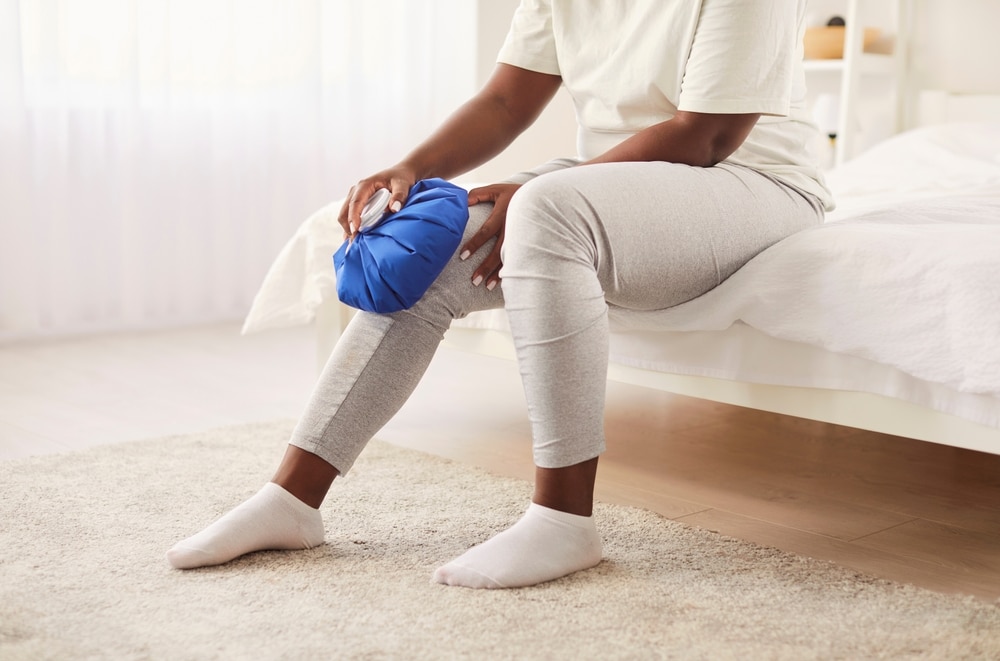
Ice the knee for roughly 15 to 20 minutes at a time, several times a day, with a thin towel against the skin
Testing the knee to see if it "still works"
Prop the leg up above heart level when you're sitting or lying down
Going back into the game or practice, even if the pain eases
Use a light compression sleeve or wrap if it feels better
Twisting, cutting, or pivoting on the leg
Use crutches if walking makes you limp or hitch
Hot tubs, heating pads, and deep massage in the first days
Gently bend and straighten the knee as tolerated so it doesn't stiffen up
Waiting weeks to be seen because the pain settled down
Call us to be examined
Guessing at the diagnosis from videos online
Over the counter anti inflammatory medicine is reasonable for many people, as long as it's safe for you. Check with your doctor or pharmacist first if you have kidney disease, a history of stomach ulcers or bleeding in the gut, heart failure, or blood pressure that isn't well controlled, if you take a blood thinner, or if you're pregnant.
Walking on it fools a lot of people
Plenty of patients who turn out to have a complete tear stand up and walk off the field.
Straight line walking on a flat floor doesn't ask much of the ACL. The ligament's job is controlling rotation and keeping the shin bone from sliding forward on the thigh bone, so the trouble shows up later, when you turn quickly, change direction, or step down off a stair. Patients describe the knee shifting or buckling. Others just say they don't trust it.
You'll hear the words partial and complete. A complete tear means the ligament is torn all the way through and no longer steadies the shin bone. A partial tear leaves some fibers attached, and a few of those knees stay stable enough for sport, while others start behaving like a complete tear once the swelling clears. The exam and the MRI together usually sort out which one you have.
There's another reason the early days can be misleading. Pain and swelling can shut the quadriceps down, so the thigh muscle stops firing the way it should, and that weakness lingers well after the knee stops hurting.
What we do at your visit
We start by listening to the story of the injury. How it happened, whether you heard or felt a pop, and how fast the knee swelled all point us in a direction before we ever touch the leg.
Then we examine both knees and compare them. We check how much fluid is in the joint, how far the knee bends and straightens, where it's tender, and how much the shin moves when we gently steady the thigh. We often take X rays to look at the bones. In kids and teens who are still growing, those films also help rule out a growth plate fracture or a tibial spine avulsion fracture, where a piece of bone pulls away with the ligament, since both can look and feel like an ACL tear.
An MRI gives us the rest of the picture. It confirms the ligament injury and shows the meniscus, the cartilage surfaces, and the other ligaments. These injuries travel together more often than people expect.
Injuries that feel like a torn ACL
A pop and a swollen knee can come from several different injuries, and more than you can happen at the same moment. The table below shows patterns we tend to see. Patterns aren't diagnoses, though, and sorting this out takes an exam, with imaging when it's needed.
Injury
What often stands out
ACL tear
Pop during a twist or landing, swelling within hours, the knee feels like it could give way when turning
Meniscus tear
Swelling that builds over a day or two, catching or locking, soreness along the joint line
Kneecap dislocation
The kneecap slides out of place and may pop back on its own, with pain and swelling across the front of the knee
MCL sprain
Pain along the inner side after the knee is pushed inward, with less swelling and often the ability to walk
Patellar or quadriceps tendon tear
Trouble straightening the knee or lifting the leg, and the kneecap may sit higher or lower than usual
Bone bruise or fracture
Sharp pain over bone, trouble putting any weight on the leg, swelling that comes on quickly
Prehab: the weeks before surgery count
If surgery is on the table, the time between the injury and the operating room isn't dead time. We use it.
Physical therapy before an ACL reconstruction, often called prehab, has a few clear jobs. Calm the swelling. Get the knee straightening fully again. Wake the quadriceps back up and rebuild strength in the hip and hamstring. Many patients who go into surgery with a quiet, mobile, stronger knee recover motion and strength more easily afterward, and a stiff, swollen knee at the time of surgery tends to stay stiff longer.
Swelling control and full knee extension
Quadriceps activation and strengthening
Hamstring, glute, and calf strength
Balance and body position awareness
Walking normally again, without a limp
Learning what the surgery and the first weeks after will involve
The research behind prehab is encouraging rather than settled. Study quality is moderate, so the benefit is best described as likely instead of certain. We still use those weeks, because there's little downside to arriving at surgery with a calmer, stronger knee.
Prehab helps patients who choose not to have surgery too. For some people, a strong, well trained knee handles daily life comfortably without a reconstruction, and that's a legitimate path we discuss openly.
Kids and teens are not small adults
A growing child has open growth plates near the knee, and surgeons used to routinely wait for those plates to close before reconstructing an ACL. That thinking has shifted.
Research over the past couple of decades has shown that a young knee left unstable tends to keep shifting during sports and play, and that shifting can damage the meniscus and the cartilage surfaces over time. Kids also find it harder than adults to sit still. Surgical techniques now exist that work around or across the growth plates with care, which gives families real options.
None of that means every child needs surgery tomorrow. It means the decision deserves a conversation with a surgeon who treats young athletes, weighing how much growth is left, how unstable the knee is, and what else was injured.
Why the calendar alone can't clear you for sports
Patients ask for a date. We understand why, and we'd rather give you a target with honest conditions attached.
A graft needs many months to mature inside the knee. In the Delaware-Oslo ACL cohort, Grindem and colleagues reported in 2016 that reinjury risk dropped with each added month of delay up to about nine months, and athletes who went back before nine months had much higher reinjury rates. Time is only half of it. Strength and hop testing is usually expected to reach roughly 90 percent of the uninvolved leg, along with controlled landing, confident change of direction, and a knee that doesn't swell after hard sessions. Many competitive athletes need twelve months or longer.
Confidence belongs on that list too. Fear of reinjury keeps some athletes from returning even when the leg tests well, and it's worth naming and working on with your therapist rather than ignoring.
One more thing that surprises people: after an ACL reconstruction, the opposite knee carries real risk as well, especially in young athletes going back to pivoting sports. Rehab should train both legs.
The warm up that lowers your risk
Here's the part worth sharing with a coach. Structured warm up programs built around strength, balance, hopping, and landing and cutting technique have been studied across many sports. They've been shown to reduce lower body injuries, including ACL injuries, in athletes who do them consistently. The FIFA 11+ and the PEP program are the best studied examples. They run about 15 to 20 minutes, stand in for a normal warm up, and need little or no equipment, usually a ball and a few cones.
Done as the team warm up, most practice days, all season
Hip and hamstring strengthening, not just stretching
Single leg balance work
Jump and landing drills with the knees tracking over the toes, not caving inward
Deceleration and cutting drills at controlled speed before full speed
Female athletes in cutting and pivoting sports tear the ACL at a notably higher rate than male athletes in the same sports. A good part of that gap is tied to muscle control and landing mechanics, and that's exactly what these warm up drills train, so part of the risk is trainable.
The honest catch is sticking with it. These programs work when teams do them routinely, and the benefit fades when the warm up gets skipped in a busy week.
Get care the same day if you notice any of these
Not every alarming knee is an emergency, and knowing the difference saves you a long night in a waiting room. A few findings point to a possible injury to the artery or the nerves behind the knee, and those can't wait. Others need attention quickly, though a clinic visit within a day or two is enough.
Emergency, go now: a foot that is cold, pale, blue, or numb
Emergency, go now: an obvious deformity of the knee or leg, or a knee that may have dislocated, since that usually means several ligaments tore and the popliteal artery may be hurt
Emergency, go now: severe pain with a knee that swells very quickly and feels tense and hard
Same day visit: fever, spreading redness, or warmth over the joint in the days after an injury, which can signal infection
Urgent, within a day or two: a knee locked in one position that will not straighten, often a bucket handle meniscus tear folded into the joint
Urgent, within a day or two: no ability to put weight on the leg at all
Everything short of that still deserves an appointment, ideally within a week or so. Symptoms that quiet down are not proof that the ligament is intact.
Surgery or not: how we decide together
The American Academy of Orthopaedic Surgeons published a clinical practice guideline on ACL injuries in 2022, and it weighs how much growing is left, age, and activity level together rather than any one of them alone. Younger, more active patients are generally treated without long delay, while older, less active patients often do well without surgery. A seventy year old who plays doubles tennis four times a week and a thirty year old with a desk job and a treadmill are still two different conversations.
Several things get weighed together when we talk through your options, and none of them stands alone. How the knee behaves day to day matters as much as what the MRI shows, and what you want to get back to matters just as much as both. Here's what usually shapes the conversation:
Whether the knee gives way during normal activity
Whether the meniscus or cartilage is also injured
The sports, work, and daily activities you want back
Your age and how much growing is left, for younger patients
How the knee responds to a course of physical therapy
For years the teaching was flat: a torn ACL doesn't knit back together. The picture has gotten more detailed. Some tears near the top of the ligament have shown signs of healing on MRI when the knee is braced early in a specific position, though that work is still being studied and isn't standard care for every patient yet.
The practical message hasn't changed much. Pain and swelling settle, plenty of people walk comfortably afterward, and the rotational stability needed for pivoting usually still has to be rebuilt, either through surgery or through serious, ongoing strength and control work. Structured rehab without surgery is a well studied path for selected patients, including many who are not heading back to pivoting sport.
Let's take a look at that knee
For most knee injuries like this, the first visit follows the same plan. We examine both knees, order an MRI when it's needed, and build a plan with you, and with your parents if you're a young athlete, that starts with swelling control and quad strength long before any decision about surgery.
Our sports medicine physicians, knee surgeons, and physical therapists work together at Princeton Orthopaedic Associates, so your exam, imaging, and rehab stay connected from the first visit through your return to the activities you care about. If your knee popped, swelled, or feels unreliable, schedule an exam with our team.
This blog post is meant to be informative and should not act as a self-diagnosis tool. If you’d like to see one of our doctors, please contact us here.
Shoulder pain myths we hear in clinic, and what's actually true
Shoulder pain collects bad advice faster than almost any other joint we treat. Friends hand out diagnoses, and the search results are usually worse. The same handful of beliefs come up week after week: what a scan can tell you, whether a rotator cuff tear means surgery, why frozen shoulder isn't your fault, what night pain means, and when shoulder pain isn't coming from the shoulder at all.
Reading about your shoulder never replaces an exam. It can, though, help you ask better questions.
The short version
Scans and symptoms don't always match. Rotator cuff changes show up in plenty of shoulders that don't hurt at all.
Most shoulder problems that come on without an injury start with guided exercise, not surgery.
Frozen shoulder moves through phases, and diabetes raises the risk.
Pain that wakes you up is worth telling us about.
Weakness after a fall, especially trouble raising the arm, deserves a prompt exam.
Shoulder, arm, neck or jaw pain with chest pressure, sweating or shortness of breath is an emergency. Call 911.
Pain that doesn't change when your shoulder moves may be coming from somewhere else.
#image_title
Myth: an MRI will point straight at the problem
We wish it were that clean. Imaging shows structure, not pain, and the two don't always line up.
Rotator cuff tears are common in people with no shoulder pain at all, and they become more common with age. So a tear on a report doesn't automatically mean that tear is why you hurt.
That's why we read your images next to your story and your exam, never alone. X-rays show the bones and can spot calcium deposits. Ultrasound or MRI can help when we need a closer look at a tendon.
Myth: a rotator cuff tear always ends in surgery
Some tears do need repair. A tear that happens in a moment, from a fall or a hard pull, is different from a tendon that has frayed slowly over the years. If an injury leaves you suddenly unable to raise your arm, get it checked within days, not weeks, because timing can affect your repair options.
For the slow, wear-and-tear kind, we usually start with guided exercise and consider surgery only if you aren't improving after a few months. If pain is too strong for therapy, an injection may calm it down enough to get started. And an older surgery that shaved bone at the top of the shoulder for pinching pain generally hasn't worked better than exercise, so we rarely recommend it.
Non-surgical care isn't the same as doing nothing. A good plan includes:
Exercises that steadily strengthen the rotator cuff and the muscles around the shoulder blade
Short-term changes to overhead work and training rather than full rest
An injection in some cases, to make therapy possible
A set check-in, so you aren't left drifting without a decision
Imaging only when the answer will change the plan
Myth: frozen shoulder means you didn't move it enough
Keeping the arm still for a long time is one risk, so there's a grain of truth here. But it isn't the whole story, and people who blame themselves are usually being unfair to themselves.
Frozen shoulder happens when the lining around the joint thickens and tightens. People with diabetes or thyroid problems are more likely to get it, and so are people whose arm was kept still after surgery or an injury. The telltale sign is stiffness in every direction, even when we move your arm for you.
The phases of frozen shoulder
Phase
What people notice
Freezing
Pain builds, often worst at night, and motion starts to shrink
Frozen
Stiffness takes over while the pain often settles down
Thawing
Motion gradually returns and daily tasks get easier
It can take a year or more to run its course, and every shoulder moves at its own pace. An injection combined with physical therapy often helps with both pain and motion, and most people improve without surgery. If stiffness stays severe despite good care, we'll talk through other options. Some people are left with a little lasting stiffness, which is why we don't just wait it out.
Myth: night pain just means you slept on it wrong
Position matters, but it isn't the only thing going on. Lying on the sore side presses on irritated tendons, and the joint stays still for hours, so swelling builds. Without the day's distractions, you notice the pain more. Night pain is common with rotator cuff problems.
A few changes at bedtime can help while you wait for your appointment:
Sleep on your back instead of the painful side
Tuck a pillow under the elbow so the arm isn't dangling
If you side-sleep, lie on the good side and hug a pillow
Try a recliner or a wedge during a bad flare
Ice the shoulder in the evening for short sessions
Ask your doctor before taking over-the-counter pain medicine, especially if you have kidney or heart problems, stomach ulcers, or take blood thinners
If pain wakes you several nights a week for more than a couple of weeks, come in. Losing sleep makes recovery harder.
Myth: if it hurts in your shoulder, the shoulder is the problem
Pain can travel. A pinched nerve in the neck can send pain, tingling or weakness down the arm. The gallbladder and liver can cause pain in the right shoulder or shoulder blade. And the heart can cause pain in the shoulder, arm, back, neck or jaw, on either side. In women, older adults and people with diabetes, heart symptoms often look unusual, so don't wait for classic left-arm pain before calling 911. One clue we look for: pain from somewhere else usually doesn't change when we move your shoulder.
When shoulder pain isn't an orthopaedic appointment
What you're noticing
What to do
Shoulder, arm, back, neck or jaw pain with chest pressure, shortness of breath, sweating, nausea or lightheadedness
Call 911. Don't drive yourself.
Sudden pain at the tip of the shoulder after a hit to the belly or chest, or with severe belly pain or faintness
Go to the emergency room
Shoulder or shoulder blade pain with sudden shortness of breath, coughing up blood or chest pain
Go to the emergency room
Right shoulder pain with upper right belly pain, fever, vomiting, or yellow skin or eyes
Get medical care the same day
A red, hot, swollen shoulder with fever
Get medical care the same day
New numbness or weakness down the arm, or you can't lift the arm after a fall
See us promptly
Pain that stays the same no matter how the shoulder moves
Get it checked; the cause may be outside the joint
Myth: if you can still lift your arm, nothing's torn
Plenty of people with tears lift their arm just fine, and plenty of people who can't lift it have no tear at all. In the exam room we look at the whole pattern: what you can do on your own, what happens when we move the arm for you, where exactly it hurts, and which positions set it off. That pattern tells us more than any single test, and it's the best reason to come in rather than guess.
What a shoulder visit with our team looks like
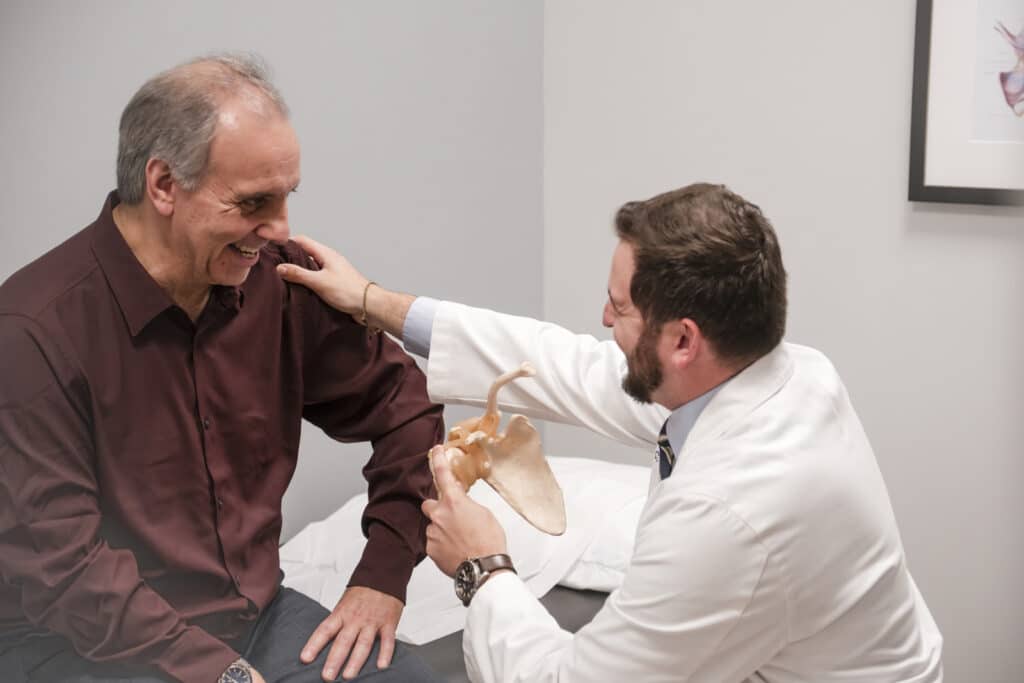
We start with how it began, because a shoulder that gave out during one lift tells a different story than one that has ached for months. Then we test motion, strength and the positions that bring on your pain. We often take X-rays the same day, and order other imaging only when it would change what we recommend.
It helps to jot down when the pain started, which motions trigger it, how often it wakes you, what you've already tried, and what you need your shoulder to do again.
The backbone of care for most rotator cuff and stiffness problems
Orthopaedic Shoulder Specialist
Injury-related tears, dislocations, arthritis, cases that stall
For imaging review and surgery decisions when needed
Get your shoulder looked at
If your shoulder has been aching for a few weeks, waking you at night, or quietly changing how you reach and lift, we'd like to take a look. Our team will sort out what's driving the pain and build a plan around what you need your arm to do. Schedule Exam.
This blog post is meant to be informative and should not act as a self-diagnosis tool. If you’d like to see one of our doctors, please contact us here.
We use cookies to understand how people use our site. You can accept or reject non-essential cookies, and change your choice at any time in Preferences.
Cookie Preferences
Manage your cookie preferences below:
Essential cookies enable basic functions and are necessary for the proper function of the website.
Name
Description
Duration
Cookie Preferences
This cookie is used to store the user's cookie consent preferences.
365 days
CloudFlare provides web performance and security solutions, enhancing site speed and protecting against threats.
The cf_ob_info cookie provides information on: The HTTP Status Code returned by the origin web server. The Ray ID of the original failed request. The data center serving the traffic
session
cf_use_ob
The cf_use_ob cookie informs Cloudflare to fetch the requested resource from the Always Online cache on the designated port. Applicable values are: 0, 80, and 443. The cf_ob_info and cf_use_ob cookies are persistent cookies that expire after 30 seconds.
session
__cfwaitingroom
The __cfwaitingroom cookie is only used to track visitors that access a waiting room enabled host and path combination for a zone. Visitors using a browser that does not accept cookies cannot visit the host and path combination while the waiting room is active.
session
cf_chl_rc_i
These cookies are for internal use which allows Cloudflare to identify production issues on clients.
session
cf_chl_rc_ni
These cookies are for internal use which allows Cloudflare to identify production issues on clients.
session
cf_chl_rc_m
These cookies are for internal use which allows Cloudflare to identify production issues on clients.
session
__cfruid
Used by the content network, Cloudflare, to identify trusted web traffic.
session
__cf_bm
Cloudflare's bot products identify and mitigate automated traffic to protect your site from bad bots. Cloudflare places the __cf_bm cookie on End User devices that access Customer sites that are protected by Bot Management or Bot Fight Mode. The __cf_bm cookie is necessary for the proper functioning of these bot solutions.
session
__cflb
When enabling session affinity with Cloudflare Load Balancer, Cloudflare sets a __cflb cookie with a unique value on the first response to the requesting client. Cloudflare routes future requests to the same origin, optimizing network resource usage. In the event of a failover, Cloudflare sets a new __cflb cookie to direct future requests to the failover pool.
session
_cfuvid
The _cfuvid cookie is only set when a site uses this option in a Rate Limiting Rule, and is only used to allow the Cloudflare WAF to distinguish individual users who share the same IP address.
session
cf_clearance
Whether a CAPTCHA or Javascript challenge has been solved.
session
__cfseq
Sequence rules uses cookies to track the order of requests a user has made and the time between requests and makes them available via Cloudflare Rules. This allows you to write rules that match valid or invalid sequences. The specific cookies used to validate sequences are called sequence cookies.
session
Google reCAPTCHA helps protect websites from spam and abuse by verifying user interactions through challenges.
Name
Description
Duration
_GRECAPTCHA
Google reCAPTCHA sets a necessary cookie (_GRECAPTCHA) when executed for the purpose of providing its risk analysis.
179 days
These cookies are used for managing login functionality on this website.
Name
Description
Duration
wordpress_logged_in
Used to store logged-in users.
Persistent
wordpress_sec
Used to track the user across multiple sessions.
15 days
wordpress_test_cookie
Used to determine if cookies are enabled.
Session
Statistics cookies help us understand how visitors use our website, such as which pages are viewed. If you reject them, videos and the accessibility menu load only when you choose to open them.
Google Analytics is a powerful tool that tracks and analyzes website traffic for informed marketing decisions.
Contains information related to marketing campaigns of the user. These are shared with Google AdWords / Google Ads when the Google Ads and Google Analytics accounts are linked together.
90 days
Google Tag Manager loads our website analytics. It only runs when Statistics cookies are allowed.
Used by Google Ads to measure whether an ad visit leads to activity on the site.
90 days
_gcl_gs
Google uses cookies for advertising, including serving and rendering ads, personalizing ads (depending on your ad settings at g.co/adsettings), limiting the number of times an ad is shown to a user, muting ads you have chosen to stop seeing, and measuring the effectiveness of ads.
90 Days
_gcl_gb
Google uses cookies for advertising, including serving and rendering ads, personalizing ads (depending on your ad settings at g.co/adsettings), limiting the number of times an ad is shown to a user, muting ads you have chosen to stop seeing, and measuring the effectiveness of ads.
90 Days
_gcl_aw
Google uses cookies for advertising, including serving and rendering ads, personalizing ads (depending on your ad settings at g.co/adsettings), limiting the number of times an ad is shown to a user, muting ads you have chosen to stop seeing, and measuring the effectiveness of ads.